It’s easy to assume that building wealth requires a head start — an inheritance, a high-paying job out of the gate, or simply better luck than everyone else. The evidence says otherwise. Every year, people with none of those advantages join the ranks of the financially independent, using a sequence of decisions that’s available to almost anyone, regardless of where they’re starting from.
In 1964, Tom and Judy Love leased an abandoned service station in Watonga, Oklahoma, for $5,000. Over the following decades, that single station grew into Love’s Travel Stops & Country Stores, now one of the largest privately held travel-stop chains in the United States, with thousands of locations across dozens of states. Tom Love passed away in 2023; Judy Love and the family remain on Forbes’ list of America’s wealthiest, still running the business he started. The point isn’t the scale of what they built — it’s where they started: a leased building and very little capital.
Most people don’t need or want that scale. What they want is financial independence — the freedom to stop trading time for money without upending their lifestyle. That’s a realistic goal from any starting point, provided you work through it in order. Here’s the sequence.
Step 1: Know Your Actual Starting Point
You can’t measure progress toward a destination you haven’t located on the map. The starting point for building wealth is your net worth — not your income, not your job title, not how things look from the outside.
Net Worth = Assets − Liabilities
- Assets: cash, investments, retirement accounts, equity in your home, and anything else of real value you own.
- Liabilities: your mortgage, credit card balances, student loans, car loans, and any other money you owe.
A simple example: $250,000 in assets minus $100,000 in liabilities leaves a net worth of $150,000. If your own number comes out negative, or lower than you expected, that’s useful information, not a verdict — most people who eventually build real wealth started from a number they weren’t proud of. What matters from here is the direction it moves, not where it starts.
Step 2: Define Where You’re Actually Going
Once you know where you stand, decide where you’re headed. Two questions do most of the work:
- What annual income would let you live the life you actually want? Not an arbitrary round number — a figure tied to a real lifestyle.
- What net worth would need to produce that income without you having to work for it? This is the asset base — investments, property, business equity — that eventually replaces your paycheck.
A goal is a dream with a number and a deadline attached to it. Skipping this step is why so many people save and invest without a clear sense of when — or whether — it adds up to actual freedom.
Step 3: Choose the Engine That Gets You There
Every income source — a job, a business, a professional practice — is an engine, and every engine has a ceiling. That ceiling is set by three things: who you serve, what you provide, and how you reach them.
A dentist’s income is capped by the number of patients one person can see in a day, in one location, during business hours. A business that sells through a website has none of those limits — it can reach customers anywhere, at any hour, without the owner’s hours being the bottleneck. Neither path is wrong. But it matters which one you’re relying on, because the ceiling on your current engine is also the ceiling on how fast you can build wealth from it.
In practice, most people build wealth through some combination of four vehicles:
- Investing — building a portfolio of stocks, bonds, and funds over time.
- Real estate — rental income and appreciation on property you own.
- Business ownership — equity in something you built or bought that generates profit without requiring all of your time.
- A scalable profession or side business — work whose income isn’t capped by hours alone, often built alongside a primary job before it replaces it.
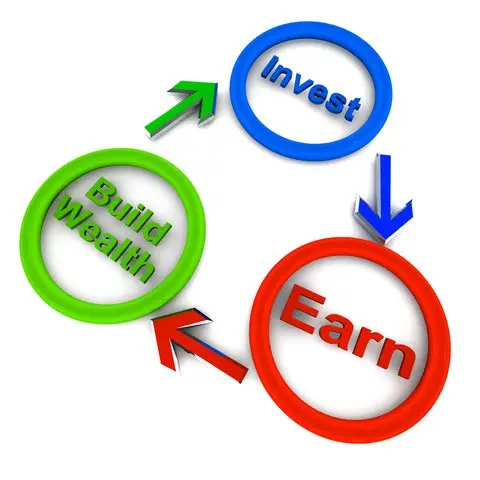
None of these are shortcuts, and none of them work without the surplus from Step 1 actually going somewhere. But choosing one deliberately — instead of drifting along on whatever income you happen to have — is what moves you from Earner to Builder on the path to ownership.
Step 4: Expect Setbacks, and Have a Mindset Ready for Them
Nobody builds meaningful wealth without hitting a stretch where the plan doesn’t seem to be working — a job loss, a market downturn, more debt than expected, or just slower progress than the spreadsheet promised. What separates people who push through from people who quit isn’t luck. It’s a specific way of holding two things at once.
Researcher Jim Collins named this the Stockdale Paradox, after Admiral James Stockdale, the highest-ranking U.S. military officer held as a prisoner of war in Vietnam. Stockdale survived years of captivity by holding two things in tension: an unflinching, honest look at how bad the situation actually was, combined with an unshakable belief that he would ultimately prevail. Collins found the same pattern in companies that turned around from serious decline — they didn’t paper over the brutal facts, and they didn’t lose faith in the outcome either. One without the other tends to fail: blind optimism collapses the first time reality intrudes, and realism without faith just produces resignation.
Applied to your finances, that looks like this: an honest, unflinching look at your actual numbers — including debt you’d rather not think about — combined with a genuine belief that your position today isn’t your final position. Someone carrying five figures of credit card debt who commits to tracking every dollar and paying it down methodically is practicing exactly this. So is someone who loses a job and treats it as a forced pivot rather than a verdict on their prospects — picking up freelance work, upskilling, and rebuilding income on their own terms. Neither story requires talent most people lack. Both require facing the numbers honestly and refusing to treat a bad chapter as the whole book.
Step 5: Learn to See Opportunity Instead of Luck
People who never build wealth tend to describe it as a matter of luck — being in the right place, knowing the right people, catching a break they never got. People who do build it tend to describe the same landscape very differently: as a set of problems worth solving, most of which are sitting in plain sight.
The line often attributed to Seneca captures it well: “Luck is what happens when preparation meets opportunity.” Opportunity rarely announces itself — it shows up disguised as a complaint, an inefficiency, an underserved group of customers, or a problem you happen to have solved for yourself already. The habit worth building is treating problems as a signal rather than an annoyance: the more specifically you can name who has a problem and what solving it is worth to them, the closer you are to a real income opportunity, whether that’s a side business, a new offer inside your existing work, or an investment thesis.
This isn’t a claim that wealth is easy or guaranteed. It’s the opposite: it’s usually the least dramatic explanation available. The people who build it are rarely the ones who got the lucky break — they’re the ones who had done enough preparation that when a break-shaped opportunity showed up, they were in a position to actually use it.
Putting It Together
Building wealth from zero isn’t one big decision — it’s five ordinary ones, repeated: know your real number, define where you’re headed, choose a deliberate vehicle to get there, expect the setbacks without letting them become the whole story, and treat problems as the raw material of opportunity rather than evidence of bad luck. None of it happens overnight. All of it is available starting today, regardless of where your net worth statement currently reads.
Worth asking yourself: of the five steps above, which one have you genuinely never done — calculated your real net worth, set a specific target, chosen a deliberate wealth vehicle, or named a problem worth solving in your market?
If you’re not sure which of these five steps to focus on first, the Financial Clarity Diagnostic can help you find your place on the Earner–Builder–Investor–Owner path.