
Secret of Millionaire Mind- How to Grow Richer Daily
The secret of millionaire mind no one is telling you
One of the habits you must develop if you are going to become wealthy and keep your wealth is … learn to track your net worth.
In order words, you need to know how to count your money. 
Wait… before you think I am asking you to become like Ebenezer Scrooge the mean character in Charles Dickens’ book A Christmas Carol…
No this is far from the truth.
You see wealth is a measure of your net worth. This is the secret of a millionaire mind
[Net worth is the amount by which your assets(what you own) exceed your liabilities(what you owe). Assets are things like stocks, bonds, cash or gold.
Liabilities are things like mortgage, credit card debt, or student loans. Net worth can apply to both individuals and businesses as a key measure of how much a business is worth.]
The person with a millionaire mind knows …the only way you can know your net worth is to keep track of how much you are worth regularly.
The best way to check your net worth is to organize your finances in such a way that you can easily monitor how you are faring.
You can keep track of your net worth with a personal spreadsheet. I use a spreadsheet which is divided into 4 rows by 2 columns. I divide my own wealth tracker into:
Top row: Income and expenses
Bottom row: Assets and liabilities
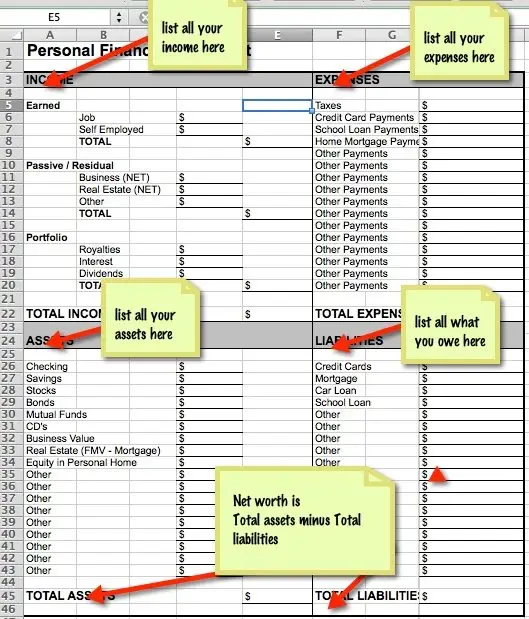
Figure 1. Personal wealth tracker
I must warn you about this exercise that it could be gut wrenching…
You may feel so depressed… or feel hopeless …And want to beat yourself silly when you see how much you owe.
Please don’t be too hard on yourself.
You are not the first person who has made mistakes with money.
The most important thing you must do is to learn from your mistakes and move on.
I want to tell you how you move on. Are you ready to hear how to move on?
- You must make a commitment that you’ll increase your net worth every month.
- You must make up your mind you’ll make paying down your debt a priority.
- You’ll also promise you’ll start saving more and keep your expenses down.
Finally, you’ll make a commitment that you must start taking action today.
You must banish all excuses and start now. Keeping track of your net worth is the secret of millionaire mind.
The key to becoming a successful wealth builder
If you are ever going to become financial independence, you must realize … that succeeding takes time.
You should also be prepared to fail several times.
Yes, you heard me clearly. You must be willing to make mistakes and learn from your mistakes.
It’s in making mistakes and learning from your mistakes that you’ll make it.
The truth is that there are no surefire methods to become wealthy.
However, if you’ll hang just enough with your commitment you’ll overcome failure
And that is the hallmark of successful people: They persist in their journey to their goals even in the face of adversity
Thomas Edison, Colonel sanders (founder of Kentucky fried chicken), Maya Angelou, Oprah Winfrey…
all have on common trait : they never gave up on their dreams.
The bond that kept these successful individuals going is that they all vowed to succeed.
Here, is a quote from Winston Churchill about success:
“Success consists of going from failure to failure without loss of enthusiasm.”
Are you willing to go from failure to failure without losing your zeal?
If you answered, yes welcome to the wealth builders club.