

You Were Never Taught This in Medical School
The Education I Didn’t Know Was Missing
There is something curious about the way we educate physicians.
We spend years learning how to recognize disease, assess risk, manage uncertainty, and prevent complications before they become emergencies.
We are trained to look beyond reassuring appearances and understand the systems that determine long-term outcomes.
Yet when it comes to our own financial lives, many of us enter professional practice without an equally coherent framework.
I have often reflected on this contradiction.
My medical journey has taken me from training in Lagos to practising in the United Kingdom and, eventually, Canada.
Different healthcare systems. Different professional environments. Different financial realities.
But across that journey, I encountered a recurring educational gap.
I received extensive training in how to practise medicine. I received remarkably little structured education in how to convert the income generated by that practice into lasting financial security.
And for a long time, I did not fully appreciate the significance of that omission.
Like many physicians, I understood the importance of hard work, professional competence, and delayed gratification.
But I gradually came to recognize that financial independence requires something different.
It requires understanding how income becomes surplus, how surplus becomes capital, and how capital can eventually create choices that professional earnings alone cannot provide.
That realization sits at the heart of Financial Alchemy.
Medical school teaches us how to become excellent earners. Building lasting wealth requires a second education.
I call it the Missing Financial Curriculum.
The Physician Who Appeared Financially Successful
Consider a hypothetical physician I will call Dr. K.
After more than a decade of undergraduate education, medical school, residency, examinations, night shifts, and delayed gratification, she finally receives her first substantial billing statement as an independently practising physician.
The number feels like a reward for everything she has sacrificed.
And in many ways, it is.
Within eighteen months, she has moved into a larger house, purchased the car she promised herself during residency, and acquired an interest in a medical practice.
Her professional life is progressing beautifully.
Her financial life is more complicated.
Her student debt has barely moved. Her household expenses have expanded to match her income. Her investments are modest relative to what she earns.
Nothing appears obviously wrong.
The bills are paid. Her credit is good. Her professional income is strong.
But there is a question she has never been taught to ask:
How much of what I earn is actually becoming wealth?
Dr. K is not reckless.
She is not unintelligent.
She is living through a transition that many physicians recognize: the movement from years of financial sacrifice into a career with substantial earning potential.
The problem is that increased income can create the appearance of financial progress without producing the underlying structure required for financial resilience.
That is where the missing education becomes important.
The Competence Transfer Illusion
There is a widespread assumption that highly educated professionals should naturally be financially capable.
Physicians are intelligent, disciplined, analytical, and comfortable with complexity.
Surely someone capable of managing diabetic ketoacidosis, interpreting an ECG, or making difficult clinical decisions can manage their own finances.
But this assumption confuses two different forms of competence.
I think of it as the Competence Transfer Illusion.
Mastery in one demanding discipline can create confidence that does not automatically transfer to another.
You did not become competent at interpreting an ECG simply because you were intelligent.
You learned physiology. You studied abnormal patterns. You practised interpretation. You received feedback. Over time, you developed clinical judgment.
Financial competence also requires structured learning.
Yet physicians are often expected to navigate taxation, investments, insurance, professional corporations, contracts, debt, and retirement planning without an equally coherent foundation.
Some medical schools and professional organizations offer financial education, but the experience remains uneven. Much of the learning still occurs informally, often after important financial decisions have already been made.
The deeper problem is not simply a lack of financial information.
We live in a world overflowing with financial information.
The problem is the absence of a coherent sequence in which to understand and apply it.
We did not learn medicine through scattered tips. We learned it through a curriculum.
Our financial education deserves the same discipline.
The Income Mask: When High Earnings Hide Fragility
In medicine, we understand that a patient can appear well while carrying significant underlying risk.
Normal observations do not always mean the underlying system is healthy.
A patient may remain clinically compensated for years before an additional stress reveals a vulnerability that had been developing quietly.
Something similar occurs in personal finance.
I call it the Income Mask.
Imagine a physician earning $350,000 annually.
The household is comfortable. The mortgage is paid. The family travels. Investments exist.
From the outside, everything appears secure.
But beneath that income, fixed expenses have grown substantially. Accessible savings are limited. Much of the family’s financial security depends on the physician continuing to work at the same intensity.
Now imagine that physician wants to reduce clinical work from five days to four.
Not retire.
Not abandon medicine.
Simply create more time for family, recovery, teaching, or a more sustainable professional life.
Suddenly, the financial picture changes.
The mortgage does not shrink by twenty percent.
School fees remain.
Insurance premiums, household expenses, and other obligations continue.
And a physician who appears financially successful discovers that reducing clinical income would require difficult changes.
The income was real.
But so was the fragility it concealed.
This is the distinction between financial appearance and financial diagnosis.
A high income tells us what the financial system can support while earnings continue.
It does not necessarily tell us how resilient that system would be if something changed.
A high income can make you comfortable while leaving you dependent.
Four Conditions of the Financially Untrained Physician
When we examine financial fragility among physicians, four recurring patterns become visible.
They are not character flaws. They are predictable consequences of a demanding professional pathway combined with incomplete financial preparation.
1. Delayed Onset
Physicians often spend much of their twenties and early thirties training.
While contemporaries may already be saving, investing, or building equity, doctors may still be earning training salaries and carrying educational debt.
The problem is not simply starting later.
It is failing to develop a deliberate capital-building system when higher earnings finally arrive.
2. Deferred-Life Rebound
After years of sacrifice, the desire to enjoy the rewards of medicine is understandable.
A better home. A reliable vehicle. Travel. Opportunities for children.
None of these is inherently irresponsible.
The difficulty begins when lifestyle commitments expand faster than the capacity to accumulate capital.
What begins as a reward gradually becomes a recurring obligation.
3. Labour Dependence
For many physicians, income depends directly on clinical work.
Consultations, procedures, shifts, and billings require their time, expertise, and physical presence.
An illness, injury, professional disruption, or reduction in working capacity may therefore threaten household income.
Their greatest economic asset is their ability to practise medicine.
Yet that asset may also represent their greatest concentration of financial risk.
4. Delegated Blindness
Physicians are busy.
It is entirely reasonable to rely on accountants, advisers, lawyers, and other financial professionals.
But there is a difference between delegating expertise and surrendering understanding.
Without basic financial literacy, it becomes difficult to evaluate recommendations, identify conflicts of interest, or understand whether an individual financial product supports the broader plan.
Together, these four conditions can create a Financial Fragility Loop:
High income → Rising fixed costs → Limited surplus → Inadequate resilience → Financial shock → Reduced options
High income does not automatically interrupt this loop.
Sometimes it finances it.
And this brings us to the first foundational principle of Financial Alchemy.
Financial Alchemy Principle: Capacity Before Compounding
When physicians begin thinking seriously about wealth, the conversation often moves immediately toward investment returns.
Which stocks should I buy?
Should I invest in real estate?
Should I incorporate?
How can I improve my portfolio performance?
These may become important questions.
But they are not necessarily the first questions.
Before asking how quickly capital can grow, we must ask whether the financial structure is strong enough to support that growth through uncertainty.
This is what I mean by Capacity Before Compounding.
At the centre of Financial Alchemy is a simple proposition:
Income is not wealth. Income is the raw material from which wealth can be built.
Clinical expertise creates earning power.
But earning power depends on the physician’s continued capacity to generate income.
Financial independence develops when a growing portion of that income is deliberately preserved, protected, and converted into capital and productive assets.
The transformation follows a sequence:
Income → Surplus → Capital → Assets and Systems → Time → Freedom
Income must exceed the demands placed upon it.
Surplus must be captured rather than automatically absorbed into lifestyle expansion.
Accessible reserves and appropriate protection help the financial system withstand disruption.
Capital can then be allocated according to purpose, risk capacity, and time horizon.
Over time, accumulated assets and well-designed systems may reduce dependence on immediate clinical earnings.
This process is not automatic.
A physician can earn $400,000 annually for twenty years and remain financially vulnerable if nearly all that income is committed to consumption and recurring obligations.
Another physician earning considerably less may develop greater financial flexibility through consistent saving, prudent capital allocation, and manageable fixed expenses.
The distinction is not simply how much money passes through their hands.
It is how much of that money becomes lasting financial capacity.
Capacity Before Compounding does not mean postponing all investing until every financial risk has disappeared.
It means building the liquidity, protection, and financial discipline needed to sustain an appropriate long-term investment strategy.
A portfolio cannot deliver its intended long-term benefits if every unexpected disruption forces the investor to sell assets at an unfavourable time.
Before optimizing returns, build the capacity to remain invested.
Before pursuing complexity, establish resilience.
And before asking money to work harder, understand the financial system in which that money operates.
The Missing Financial Curriculum: Six Courses Every Physician Should Understand
If we accept that physicians need a second financial education, where should it begin?
I believe the answer lies in the structure of medical education itself.
We do not begin medical school by studying a collection of treatments without first understanding the human body.
We begin with foundations.
Anatomy.
Physiology.
Pathology.
Pharmacology.
Then clinical reasoning, supervised practice, and increasingly independent judgment.
Financial education should follow a similarly coherent progression.
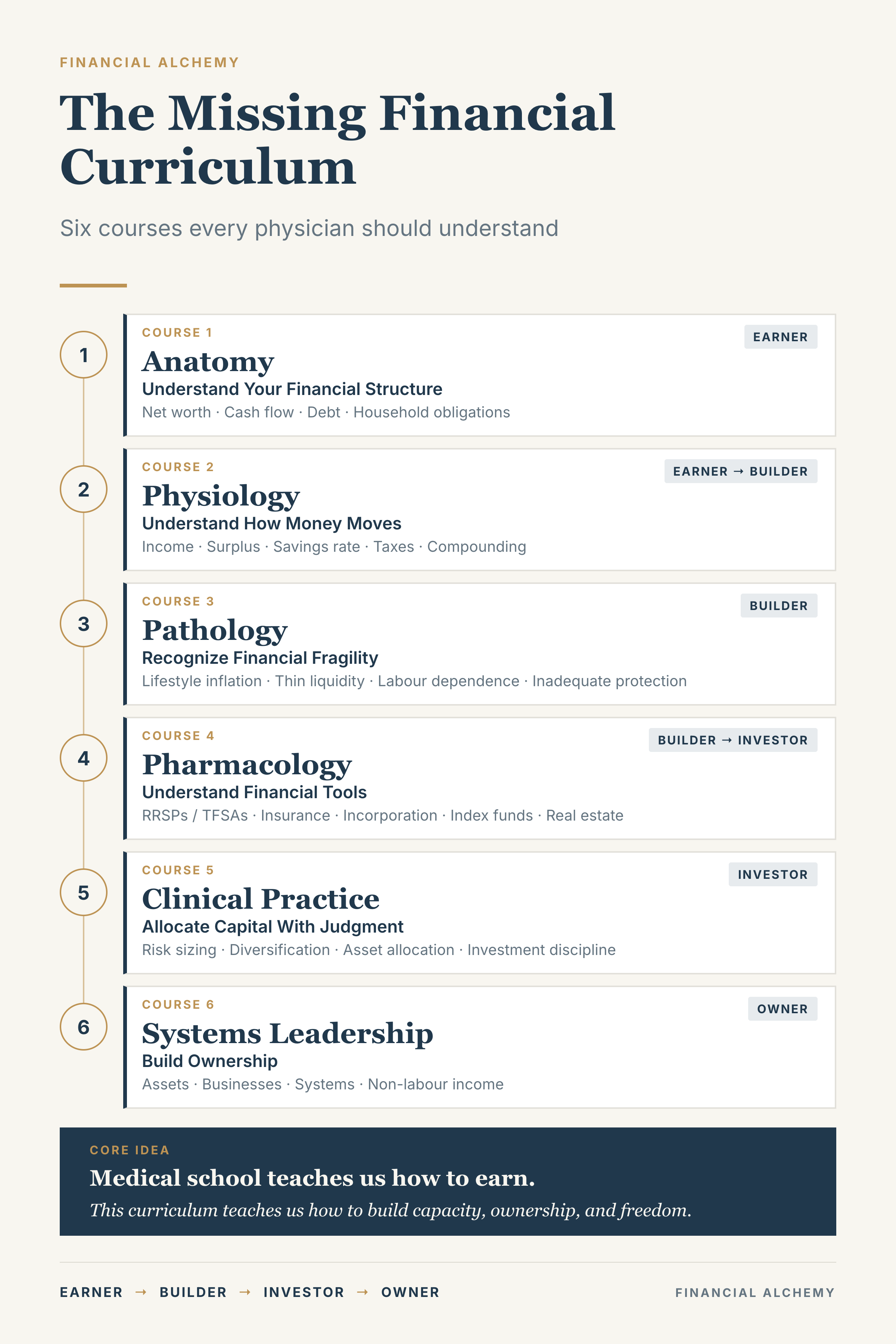
The Missing Financial Curriculum — Financial Alchemy’s six-course framework for moving from earning income to building financial capacity, investing with judgment, and developing ownership.
This is The Missing Financial Curriculum.
It consists of six connected courses.
Course 1: Anatomy — Understand Your Financial Structure
Before making financial decisions, understand what you own, what you owe, how money enters your household, and where it goes.
Your balance sheet and cash flow reveal the anatomy of your financial life.
The first task is not to optimize returns.
It is to see the structure clearly.
Course 2: Physiology — Understand How Money Moves
Learn how income becomes surplus, how surplus becomes capital, and how capital can grow over time.
Understand savings rates, cash-flow allocation, taxation, inflation, and compounding.
This is where the Surplus Conversion Engine begins: a repeatable system that directs a deliberate portion of earnings toward reserves and long-term capital before discretionary spending absorbs it.
Course 3: Pathology — Recognize Financial Fragility
Identify the conditions that undermine high-earning professionals.
Lifestyle inflation.
Excessive fixed obligations.
Thin liquidity.
Inadequate income protection.
Debt exposure.
Overconcentration in a single source of income or asset.
The objective is to identify vulnerabilities before they become emergencies.
Course 4: Pharmacology — Understand Financial Tools
Only after establishing the foundations should we examine specific financial instruments and structures.
Investment accounts.
Insurance.
Registered savings plans.
Professional corporations.
Diversified portfolios.
Property and business ownership.
In Canada, tools such as TFSAs, RRSPs, and professional corporations may be relevant, depending on individual circumstances.
Each tool has a purpose, limitations, costs, and risks.
The appropriate intervention depends on the diagnosis.
Course 5: Clinical Practice — Allocate Capital With Judgment
Knowing the available financial tools is different from knowing how to use them together.
This stage involves matching capital to objectives, risk capacity, liquidity needs, and time horizons.
It requires disciplined asset allocation, suitable diversification, and an investment philosophy that can withstand market uncertainty.
The central question becomes:
Is my capital allocated in a way that supports my goals without exposing the rest of my financial life to unacceptable risk?
Course 6: Systems Leadership — Build Ownership
Ultimately, durable wealth is about more than accumulating financial products.
It is about developing and governing assets and systems that create value beyond your immediate clinical labour.
For some physicians, that may involve business equity or productive enterprises.
For others, a diversified investment portfolio may provide much of the required financial capacity.
Ownership is not necessarily about running another business.
It is about developing a financial structure in which clinical income is no longer the only engine supporting your future.
And here is something I have come to recognize:
Physicians often want to begin with Course 4.
We ask, “What should I invest in?”
Before we have understood our financial anatomy, physiology, or pathology.
In medicine, we would recognize the danger immediately.
Prescribing before diagnosing is poor clinical practice. Investing without understanding your financial structure can be its financial equivalent.
From Earner to Owner: The Financial Alchemy Path
The Missing Financial Curriculum supports a progression through four stages of Financial Alchemy:
Earner → Builder → Investor → Owner
These stages are not judgments of intelligence, professional success, or personal worth.
They describe the principal financial capabilities a person is developing.
The Earner generates income and protects the financial foundation. The central question is: What happens if my income stops?
The Builder creates repeatable surplus, manages obligations, builds reserves, and establishes systems that turn earnings into capital.
The Investor allocates accumulated capital deliberately, balancing risk, liquidity, diversification, and long-term growth.
The Owner develops and governs assets capable of supporting life increasingly independently of personal clinical output.
The progression is not perfectly linear.
A physician may already own investments while still having significant vulnerabilities in cash flow or income protection.
The point is not to earn a more impressive title.
It is to recognize the next capability that needs development.
More income does not automatically move a physician from Earner to Owner.
Not sure which stage you are in? The free Financial Clarity Diagnostic shows where you stand on the path from Earner to Owner.
Different financial systems do.
Your First Assignment: Write a Financial SOAP Note
There is a practical way to begin this second education.
And physicians already understand the method.
For years, we have used the SOAP framework to turn clinical observations into structured assessment and management.
We can apply a similar discipline to our financial lives.
S — Subjective
What do you believe about your current financial position?
What worries you?
What does “enough” actually mean?
If you could work differently tomorrow, what would you change?
Before examining the numbers, understand the life those numbers are supposed to support.
O — Objective
Gather the facts:
- Your net worth.
- Your monthly surplus.
- Your savings rate.
- Your fixed-cost ratio.
- Your liquidity runway: the number of months essential spending could be covered from accessible reserves.
- The proportion of income that does not require your direct clinical labour.
These numbers will not explain everything.
But they offer a more meaningful picture than gross income alone.
A — Assessment
What does the information reveal?
Are you primarily operating as an Earner, Builder, Investor, or Owner?
Which of the four financial conditions are present?
Where is the greatest vulnerability?
A useful assessment identifies the priority problem rather than attempting to solve everything at once.
P — Plan
Choose one meaningful financial system to improve over the next quarter.
Perhaps you need to automate surplus.
Build accessible reserves.
Review disability coverage.
Reduce a recurring fixed expense.
Or establish a written investment policy.
The best intervention is not necessarily the most sophisticated.
It is the one that addresses an important vulnerability and can be sustained.
Follow-Up
Review your financial position every quarter.
Measure what has changed.
Reassess your risks.
Adjust the plan as circumstances evolve.
Financial resilience is not a single transaction.
It is an ongoing process.
You would not consider a patient adequately managed simply because a treatment had been prescribed.
You would assess the response.
Your financial life deserves the same attention.
Companion resource: The Financial SOAP Note — A 20-Minute Examination of Your Financial Health.
Use the downloadable worksheet to complete your first assessment and identify one financial priority for the next quarter.
The Freedom to Remain
I want to return to the physician who wanted to reduce clinical work from five days to four.
Because, for me, this is where the discussion about wealth becomes something more meaningful.
The physician did not necessarily want to retire.
They did not necessarily dislike medicine.
They may have spent much of their adult life preparing for a profession they still value deeply.
They may love the intellectual challenge of clinical practice, the relationships with patients, and the privilege of participating in decisions that matter to other people’s lives.
But they also wanted more control over the place medicine occupied in their life.
More time with family.
More room for recovery.
Perhaps more space for teaching, research, mentorship, or community service.
Their difficulty was not necessarily a lack of professional success.
It was that their financial structure had made their current level of clinical work difficult to change.
Now imagine a different financial position.
Imagine that over several years, the physician had built adequate liquidity, controlled fixed expenses, established appropriate protection, and accumulated long-term capital.
A reduction in clinical income might still require planning and trade-offs.
But the decision would no longer be made under the same financial pressure.
They might continue working five days because they genuinely enjoy a busy practice.
They might move to four.
They might explore a different professional role.
The important difference is that they would have options.
This is what I think we sometimes miss when we talk about financial independence.
We reduce it to an investment target.
A retirement age.
A portfolio value.
A number that tells us when we can finally stop working.
But I have spent too many years in medicine to believe that the purpose of financial independence must be to escape the profession.
Medicine is difficult. It can be exhausting. Its demands can affect health, family life, and personal well-being.
Yet it can also be deeply meaningful.
It offers intellectual challenge, service, relationships, purpose, and the opportunity to make a difference in people’s lives.
I do not believe wealth should automatically be understood as an exit strategy from that work.
I prefer to think of financial independence as the capacity to choose our relationship with medicine more deliberately.
The Freedom to Remain.
The freedom to continue practising because the work matters to us, not simply because the mortgage requires another year of billings.
The freedom to reduce our workload when circumstances demand it.
The freedom to leave an unhealthy professional environment.
The freedom to teach, mentor, volunteer, or spend more time with the people who matter most.
And, perhaps, the freedom to continue practising medicine for longer because we have made it more sustainable.
There is a profound difference between two statements:
I must continue working this way because my financial life depends on it.
And:
I choose to continue working because the work remains meaningful to me.
From the outside, those two physicians may appear identical.
The difference is the freedom behind the decision.
Financial independence cannot solve every problem in medicine.
It cannot, by itself, correct unhealthy work environments, professional burnout, or the structural challenges of healthcare systems.
But it can expand the range of choices available to us.
And choice, I have come to believe, is one of the most valuable things wealth can provide.
Your Second Education Begins Here
When I reflect on my journey through medicine—from Lagos to the United Kingdom and now Canada—I remain grateful for the depth of professional education that made that journey possible.
Medicine taught me to respect evidence.
To recognize uncertainty.
To assess risk before complications develop.
To look beyond reassuring appearances.
To understand that prevention, thoughtful intervention, and follow-up matter.
Those lessons have shaped how I think as a physician.
Increasingly, they have also shaped how I think about money.
I no longer see financial education as something separate from the broader responsibility of building a sustainable professional life.
I see it as a second curriculum that physicians deserve to understand.
A curriculum that begins with financial anatomy, progresses through resilience and capital allocation, and ultimately develops the capabilities required for ownership.
Its foundational principle is Capacity Before Compounding.
Its educational structure is The Missing Financial Curriculum.
And its deeper purpose is The Freedom to Remain.
Not necessarily to practise medicine for fewer years.
But perhaps to practise for longer, under conditions that remain meaningful, healthy, and deliberately chosen.
We spent years learning how to care for other people.
It is worth developing the financial knowledge and systems that allow us to care responsibly for our own futures as well.
The freedom to leave is valuable.
But the freedom to remain—on terms you have deliberately chosen—may be even more meaningful.
Medical school taught us how to become physicians. Our second education should teach us how to build a financial life that allows us to remain physicians by choice.
Begin Your Financial Examination
Before choosing your next investment, take twenty minutes to examine the financial system you already have.
Step 1 — Complete The Financial SOAP Note. Use the companion worksheet to assess your financial structure, identify vulnerabilities, and choose one financial system to improve this quarter.
Step 2 — Discover Your Financial Alchemy Stage. Explore the Financial Clarity Diagnostic and the Earner → Builder → Investor → Owner pathway.
Start Here — Your Financial Alchemy Journey
If this essay resonated, consider sharing it with a colleague who completed medical training but never received this second curriculum.
Dr. Akinniyi Osho, MD, MRCGP, CCFP
Financial Alchemy | The Investing Mindset
This essay is for educational purposes and is not individualized financial, investment, tax, insurance, or legal advice. The illustrative case is hypothetical. Financial decisions should reflect personal circumstances, jurisdiction, and advice from appropriately qualified professionals.