Structural Durability: What “Diversified” Actually Means
Owning many things is not the same as depending on many different things.
Dr. M did what responsible investors are told to do.
She saved into her retirement accounts every year. She owned a few broad index funds. She had equity in her medical practice. She owned a rental property across town.
Public stocks. Private business. Real estate. Retirement savings.
If you had asked whether she was diversified, the answer seemed obvious.
Then the regional economy slowed down.
Clinic billings dropped. Her tenant lost his job and fell behind on rent. Part of her portfolio fell at the same time. Her mortgage came up for renewal at a higher rate, right when the rental needed cash.
Nothing she owned failed.
But several parts of her financial life weakened together.
Dr. M had diversified what she owned. She had not diversified what she depended on.
That gap is what this article is about. The biggest risks in your finances are often not visible in the names of your assets. They hide in the conditions those assets share.
Why Counting Investments Doesn’t Measure Risk
Most of us measure diversification by counting.
How many funds do I own? How many accounts? How many properties?
More holdings can lower some kinds of risk. But the number of investments tells you very little about how sturdy the whole system is.
Look at a few common examples:
- Three funds can own many of the same companies.
- A medical practice and two rentals can depend on the same local economy.
- A business, a portfolio and a new property can all depend on cheap credit.
- A dozen investments can all depend on one person going to work.
The accounts look different. The dependencies can be almost the same.
So a better question is not “How many things do I own?”
It is this: Which risks have I actually spread, and which have I just repeated?
That is the heart of true diversification.
Three Illusions That Make You Feel Safer Than You Are
Hidden dependency tends to show up in three ways.
1. The Label Illusion
Different names can describe the same exposure.
A dividend fund, a Canadian equity ETF and another Canadian equity fund look like three choices. But if they own many of the same companies, you have made roughly one choice three times.
The same is true outside the stock market. Different legal entities do not always mean different risks. Different accounts do not always mean different exposures.
An account is a container. What matters is what’s inside it, and what those assets depend on.
2. The Local Illusion
Familiar things often create concentration you can’t see.
Your income may depend on one regional economy. Your practice may serve patients from that same region. Your home and rentals may depend on jobs in that region too. Your portfolio may add even more exposure to the same industries and currency.
Each asset makes sense on its own. The concentration only appears when you look at them together.
Local exposure is not automatically wrong. Concentration can be a smart, deliberate choice. A founder can reasonably hold a big stake in a company they know well.
The real question is whether the concentration is visible. Once you can see it, you can decide what the rest of your finances need to do around it.
3. The Labour Illusion
This may be the most important dependency of all.
A portfolio can hold many assets and still run on one engine: your ability to keep working.
When a property needs cash, where does the money come from? When the business has a weak quarter, what supports the household? When an investment needs more capital, what fills the gap?
For most high-income professionals, the answer is the same every time. Future earned income.
So assets that look independent may all rest on one shared foundation. You.
Hiring help doesn’t fully solve this. Several investments can still depend on one operator or one decision-maker who is expected to step in whenever something goes wrong.
The deeper question is: Who, or what, must keep working for this asset to do its job?
How a Small Shock Turns Into a Forced Decision
Hidden concentration is easy to ignore when times are good. The trouble starts when one event touches several dependencies at once.
Go back to Dr. M.
The local economy weakens. Her practice brings in less cash. Vacancies last longer. A property needs a repair. A mortgage renews at a higher cost. Part of her portfolio falls.
Each problem alone is manageable. Together, they are something different.
Less money is coming in at the exact moment more money is needed. The practice can’t easily support the property. The property starts drawing on savings. Those savings were also meant to protect the household. Long-term investments start to look like a source of short-term cash.
Soon she may face a choice she never planned to make:
- sell an asset she wanted to keep,
- borrow on bad terms,
- delay another commitment, or
- keep propping it all up with her own income.
This is the real danger. The shock doesn’t just lower asset values. It weakens the assets and the resources meant to support them, at the same time.
The pattern looks like this:
Shared dependency → combined disruption → cash-flow pressure → forced action → permanent loss.
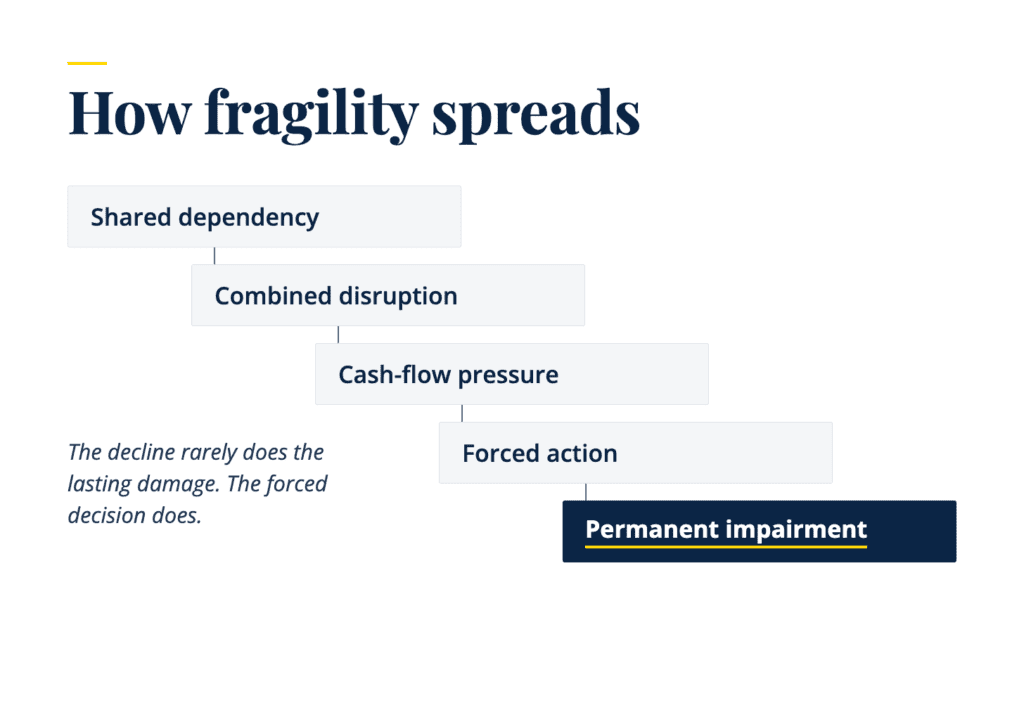
This is how the Financial Fragility Loop often begins at the Investor stage. The market drop is rarely what does the lasting damage. The forced decision is.
That is why diversification alone is not enough. A portfolio can be diversified and still sit inside a fragile financial structure.
From Diversification to Structural Durability
This leads to a bigger idea.
Structural durability is the capacity of your financial system to absorb disruption, meet its obligations and give your long-term money the time it needs to work.
Diversification helps. But so do cash reserves, how your debt is set up, how steady your income is, and how you behave under stress.
Here is the difference:
- Diversification asks whether your investments expose you to different risks.
- Structural durability asks whether your whole financial system still works when several risks arrive together.
This matters because compounding needs more than good investments. It needs time. And time only helps if your structure lets you stay invested.
A great long-term return is worth little if a short-term cash need forces you to sell first. This is the idea behind Capacity Before Compounding: you build the capacity to hold on before you count on the returns.
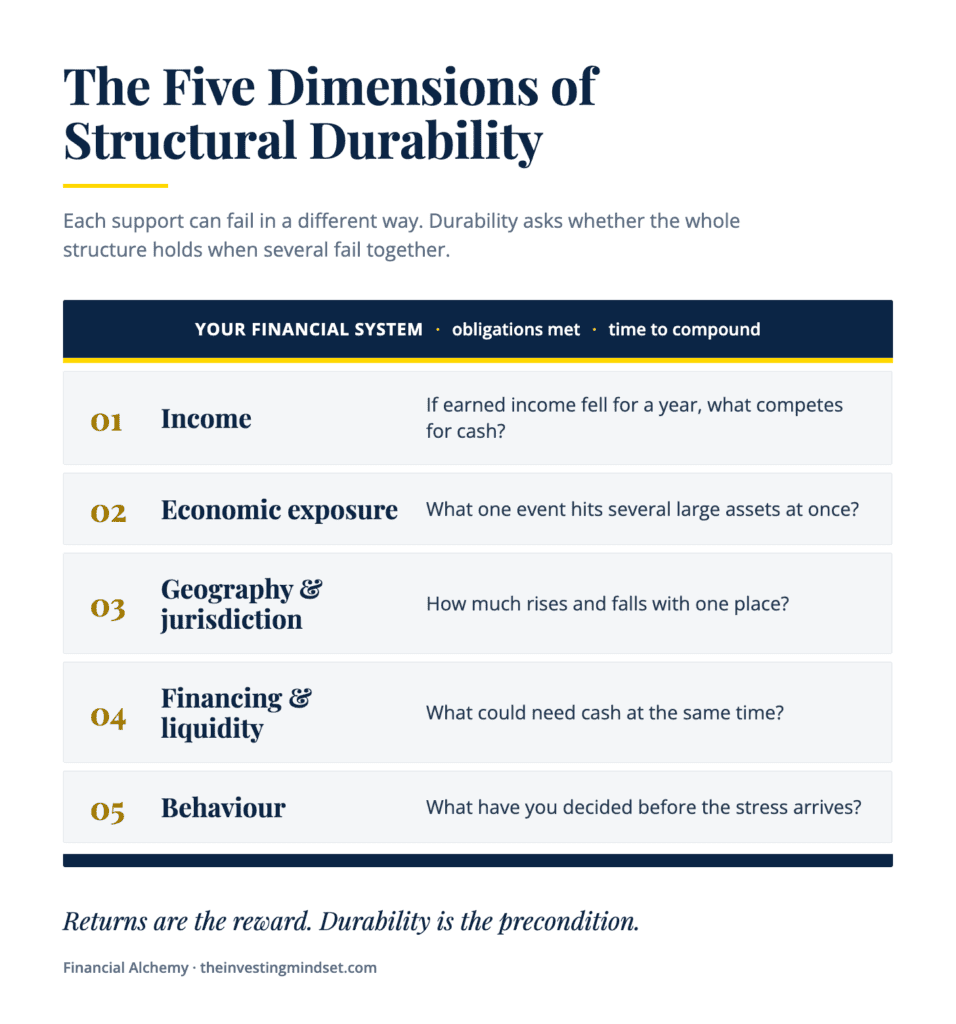
Returns are the reward. Durability is the precondition.
The Five Dimensions of Structural Durability
Stop thinking of your finances as a pile of assets. Start thinking of them as a structure. Every structure has supports, and each support can fail in its own way.
1. Income Durability
What happens if your main income weakens?
For many professionals, earned income is not just one part of the system. It holds up everything else. It pays the bills, funds investments, covers surprise property costs, carries a business through slow months and refills savings.
Ask: If my earned income dropped a lot for a year, which parts of my financial life would start fighting over cash?
2. Economic-Exposure Durability
Different assets can react to the same economic force. A business and a rental can look unrelated but rely on the same local jobs. An employee who owns lots of company stock has tied their paycheque and their savings to one employer.
Ask: What single economic event would hurt several of my largest assets at once?
3. Geographic and Jurisdictional Durability
Where does your wealth live, economically? Think about your income, business, property, investments, currency and the rules you operate under.
Ask: How much of my financial life rises and falls with the same place?
The goal is not to remove local exposure. It is to understand it.
4. Financing and Liquidity Durability
Some assets fail because their economics get worse. Others fail because they need cash at the wrong moment.
Which loans must be renewed? Which payments continue no matter what? Which assets might need repairs? Most important: what could need cash at the same time?
A reserve that looks big enough may quietly have four jobs:
- household emergencies
- business losses
- property repairs
- new investment opportunities
That money cannot do all four jobs at once. Liquidity isn’t idle cash. It is what stops a short-term problem from becoming a permanent decision.
5. Behavioural Durability
The last weak point is the investor.
Markets fall. Income feels uncertain. Headlines get scary. Assets that felt sensible start to feel unbearable.
Ask: What have I already decided I will do when things get uncomfortable?
This is where written investment rules help. You don’t need to predict every crisis. You need enough clarity that a scary month doesn’t rewrite your long-term plan.
Run a Structural Durability Audit in One Page
You don’t need special software. Take one sheet of paper and list your:
- income sources
- businesses
- investment accounts and big holdings
- properties
- debts
- known future commitments
- reserves you can actually reach
Then ask four questions about each item.
1. What must stay true for this to do its job? Be specific. “The rental needs to do well” tells you little. “Rent must cover costs and the mortgage, with a separate repair fund” gives you something to check.
2. What else depends on that same condition? Look for repeats: the same employer, region, industry, lender, pool of cash or person. These clusters matter more than the number of rows on your list.
3. If that condition weakens, do I lose income, need cash, or both? The most dangerous dependencies do both. A weak economy can cut income and drain reserves. An illness can lower earning power and raise costs.
4. Where would the response money come from? Cash? Pausing investments? The business? Borrowing? Selling? This question turns abstract risk into something real.
Then ask one final question:
If my income fell while several investments also weakened, what would I have to sell, borrow or postpone?
Follow the cash. It will often tell you more about your real risk than your investment returns.
Want a structured version? The Structural Durability Map walks you through this audit across income, investments, property, debt and reserves.
Strengthen the Weakest Connection First
Once you find a dependency, you don’t need to rebuild your whole financial life. Find the one connection that needs attention first.
Reduce overlap you don’t need. Before adding a new investment, ask what it adds to what you already own. Is it a truly different exposure, or another version of something you have?
Give each dollar a distinct job. Protective money should protect. Money set aside for a known bill should stay ready for that bill. Long-term money should get the time it needs to grow. Problems start when the same dollars quietly take on several jobs.
Review debt and cash together. Debt isn’t only about the interest rate. It’s also about timing. When do loans renew? When could big costs land? What if several hit during a weak income year?
Write one rule for your next investment. For example:
- Before adding to a concentrated asset, I will check my total exposure to the same economic driver.
- I will refill a used-up reserve before investing more long-term money.
- I won’t buy another asset that needs my income to support it until my current assets can meet their own obligations.
The rule should fit the weak spot you actually found. That is what turns insight into structure.
From Collector to Architect: The Identity Shift
Underneath all of this is a change in how you see yourself.
The Collector asks: What should I buy next? Each choice may be sensible on its own. But no one is studying what the choices build together.
The Allocator asks: How does this fit with what I already own? This is a real step up. It brings in balance, proportions and overlap.
The Architect asks: What could break this system, and have I designed for it? The Architect thinks in dependencies, failure points, liquidity, buffers and options.
This shift is part of the move from Investor to Owner on the Financial Alchemy path of Earner → Builder → Investor → Owner:
- The Builder creates capacity.
- The Investor learns to deploy capital.
- The Owner builds systems that hold their value without constant personal rescue.
Structural durability supports that climb because it protects your ability to keep going. If you’re not sure which stage you’re in right now, the free Financial Clarity Diagnostic will show you. You can also read more about the Investor path. Readers already at the Owner stage may find the Stewardship Audit a better next step.
Common Questions About True Diversification
Is owning index funds enough to be diversified?
Broad index funds spread company risk well. But they don’t cover the risks outside your portfolio, like your income, your property or your local economy. True diversification looks at the whole system.
Is concentration always bad?
No. Many people build wealth through a concentrated business or property. The goal is to make the concentration visible, then design the rest of your finances to support it.
Why does this matter more for physicians and other high earners?
High earners often use their income to support everything else. That makes the Labour illusion common. When income is the backstop for every asset, a pause in work can affect all of them at once.
Putting It Together
Dr. M doesn’t need to sell her share of the practice. She doesn’t need to give up real estate. She doesn’t need to remove every concentrated position.
What she needs is a clear view of what the rest of her system is being asked to support.
Maybe her next investment should add a different economic exposure. Maybe her reserves need clearer jobs. Maybe her refinancing dates should be spread apart. Maybe some assets need to depend less on her income. Maybe her next dollar does more good strengthening the structure than buying another holding.
This is what progress can look like at the Investor stage. Not just a bigger balance sheet. A financial life that can take a hit without forcing you to give up good long-term decisions.
Your progress shows up in what you can withstand, and in the choices you still have when times get hard.
Before your next investment, ask yourself:
What am I depending on, and how many parts of my financial life depend on it too?
This essay was first published in the Financial Alchemy newsletter. Read the original on Substack.
About the author: Dr. Akinniyi Osho is a family physician in Edmonton, Alberta, with three decades of medical practice across three continents and many years of investing in real estate. He founded Financial Alchemy to help high-income professionals move from income to ownership.