

The Upgrade-to-Obligation Pipeline
A Financial Alchemy paid deep dive — the implementation companion to The Lifestyle Creep Audit
Eighteen months ago, Elena’s income jumped by $3,500 a month.
It was a long-awaited partnership buy-in—the kind of raise she had quietly measured her whole career against.
She did the sensible things, one at a time.
A larger home, because the old place had felt cramped for two years already.
A better vehicle, because the old one was reaching the stage where every few months seemed to bring another repair.
A weekly cleaning service, because Sunday afternoons spent scrubbing grout were Sunday afternoons she wasn’t getting back.
A few more activities for the kids. A handful of subscriptions that made workweeks and evenings run more smoothly.
None of these decisions, examined individually, looked reckless.
Each passed the test most of us apply without thinking:
Can I afford this?
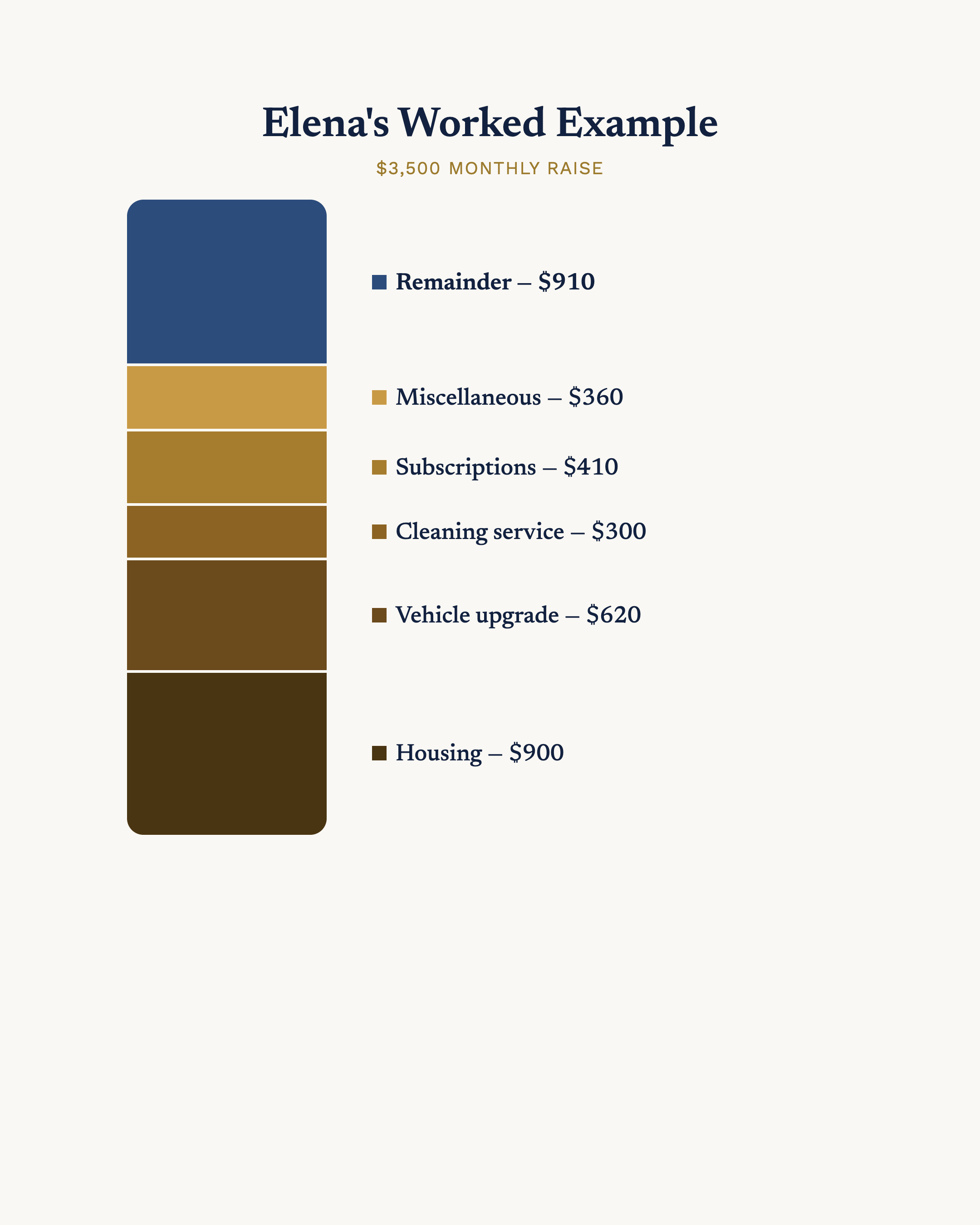
Against a $3,500 monthly increase, a $900 housing upgrade seemed manageable.
So did the $620 vehicle increase.
So did $300 for cleaning.
So did the $410 accumulated across activities and subscriptions that never quite felt large enough to qualify as major financial decisions.
Then Elena stopped looking at the purchases individually and ran the total.
$2,590 a month.
Seventy-four percent of the raise was gone before it ever reached savings, investing, debt reduction, or any other deliberate destination.
What remained was $910.
Nothing about this had felt like a crisis while it was happening.
That was precisely the problem.
Then, this spring, Elena’s partner wanted to reduce his clinical schedule to four days a week and use the fifth to begin building a side venture.
The math would not work.
Not because the household had become irresponsible.
Not because anyone had made one catastrophic financial decision.
Because, one reasonable upgrade at a time, they had engineered a life that required both full incomes to keep running.
Elena is not unusually undisciplined.
She is describing the mechanism this deep dive exists to name.
The Problem Doesn’t Begin at the Purchase
Most conversations about lifestyle creep stop at:
You earn more, so you spend more.
That is true.
It is also not especially useful, because it treats every new dollar of spending as the same kind of decision.
It isn’t.
A nice dinner is spending.
A larger mortgage is infrastructure.
A weekend away is spending.
A private-school commitment is infrastructure.
A new phone bought outright is one decision.
A vehicle payment that will arrive for the next five years is another kind entirely.
The difference is not simply the price tag.
It is what happens after the purchase.
Some spending resolves itself. You enjoy it, the money is gone, and the decision ends.
Other spending keeps making decisions on your behalf.
It arrives again next month.
And the month after that.
It carries insurance, maintenance, financing, fees, replacement expectations, or contractual commitments behind it.
Sometimes it pulls other costs into its orbit.
The bigger home requires more furniture and higher utilities.
The better vehicle carries more expensive insurance, tires, maintenance, and eventually a stronger psychological resistance to driving something cheaper.
The new neighbourhood may reset schooling expectations, social spending, commuting, or what now feels “normal.”
The purchase is only ever the visible moment.
The real financial event is everything that follows.
And then something subtler happens.
The upgrade stops feeling like an upgrade.
It becomes the baseline.
What was once a choice becomes an expectation.
What was once discretionary begins to feel necessary.
And once something has become part of the baseline, giving it up rarely feels like making a financial adjustment.
It feels like moving backward.
That is how high income and low autonomy can coexist.
The balance sheet may look respectable.
The household may look successful.
The calendar may be full.
And yet a sabbatical, reduced schedule, career pivot, business opportunity, or simply a slower season feels financially impossible.
Not because the income isn’t substantial.
Because too much of it is already spoken for.
Why Capable People Build This Without Noticing
If this pattern only caught people who were careless with money, it would not be worth a deep dive.
It doesn’t.
It catches people who are excellent at working hard, delaying gratification, carrying responsibility, and increasing their earning power.
Which is why “be more disciplined” is usually aimed at the wrong problem.
There are three forces operating underneath the surface.
The earned-it permission
Years of training, long hours, delayed gratification, professional risk, call schedules, exams, childcare juggling, or simply sustained effort create a reasonable feeling once the higher income finally arrives:
I earned this.
You probably did.
That is not the mistake.
The mistake is allowing I earned this to authorize every upgrade to become permanent.
Some upgrades are long-overdue relief.
Some genuinely improve the household.
Some protect scarce time.
Others are simply pleasant.
The problem begins when all of them are allowed to make permanent claims on future income without being distinguished from one another.
The isolation illusion
Almost every upgrade looks affordable when evaluated alone.
A $150 monthly service beside a six-figure income feels trivial.
So does the next one.
And the next.
The household rarely experiences lifestyle creep as one large decision because there was never one large decision to evaluate.
The new baseline is assembled piece by piece.
What gets missed is the sum.
Normalization
Human beings are remarkably good at adapting.
That is useful when life gets harder.
It is financially dangerous when life gets more expensive.
Within months, the larger home no longer feels large.
The premium vehicle no longer feels premium.
The service that once felt luxurious becomes part of how Tuesday works.
The standard resets.
And then the household begins defending the upgraded life not according to the value it still creates, but according to how strange it would feel to go backward.
Underneath all three is a distinction worth writing down:
Credit capacity is not risk capacity.
A lender telling you that you qualify for something does not mean the commitment fits the life you want to preserve.
Approval answers:
Can this household make the payment under the assumptions used today?
Risk capacity asks:
Can we hold this commitment through a slower year, a rate reset, a health interruption, parental leave, burnout, a business experiment—or simply a season in which we decide we no longer want to work this much?
Those are very different questions.
The Financial Alchemy Diagnosis
Here is the reframe:
Lifestyle creep is not primarily a spending problem. It is a sequencing problem.
Financial Alchemy treats income as raw material, not as the finished product.
The intended conversion is:
Income → Surplus → Capital → Assets & Systems → Time → Freedom
Each stage depends on the one before it converting cleanly into the next.
The Upgrade-to-Obligation Pipeline interrupts that process at the first joint:
Income → Surplus
The income arrives.
Before it can become deployable capital, much of it has already been claimed.
That is why a high earner can appear to be advancing while remaining structurally stuck in the Earner stage.
More income alone does not make someone a Builder.
The transition begins when a household can repeatedly preserve part of what it earns, direct that surplus deliberately, and maintain the system under ordinary pressure.
The number at the top of the pay statement is not the transition.
What happens to the number after it arrives is.
The Upgrade-to-Obligation Pipeline
Most lifestyle obligations follow the same six-stage progression.
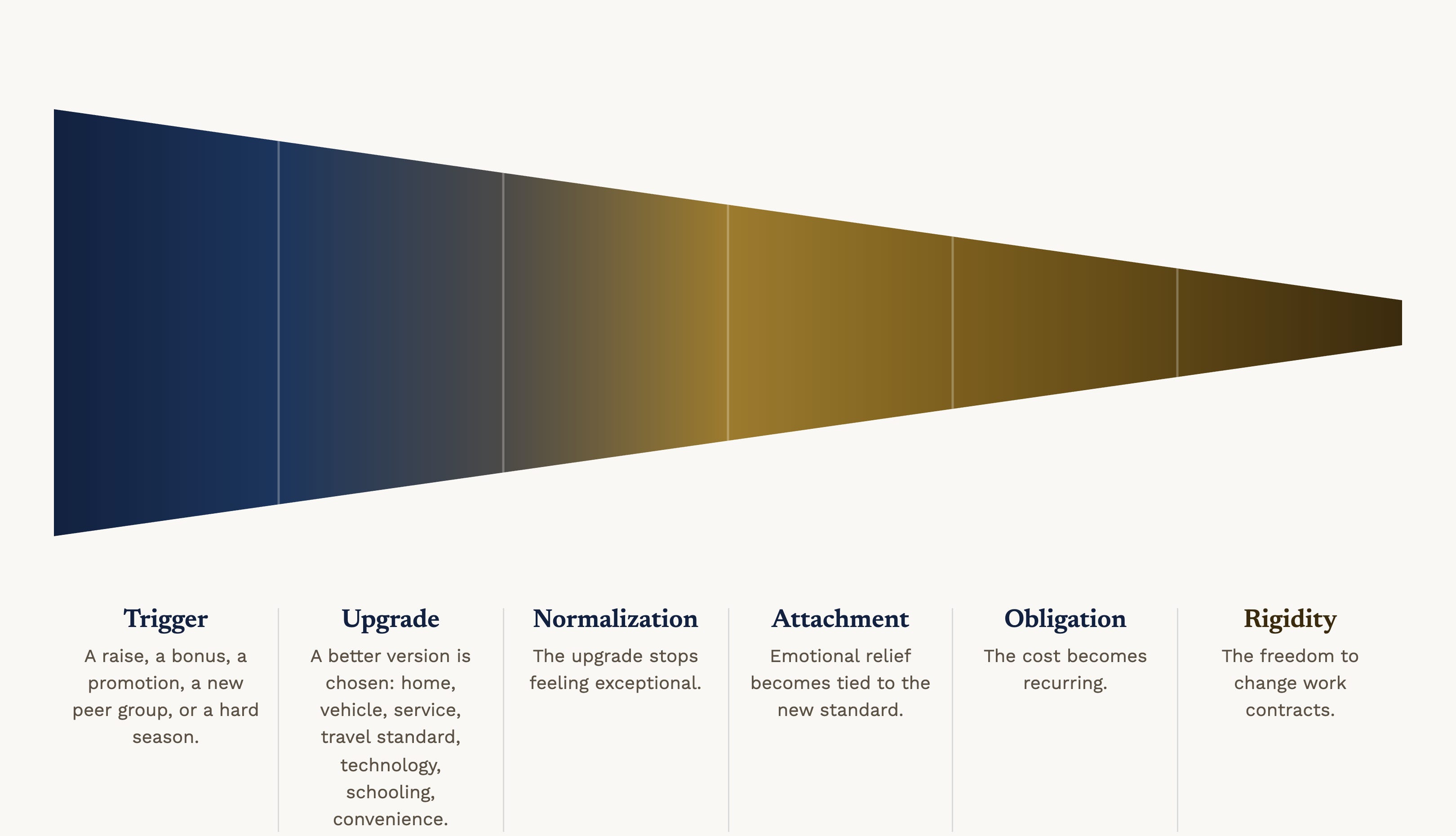
1. Trigger
A raise, bonus, promotion, new peer group, stressful season, family change, or simple desire to reward hard work creates permission to spend.
2. Upgrade
A better version is chosen.
Home.
Vehicle.
Travel.
Technology.
Schooling.
Convenience.
Membership.
Service.
3. Normalization
The upgrade stops feeling exceptional.
It becomes the expected baseline rather than a conscious indulgence.
4. Attachment
Identity, routine, convenience, family expectations, status, or emotional relief become connected to the new standard.
5. Obligation
The cost becomes recurring, financed, contractually fixed, operationally necessary, or socially difficult to reverse.
6. Rigidity
Several obligations combine.
Required income rises.
Surplus falls.
The household’s ability to reduce work, absorb a shock, make an investment, or change direction quietly contracts.
Trigger → Upgrade → Normalization → Attachment → Obligation → Rigidity
An upgrade is not dangerous merely because it enters the pipeline.
Risk accumulates as it moves to the right.
As it becomes recurring.
As other costs attach themselves to it.
As exiting becomes more expensive.
As the household begins requiring tomorrow’s income to preserve yesterday’s choices.
That is the mechanism.
Now comes the more useful question:
Which of your upgrades are actually moving through it?
Recognizing the pipeline gives you a different way to see lifestyle creep.
The next step is to measure your own version of it—and then decide what deserves to stay.
Because the goal is not to eliminate everything that makes life better.
The goal is to stop financing comfort in ways that quietly eliminate choice.
Before You Score Anything: Four Tests for an Upgrade
Before calling an upgrade “good” or “bad,” put it through four tests.
1. Value
Does this meaningfully improve health, time, safety, family life, reliability, or sustained enjoyment?
This question matters because some upgrades genuinely deserve to remain.
Elena’s cleaning service, for example, protects a scarce resource she values highly: time.
2. Recurrence
Is the cost one-time, occasional, or a monthly claim that continues automatically?
A $2,000 purchase can be less structurally restrictive than a $250 recurring payment.
The amount matters.
So does the frequency.
3. Reversibility
Could I reduce or exit this within 30 days without major penalties, disruption, or social friction?
This is where two similarly priced upgrades can carry very different risks.
Month-to-month service?
Highly reversible.
Five-year financing agreement?
Not so much.
4. Opportunity cost
What capital, debt reduction, runway, or optionality will this displace each year?
Annualize the decision.
A $500 monthly upgrade is not a $500 decision.
It is a $6,000 annual claim on future income.
An upgrade can pass the Value test and still perform poorly on Recurrence, Reversibility, and Opportunity Cost.
That does not automatically mean you should reject it.
It means the decision deserves deliberate funding rather than passive absorption.
What Most People Miss: Three Obligation Patterns
Once you begin looking for the pipeline, three patterns appear repeatedly.
The convenience stack
A demanding career makes convenience rational.
Meal delivery.
Cleaning.
Premium transportation.
Outsourced errands.
Subscriptions that simplify work or family life.
The failure is not convenience itself.
The failure is an unexamined stack of convenience.
Each item can appear small enough to ignore.
Together they can become a major fixed claim.
The useful question is not:
Is this wasteful?
It is:
Does this service still return enough time, energy, reliability, or enjoyment to justify what it claims from us every year?
The identity lock
Some obligations survive because reversing them feels like public decline.
The premium vehicle.
The membership.
The housing standard.
The travel expectations.
The household may no longer need them.
But reducing them seems incompatible with what professional success is supposed to look like.
At that point, a financial decision is being defended by a social story.
Financial Alchemy uses a different signal.
Autonomy is a stronger expression of wealth than visible consumption financed by compulsory work.
The obligation cluster
Commitments rarely stay isolated.
Housing can influence commuting, schooling, vehicles, services, and social spending.
A business upgrade can create software, staffing, insurance, and financing commitments.
One anchor decision produces several dependent ones.
This is why cancelling three subscriptions may feel productive without changing the structure very much.
Sometimes the real leverage sits further upstream.
Tool One: The Obligation Load Score
The Four Tests tell you what kind of decision you are looking at.
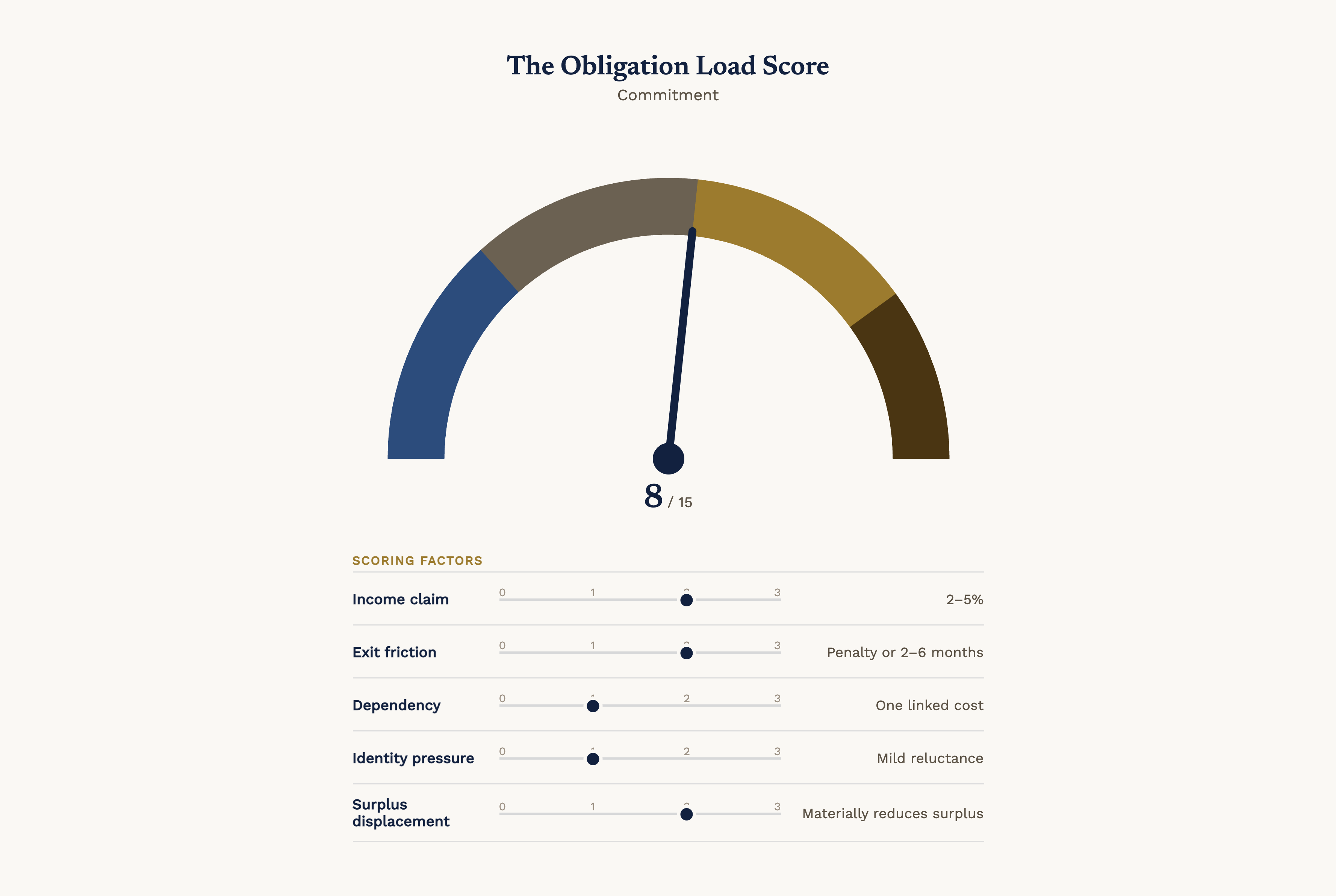
The Obligation Load Score tells you how much structural pressure an existing commitment creates.
Score each factor from 0 to 3.Add the five scores.
Maximum: 15.
Interpreting the score
0–4: Flexible upgrade
Low structural risk. Review periodically, but it is unlikely to be constraining the household by itself.
5–8: Emerging obligation
Keep it where the value is clear and the cost is deliberately funded.
9–12: Restrictive obligation
The commitment is materially reducing surplus, increasing required income, or narrowing flexibility.
13–15: Fragility driver
It deserves an exit, refinance, redesign, or containment plan.
The score is a decision aid.
It is not a moral grade.
A necessary housing commitment may score highly.
So might childcare, medical support, or another cost that the household has good reason to preserve.
The point is not to pretend those commitments should disappear.
It is to recognize where risk is concentrated so the rest of the system can compensate.
Add the five scores.
Maximum: 15.
Interpreting the score
0–4: Flexible upgrade
Low structural risk. Review periodically, but it is unlikely to be constraining the household by itself.
5–8: Emerging obligation
Keep it where the value is clear and the cost is deliberately funded.
9–12: Restrictive obligation
The commitment is materially reducing surplus, increasing required income, or narrowing flexibility.
13–15: Fragility driver
It deserves an exit, refinance, redesign, or containment plan.
The score is a decision aid.
It is not a moral grade.
A necessary housing commitment may score highly.
So might childcare, medical support, or another cost that the household has good reason to preserve.
The point is not to pretend those commitments should disappear.
It is to recognize where risk is concentrated so the rest of the system can compensate.
Tool Two: Your Household Obligation Ratio
The Obligation Load Score evaluates one commitment at a time.
You also need to see the household as a whole.
Because five moderate obligations can create the same rigidity as one enormous one.
Calculate:
Fixed and difficult-to-reverse monthly commitments ÷ monthly net household income
Include:
- essential fixed costs,
- minimum debt payments,
- financed commitments,
- contractually fixed payments,
- optional commitments you could not reasonably remove within 30 days.
Exclude spending that is genuinely flexible from one month to the next.
The result tells you how much of your income has effectively been assigned before the month begins.
But use the ratio carefully.
It is not a universal verdict.
Housing markets differ.
Family size differs.
Health needs differ.
Career stages differ.
One household’s healthy range may not map neatly onto another.
That is why the strongest use of the Household Obligation Ratio is not comparison.
It is direction.
Track it quarterly.
Track it before major upgrades.
Track it when income rises.
Track it before reducing work.
If your income rises and your obligation ratio stays unchanged, ask an uncomfortable question:
Did the raise actually increase your autonomy—or did it simply finance a more expensive baseline?
If the ratio begins to fall, something important is happening.
More of your income is once again becoming available for surplus.
And surplus is where the Financial Alchemy conversion chain restarts.
Run Elena Through the System
Return to Elena.
The answer is not:
Cancel everything.
The cleaning service costs $300 a month.
But it is highly reversible, delivers substantial time value, and makes demanding weeks materially easier.
It may be one of the upgrades most worth preserving.
Several subscriptions are barely used.
Low value.
Low exit friction.
Easy release.
The vehicle is different.
It carries a larger income claim and linked operating costs.
It cannot be fixed tomorrow without consequences.
So it becomes a planned decision around renewal or replacement.
Housing is different again.
It is an anchor commitment.
Changing it would affect several other parts of family life.
That makes it a longer-horizon structural decision rather than something to attack impulsively.
This is what a useful audit does.
It does not ask:
What can we deprive ourselves of?
It asks:
Which claims on future income still deserve to be here?
The Reversal Sequence
Avoid random cutting.
Random cutting creates fatigue, resentment, and a surprising amount of rebound spending.
Use a sequence instead.
1. Stabilize
Protect housing, utilities, insurance, basic food, medical needs, transport required for income, and all minimum debt payments.
If cash flow is already negative, suspend new commitments immediately.
The first job is to stop the pipeline from widening.
2. Expose
List every recurring obligation.
Not just the headline payment.
Include linked costs.
Annual fees.
Insurance.
Maintenance.
Required memberships.
Contract dates.
Penalties.
Annualize the total.
What feels vaguely oppressive in the background usually becomes much more manageable once it is finite and visible.
3. Rank
Score each commitment.
Then choose two targets:
The easiest meaningful release.
And:
The commitment creating the greatest structural pressure.
The first gives you momentum.
The second gives you a medium-term plan.
Do not confuse the easy win with the important win.
You usually need both.
4. Release
Cancel.
Reduce.
Renegotiate.
Refinance.
Redesign.
For simple obligations, act now.
For contract-bound obligations, establish the earliest realistic exit date.
For anchor commitments, define a trigger:
Lease renewal.
Mortgage decision.
Vehicle maturity.
School transition.
Planned relocation.
The goal is not dramatic action.
It is deliberate sequencing.
5. Redirect
This is the step most people skip.
And it may be the most important one.
Every dollar you release needs a destination before it returns to the general account.
Starter buffer.
High-cost debt.
Investable surplus.
Another deliberate capital priority.
Otherwise the newly available cash does what unassigned cash tends to do:
It quietly becomes the funding source for the next upgrade.
Released cash flow is not recovered wealth until it has a new assignment.
When the List Is Long: Use Triage
If you discover twenty-seven things during the audit, do not attempt to optimize all twenty-seven.
Work in this order:
- Stop new leakage — no new financing, subscriptions, or contracts while you are cleaning up the existing structure.
- Remove low-value recurring costs — unused services, duplicate tools, forgotten renewals.
- Reduce expensive convenience that no longer earns its keep.
- Restructure financed obligations — especially where interest and minimum payments are adding a second claim.
- Plan anchor exits — housing, transport structure, schooling, or other large commitments that require coordination.
Small releases prove change is possible.
Structural releases change the required-income floor.
Do not use the first to avoid the second.
Talk About Autonomy, Not Deprivation
Recurring commitments often affect more than one person.
Treating the audit as a unilateral cost-cutting exercise is an efficient way to turn a financial problem into a relationship problem.
Start with the shared outcome.
More breathing room.
Less compulsory work.
A faster path out of debt.
A sabbatical.
A parental leave.
The ability to say no to an unhealthy job.
A business runway.
Then examine which commitments support that goal and which compete with it.
Language matters.
“This costs too much” invites a defence of the purchase.
“This commitment uses 6% of our net income and delays the buffer by eight months” creates a decision.
Where something carries real value, keep it.
Choose a different release.
The goal was never to win every line item.
It is to reduce the amount of income the household requires merely to stand still.
Your 30-Day Upgrade-to-Obligation Reset
You do not need a six-month financial overhaul to begin changing the structure.
You need one month of deliberate work.
Days 1–3: Inventory
Capture every recurring commitment and its linked costs.
Use statements, subscription lists, loan schedules, insurance records, and your calendar.
Do not edit yet.
Just make the invisible visible.
Days 4–7: Score
Calculate an Obligation Load Score for each recurring commitment.
Mark essential commitments separately.
Calculate your Household Obligation Ratio.
Days 8–10: Choose
Select:
- one quick release, and
- one structural obligation requiring a longer plan.
This prevents the audit from becoming either trivial or overwhelming.
Days 11–14: Communicate
Discuss the affected commitments with anyone sharing the consequences.
Define the outcome you are trying to create.
Do not begin with what must be cut.
Begin with what you want the household to be able to choose.
Days 15–21: Execute
Cancel.
Downgrade.
Renegotiate.
Refinance where appropriate.
Set formal exit dates for commitments that cannot move immediately.
Record the new monthly amount.
Days 22–30: Redirect
Automate the recovered cash flow.
Make the first transfer.
Then recalculate the amount of income required to keep the current household structure running.
That number matters more than most people realize.
It is your required-income floor.
Your long-term objective is not necessarily to make that number as small as possible.
It is to keep it low enough that your life still contains choices.
Guardrails That Keep the Pipeline From Rebuilding
Reversing the pipeline once is useful.
Changing the rules that created it is better.
A few household guardrails can do most of the work.
Annualize recurring upgrades
Before adding a new $350 monthly obligation, translate it:
$4,200 per year.
The monthly number tells you whether the payment fits.
The annual number tells you what you are giving up.
Use a pause before new recurring commitments
Set a household threshold.
Above it, require a waiting period before signing.
Thirty days is enough to separate durable value from temporary enthusiasm surprisingly often.
Fund upgrades from existing surplus
Not anticipated income.
Not the bonus that should arrive.
Not the raise beginning next quarter.
Let new income become surplus first.
Then decide what portion, if any, deserves to become lifestyle.
Require an exit path
Before entering a contract or financing agreement, know how you leave it.
When?
At what cost?
With what secondary disruption?
Reversibility is part of affordability.
Review commitments quarterly
Not because every quarter should involve cutting.
Because recurring expenses stop feeling like decisions very quickly.
A recurring review turns them back into decisions.
Redirect raises before lifestyle expands
Decide in advance where part of the next income increase will go.
Automate it before the household becomes accustomed to having the money available.
Allow deliberate enjoyment
A financial system that removes everything meaningful will not survive.
Financial Alchemy is not an argument for making life smaller.
It is an argument for making sure the life you build remains yours to choose.
When Debt Reinforces the Pipeline
The most difficult version of the Upgrade-to-Obligation Pipeline occurs when the upgraded standard has been financed.
Credit-card balances.
Personal lines of credit.
Buy-now-pay-later arrangements.
Vehicle financing.
Consumer loans.
Now there are two problems.
The original lifestyle claim.
And the minimum payment created by financing it.
Cancelling the expense may stop the pipeline from widening.
It does not erase the balance.
At that stage, the household needs a debt inventory, payoff sequence, protected minimums, and a system for ensuring released cash flow actually reaches principal.
That is where the Debt Freedom Toolkit becomes the next step.
The Transformation
The Earner asks:
Can I afford the payment?
The Builder asks:
What does this commitment do to my surplus, my flexibility, and the income I will need going forward?
That second question does not prohibit a good life.
It protects your ability to keep choosing one.
There is a difference between living well and constructing a life that can only be sustained by continuously producing at your present maximum.
One creates enjoyment.
The other creates dependency.
Wealth, in any form worth having, begins with the portion of today’s income that remains available to build tomorrow’s autonomy.
Not the part already promised to yesterday’s upgrades.
Back to Elena
Elena did not cancel the cleaning service.
Once she looked at it properly, the decision was easy.
It genuinely improved the household.
The time it returned mattered more than the $300 it claimed.
The low-use subscriptions went immediately.
The vehicle became a decision tied to its next realistic exit point rather than something to deal with “someday.”
And she created one new rule:
Half of every future raise would be redirected automatically before it ever reached the household checking account.
Six months later, nothing about her life looks austere.
She has not abandoned every upgrade.
She has not turned financial discipline into punishment.
But the amount of income the household requires merely to maintain itself is moving down rather than up.
And something else has returned with it.
The four-day clinical week is back on the table.
Not as a fantasy.
As an option.
That is the point.
The real opposite of lifestyle creep is not frugality.
It is optionality.
Three Questions Before Your Next Upgrade
Before you make the next lifestyle decision—or before you attempt to walk one back—sit with three questions:
Which stage of the pipeline is my most recent lifestyle upgrade actually in right now—and would I still choose it knowing what comes next?
If our income fell by 25% tomorrow, which commitments would I be relieved to lose—and which would I fight to keep?
What is our required-income floor today, and is it moving up or down relative to what we earn?
Those answers will tell you far more than asking whether you can make the next payment.
Your Next Step
Start with the Obligation Load Scorecard.

Financial Alchemy Obligation Load Scorecard
11.9KB ∙ PDF file
Run your recurring commitments through the five factors.
Then calculate your Household Obligation Ratio and identify one quick release and one structural constraint.
For deeper modeling, use the Upgrade-to-Obligation Simulator to see how releasing, refinancing, or redesigning commitments changes your required-income floor.
Run your own numbers: open the Upgrade-to-Obligation Simulator. Access code: Optionality
If revolving debt or financed upgrades are reinforcing the pipeline, continue with the Debt Freedom Toolkit so the cash flow you release becomes a protected payoff system rather than disappearing into the next upgrade.
The goal is not to undo every good thing your income has allowed you to enjoy.
It is to make sure those good things have not quietly acquired veto power over what you are allowed to do next.
This article is educational in nature and does not constitute individualized financial, legal, tax, or accounting advice. Household obligations, debt structures, income stability, and risk tolerance differ. Consider obtaining appropriate professional advice before making major financial changes.