

The Physician Real Estate Decision System
1. The Physician Real Estate Paradox
Every physician knows a version of the story.
A colleague buys one rental property, then a second. Years later, the rental income looks less like a side project and more like an exit route from clinical dependence. Medicine created the income. Property appears to have converted it into ownership.
The appeal is understandable.
Physicians often have stable earnings, strong credit and enough career runway to hold assets through several cycles. Real estate is tangible. It can be financed. It may generate income, respond to inflation and reward competent operation. It seems to offer a bridge from earning money to owning something that can keep working when the physician is not.
But this is where the story is usually edited.
The same property can bring vacancy, repairs, refinancing pressure, tax complexity, legal exposure and a second operating role. A high clinical income can cover these weaknesses for years, allowing a poor investment to look healthy because the owner keeps rescuing it.
THE PHYSICIAN REAL ESTATE PARADOX
Physicians are unusually well positioned to buy real estate and unusually vulnerable to buying it badly.
The same income that creates access to real estate can also conceal mistakes in real estate.
The relevant question is therefore not:
Can you buy property?
It is:
Does real estate strengthen your financial system at this stage?
And, if it does, what form of exposure can your system responsibly support?
The purpose of this deep dive is not to persuade you to buy property. It is to help you decide whether real estate belongs in your wealth architecture, which form of exposure fits your life, and how to protect the rest of your system if you proceed.
The correct outcome may be direct ownership.
It may be professionally managed ownership.
It may be passive exposure.
It may be to defer the decision or decline real estate entirely.
The objective is not property acquisition.
It is sound capital allocation.
2. Why Physicians Have an Advantage and a Blind Spot
Physicians enter the real estate conversation with genuine advantages.
Reliable income supports saving and financing. A long career can provide time for amortization and compounding. Professional credibility may improve access to lenders and advisers. A physician who deliberately converts surplus into productive assets can create meaningful optionality.
Those advantages become dangerous when they are confused with competence.
A lender assesses whether you are likely to repay a loan. It does not certify that the asset is well priced, that the rent assumptions are sound, or that the investment improves your total portfolio.
Approval answers the lender’s question, not yours.
Several vulnerabilities recur.
A high income can subsidize weak economics. A property that consumes cash every month may survive because clinical earnings quietly cover the shortfall.
Strong credit can normalize excessive leverage. The amount available is rarely the same as the amount prudent.
Time scarcity can encourage premature outsourcing. A manager can perform tasks, but ownership still requires oversight and judgment.
Professional mastery can spill into false confidence. Expertise in medicine does not automatically transfer to underwriting, construction, tenancy law, financing or local market selection.
Tax reduction can also be mistaken for investment return. A deduction may soften a loss. It does not transform a poor asset into a good one.
There is one more distinction worth making early:
Direct real estate is both an asset and an operating business.
You may like the asset.
That does not mean you want the business.
In Financial Alchemy terms, the Builder creates surplus. The Investor decides where capital should go. The Owner builds systems that produce value without requiring constant personal intervention.
Real estate can support this progression.
Owning a property does not prove that the progression has occurred.
3. What Job Is Real Estate Supposed to Perform?
Before deciding what to buy, decide what real estate should do.
Is the purpose current income?
Diversification?
Potential inflation resilience?
Long-term appreciation?
Business ownership?
A future source of optionality?
Legacy?
Reduced dependence on clinical labour?
Different objectives may point toward different forms of exposure. A physician seeking control and business ownership may evaluate direct property differently from a physician seeking diversified real-estate exposure without another operating role.
This question also prevents a common mistake: adopting the asset before defining the purpose.
“Successful physicians buy real estate” is not an investment thesis.
Neither is:
“My accountant mentioned it.”
“My colleague owns six doors.”
“Property always goes up.”
“I need another tax deduction.”
“I do not want to miss the market.”
A useful investment thesis should explain what job the asset is expected to perform, why real estate is suited to that job, what risks are being accepted, and what conditions would make the thesis wrong.
This produces an important sequence:
Purpose before vehicle.
Vehicle before property.
Property before structure.
The more clearly the job is defined, the easier it becomes to reject opportunities that do not serve it.
4. Choose the Form of Exposure Before Choosing the Property
The first decision is not which building to buy.
It is which operating model fits your capital, time, skill and desired degree of control.
Direct rental ownership
You select the market, property, financing, tenants, manager and exit.
You retain the greatest control and accept the greatest operating responsibility.
Direct ownership can produce cash flow, principal repayment and appreciation, but it is concentrated and illiquid. It is best treated as a small operating business attached to a leveraged asset—not as a passive substitute for an ETF.
Professionally managed ownership
You still own the asset directly, but a third party handles leasing, rent collection, maintenance coordination and routine tenant issues.
This reduces daily burden.
It does not remove ownership responsibility.
You must choose the manager, define authority limits, review statements, approve significant work, monitor reserves and replace the manager when standards decline.
Management is delegated; accountability is not.
Public REITs
Publicly traded real-estate investment trusts provide diversified property exposure with daily liquidity and no direct landlord role.
Their prices move with public markets, interest-rate expectations, sector fundamentals and management decisions.
They are liquid real-estate securities, not miniature versions of owning a local duplex.
Private funds and syndications
A private fund may hold multiple assets; a syndication often raises capital for a particular property or project.
You exchange operating responsibility for sponsor risk, fee complexity, limited control, and restricted liquidity.
The sponsor is part of the investment.
Relevant questions include the sponsor’s experience, prior losses, leverage policy, personal capital invested, governance, reporting, fee structure, valuation practices, transparency, and treatment of investors when a project underperforms.
Mortgage investment corporations
A mortgage investment corporation, or MIC, pools investor capital to make mortgage loans.
Your exposure is primarily to real-estate credit rather than direct property ownership.
Relevant considerations include loan-to-value policy, borrower quality, geographic concentration, arrears, loss history, liquidity terms, fees and the manager’s underwriting discipline.
A high distribution is not proof of a safe yield. It may be compensation for credit, liquidity, or concentration risk.
DECISION PRINCIPLE
Passive does not mean risk-free. It means you’ve transferred the operating work to someone whose judgment you must evaluate.
No real estate is also a legitimate outcome.
A physician does not need direct property, syndications, or private real estate exposure to build substantial wealth.
“No real estate” can be a disciplined Investor decision.
Continue Reading below
Not ready to buy the article? Enter the Real Estate Decision System at the level that fits you.
Start free: Physician Real Estate Capacity Audit
Assess whether your current capital, liquidity, debt, time, and financial system can responsibly support real estate.
Take the free Capacity Audit
Go deeper: Physician Real Estate Playbook
If you want a practical framework for evaluating direct ownership, passive exposure, financing, underwriting, and portfolio decisions, the paid Playbook gives you the structured process.
Get the Physician Real Estate Playbook
Build the system: Real Estate Investor OS
If you are already investing—or intend to build a portfolio—the Real Estate Investor OS is designed to help you organize the decision-making, underwriting, operations, and portfolio-management system around it.
Explore the Real Estate Investor OS
5. Tool One: The Physician Real Estate Decision Matrix
The Decision Matrix prevents property enthusiasm from outrunning financial readiness.
Evaluate the proposed route across four dimensions: capital, time, risk and strategic fit.
Do not average away a serious weakness.
The weakest dimension is a constraint.
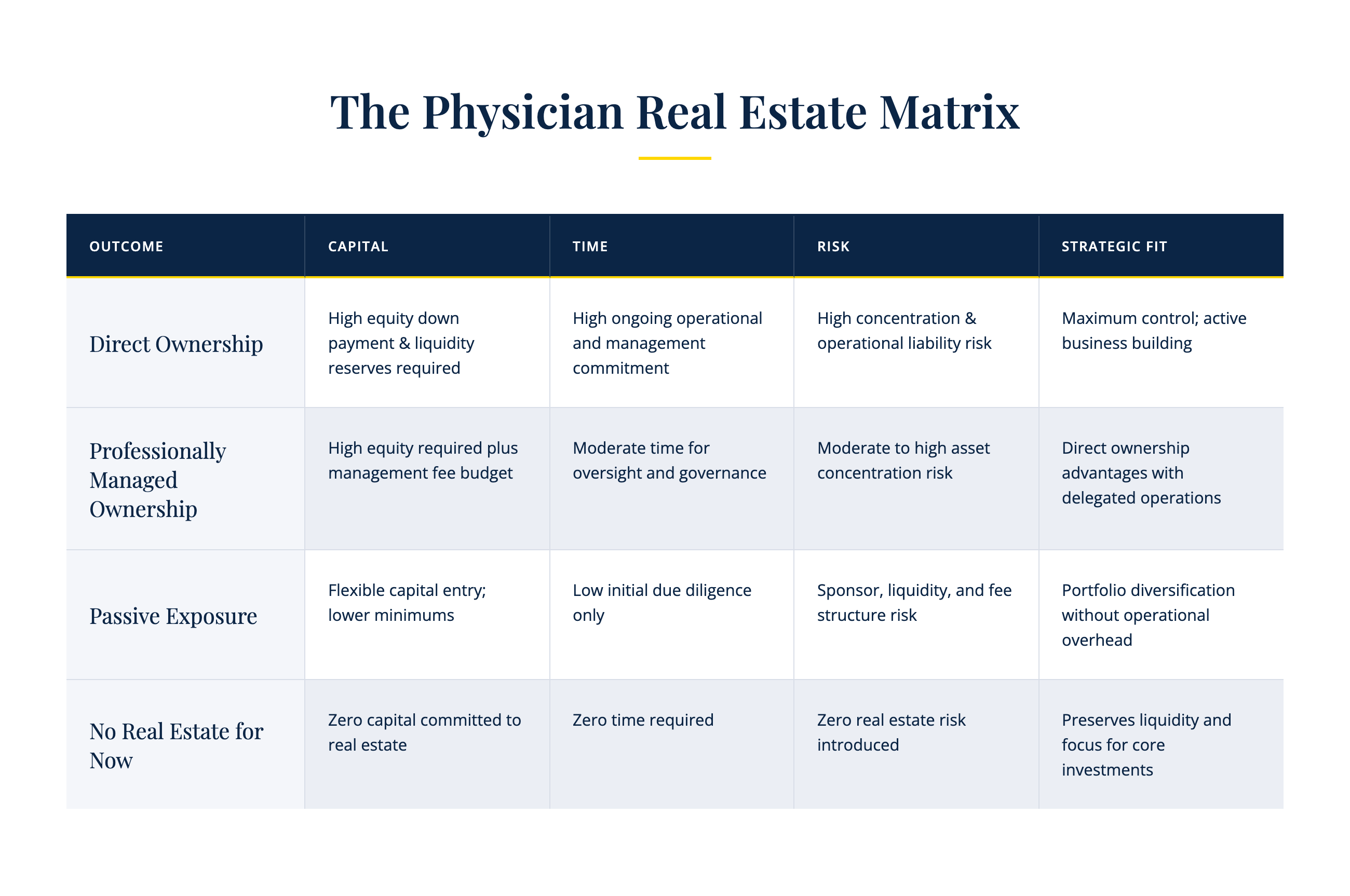
The matrix should lead toward one of four broad outcomes:
Direct ownership. Professionally managed ownership. Passive exposure. No real estate for now.
Each can be a valid Investor decision.
The purpose is fit, not permission.
The matrix answers which path appears compatible with the system.
It does not yet answer whether the system is ready.
That comes next.
6. Tool Two: The Readiness Gates
A promising property does not cure an unready balance sheet.
Before analyzing upside, the wider financial system should pass a series of gates.
Gate 1: Investable surplus
Do you consistently create surplus?
Not income.
Surplus.
A physician can earn a substantial income while consuming nearly all of it through taxes, household spending, debt service and lifestyle commitments.
Real-estate capacity begins with capital that is genuinely available for long-term allocation.
The Builder’s job is to convert income into surplus, liquidity and resilience.
Until that exists, real estate risks becoming another claim on future clinical income.
Gate 2: Household liquidity
The household emergency reserve should remain intact after closing.
It protects family spending and professional disruption.
It is not the property’s repair account.
A physician with variable billings, practice overhead, a pending career change or other unstable cash flows may require a larger buffer than someone with highly predictable employment.
The exact target is personal.
The separation is not.
Gate 3: Complete acquisition capital
The equity contribution is only one component of acquiring a property.
Budget separately for legal fees, inspection, appraisal, lender charges, land-transfer costs where applicable, immediate repairs, utility deposits and initial vacancy.
If the deal requires borrowing the closing costs or using every available dollar, the system is beginning without a margin of safety.
Gate 4: Dedicated property liquidity
After closing, retain property-specific reserves for vacancy, insurance deductibles, urgent repairs and capital expenditures.
A furnace, roof or plumbing failure is not an unexpected philosophical event.
It is an expected expense with uncertain timing.
Reserve policy should be written before the first tenant calls.
Gate 5: Balance-sheet, debt and time capacity
Real-estate equity is not the same as accessible cash.
Ask what other goals become harder after the acquisition: registered-account contributions, corporate investing, practice expansion, debt reduction, education funding, family goals or the ability to reduce clinical work.
A property can be affordable and still be the wrong allocation.
The same applies to debt.
Borrowing capacity is not investment capacity.
The question is not simply whether the bank will lend the money. It is whether the overall financial system can carry that debt through weaker conditions without becoming dependent on peak professional income.
Time belongs in the same analysis.
Time is not merely a lifestyle consideration.
It is an investment variable.
Even professionally managed ownership requires decisions, reporting, judgment and oversight.
MARGIN OF SAFETY
Do not ask only whether you can produce the down payment. Ask what remains after the down payment and what that remaining liquidity must protect.
Once the system passes these gates, the next question is not yet which property to buy.
It is where the investment thesis can reasonably be expressed.
7. Strategy → Market → Property
Investors frequently begin with:
“Where should I buy?”
That is usually too early.
The better sequence is:
Strategy → Market → Property
A market is attractive only relative to an investment thesis.
If the objective is stable income, the relevant market characteristics may differ from those required for redevelopment, appreciation, student housing, short-term accommodation or another strategy.
Market analysis should therefore be connected to the job the asset is supposed to perform.
Relevant factors can include the economic base, housing fundamentals, cost structure and regulatory environment.
The purpose is not to find a universally “good” city.
It is to determine whether a particular market supports the assumptions required by a particular strategy.
Local versus long-distance investing
Lower purchase prices in another market can be appealing.
But cheaper property can require more expensive systems.
Distance increases dependence on property managers, contractors, leasing agents, local partners, inspectors and reporting systems.
An owner who cannot physically inspect an emerging problem must have enough information, trust and process to detect it another way.
The farther you are from the asset, the stronger the operating system must become.
Once the strategy and market align, the analysis can move to the individual property.
8. Underwrite the Property, Not the Story
A property is a set of future cash flows, obligations, risks and decisions.
Underwriting attempts to describe those economics before ownership makes the analysis emotional.
At minimum, the investor needs to understand revenue, vacancy, operating expenses, net operating income, capital expenditures and financing.
The distinctions matter.
Maintenance is not the same as capital expenditure
Roofs fail.
HVAC systems age.
Plumbing deteriorates.
Parking surfaces require work.
Appliances reach the end of useful life.
Routine maintenance and long-term replacement are not interchangeable.
If the investment only works by pretending major systems never need replacement, it does not work.
Metrics Are Tools, Not Answers
Cap rate, cash-on-cash return, debt-service coverage, loan-to-value and break-even occupancy can help describe an investment.
None can make the decision by itself.
A high cap rate may reflect genuine value—or higher risk.
A high cash-on-cash return may depend on aggressive leverage.
A respectable debt-service coverage ratio may weaken rapidly when financing resets.
The spreadsheet is therefore not an advocacy document.
Its job is not to make the opportunity look investable.
Its job is to reveal what the investment requires.
Use the spreadsheet to discover what must remain true—not to prove that the deal works.
A worked example makes this clearer.
9. Worked Canadian Property Example
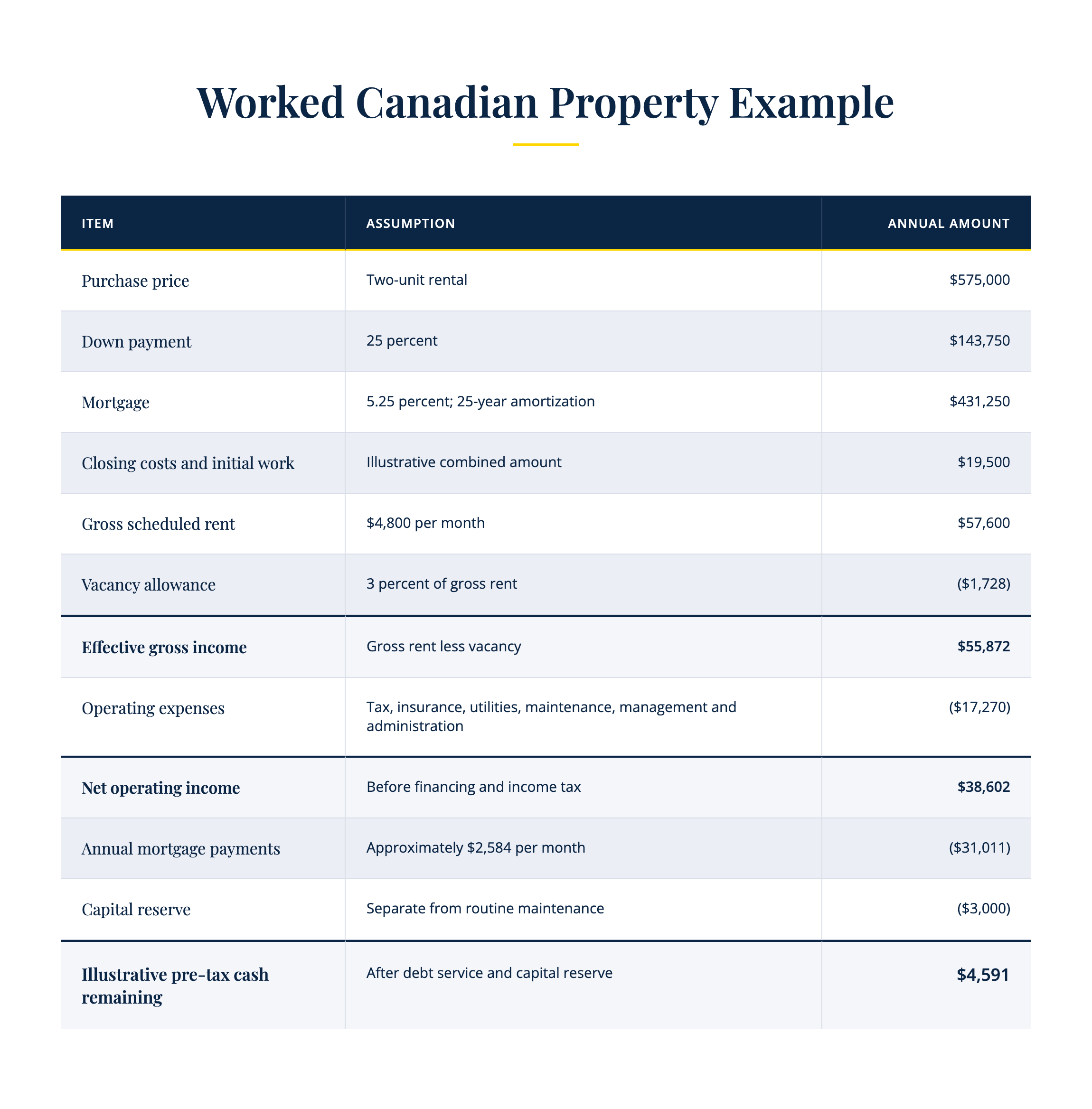
Consider a hypothetical physician evaluating a two-unit rental property in Alberta.
The figures below are illustrative, rounded, and presented before income tax. They are not a forecast or recommendation. Actual financing, insurance, expenses, tenancy rules, and taxes depend on the borrower, property, and jurisdiction.
Cap Rate
Cap rate equals net operating income divided by purchase price.
In this example:
$38,602 ÷ $575,000 ≈ 6.7 percent
Cap rate describes the property’s unlevered operating yield based on the assumptions used.
It does not include mortgage payments, income tax, appreciation or future capital gains.
Cash-On-Cash Return
Initial cash invested is approximately $163,250: the $143,750 down payment plus $19,500 of closing costs and initial work.
Pre-tax cash remaining after debt service and the capital reserve is approximately $4,591.
Cash-on-cash return is therefore about:
$4,591 ÷ $163,250 ≈ 2.8 percent
Principal repayment may add economic value, but it is not spendable cash flow and should not be used to disguise a thin operating margin.
Debt-Service Coverage Ratio
Debt-service coverage ratio, or DSCR, equals net operating income divided by annual debt service.
Here:
$38,602 ÷ $31,011 ≈ 1.24
The property produces about $1.24 of operating income for each $1.00 of scheduled mortgage payment.
That is a cushion.
It is not an invulnerable one.
The example illustrates why gross rent alone tells very little about whether a property strengthens the wider financial system.
A property producing $57,600 of scheduled annual rent in this example leaves approximately $4,591 of pre-tax cash after the stated vacancy allowance, operating expenses, debt service and capital reserve.
The distance between those two numbers is where underwriting lives.
And underwriting is still incomplete until the assumptions are challenged.
10. Stress-Test What Must Remain True
The base case tells you what happens when the assumptions broadly cooperate.
The stress test asks what happens when they do not.
Start with an assumption audit.
What rent level is being assumed?
What rent growth?
What vacancy?
What expense growth?
What insurance cost?
What financing terms?
What future refinancing environment?
What repair burden?
What management performance?
What future sale price?
The more favourable assumptions the investment requires simultaneously, the more fragile the thesis becomes.
Now challenge them.
In the worked example, consider the mortgage renewing at 6.5 percent on the same balance and amortization for illustration.
Annual debt service rises to roughly $34,942.
If vacancy, concessions or operating expenses also worsen, DSCR can fall below 1.0.
The property then requires outside cash.
Now combine the stresses rather than examining them one at a time.
What happens if rents are weaker than expected while insurance rises?
What happens if a major repair arrives during refinancing?
What happens if vacancy increases at the same time the physician wants to reduce clinical work?
What happens if a property manager underperforms precisely when the owner has less time available?
The central question becomes:
What sequence of events could force me to contribute capital, sell at the wrong time, or weaken the rest of my financial system?
For a physician, there is a particularly dangerous answer:
“I can always cover it from billings.”
Perhaps you can.
But the decisive question is not whether clinical income can rescue the property.
It is whether the property still performs the job for which it was purchased.
UNDERWRITING DISCIPLINE
The purpose of the downside case is not to predict disaster. It is to discover whether the investment remains tolerable when reality stops cooperating with the spreadsheet.
11. The Mortgage Is Part of the Investment
Financing is not merely the mechanism used to acquire the property.
It is part of the investment itself.
The mortgage changes cash flow, break-even occupancy, refinancing risk and the investor’s ability to wait through difficult markets.
This is why the question should not be:
How much can I borrow?
It should be:
How much leverage can the overall system survive?
More equity can improve resilience by reducing debt service.
But more equity also increases the amount of capital concentrated in one illiquid asset and reduces liquidity available elsewhere.
Less equity may improve capital efficiency and preserve capital for other purposes.
It can also increase debt service, refinancing sensitivity and vulnerability to weak operations.
There is therefore no universally correct down payment outside the context of the complete balance sheet.
The financing decision must be evaluated alongside household liquidity, property reserves, total debt, other investment opportunities and the physician’s dependence on future professional income.
A mortgage that works only while clinical income remains unusually high may be affordable without being resilient.
Leverage is productive when it supports an asset the system can carry through adverse conditions.
It becomes fragile when continued professional labour is the hidden reserve account.
12. Ownership Structure: Economics First, Structure Second
Canadian physicians frequently ask whether a rental property should be owned personally, through a professional corporation, through another corporation, or through a partnership.
There is no universal answer.
Ownership structure can affect financing, guarantees, legal exposure, administration, tax treatment, access to funds, passive-investment consequences and eventual sale or succession.
The correct sequence is:
Economic first. Structural second.
First determine whether the property is economically sound without relying on a tax advantage.
Then ask qualified Canadian legal and tax advisers to compare viable structures using the physician’s province, corporate arrangement, income mix, financing terms, family situation and intended exit.
The lender and insurer must also confirm what the proposed owner and use permit.
The availability of corporate cash does not, by itself, establish that a corporation should own the property.
Incorporation should not be assumed to create complete liability protection or automatically produce a lower overall tax burden.
The cost and tax consequences of moving an asset later also matter.
The intended ownership structure, assumptions and exit should therefore be reviewed before the offer becomes unconditional.
Tax strategy should improve the efficiency of sound wealth creation.
It should not manufacture the appearance of wealth creation.
A useful test is:
Would I still want this property if the expected tax benefit were smaller than anticipated?
If the answer changes entirely, tax may be doing too much of the investment thesis.
13. Build the Management Architecture
The property and the operating model must be underwritten together.
A deal that works only when your time is valued at zero is not necessarily working.
Self-Management
Self-management offers control and direct market knowledge.
It also creates tenant communication, leasing, bookkeeping, maintenance coordination and compliance work.
It suits an owner who wants the operating role, has local capacity and can respond consistently.
It is a poor default for a physician whose schedule already produces delay, fatigue or resentment.
Professional Management
Professional management reduces daily operating work, but the manager should be evaluated as carefully as the property.
Define leasing standards, maintenance-approval limits, reserve access, reporting frequency, arrears procedures, inspection cadence and termination rights.
Management fees belong in the original underwriting.
They should not appear later as an emergency adjustment when self-management becomes unsustainable.
The owner should review a simple operating dashboard: occupancy, arrears, repairs, cash balance, upcoming renewals and significant capital items.
The progression is:
Do the work → design the system → supervise the system
A mature operating architecture may include reporting standards, reserve policy, maintenance thresholds, capital-expenditure planning, insurance reviews, refinancing calendars, contractor relationships and periodic reviews of whether the original investment thesis still holds.
The goal of ownership is not to eliminate responsibility.
It is to move from personally performing every task toward designing and supervising a system capable of producing reliable information and competent action.
14. From Property One to a Portfolio
The decision to buy property two should not begin with the availability of another down payment.
Property one should first produce evidence.
Is it operating approximately as expected?
Are reserves still adequate?
Is reporting reliable?
Has the time burden been tolerable?
Is the manager effective?
Did the original thesis survive contact with reality?
Did ownership actually improve the broader wealth system?
If the first property has not established operating discipline, a second property can multiply problems faster than it multiplies wealth.
Never scale chaos.
Portfolio risk is also different from individual-property risk.
Several properties can appear diversified while sharing the same vulnerabilities.
They may all be located in one city.
They may serve the same tenant group.
They may rely on one property manager.
They may use the same lender.
Their mortgages may renew during the same interest-rate environment.
They may all depend on the same local economic driver.
One property can represent a large share of investable net worth. Several properties can make that concentration less visible while increasing it.
Measure real-estate exposure against total net worth, liquid assets and total debt—not merely against the size of the real-estate portfolio.
Write the Exit Before Entry
Possible exits include a long-term hold, sale, refinance, transfer, partner buyout or estate transition.
Each depends on market liquidity, financing conditions, transaction costs, tax and timing.
An exit plan is not a prediction.
It is a map of the routes that may remain available when circumstances change.
Further acquisitions should pause when liquidity is shrinking, leverage is rising, reporting is unreliable, management systems are strained, underwriting standards are weakening or another use of capital has become more compelling.
The objective is not accumulation.
It is allocation.
15. Tool Three: The 90-Day Invest, Defer or Decline Protocol
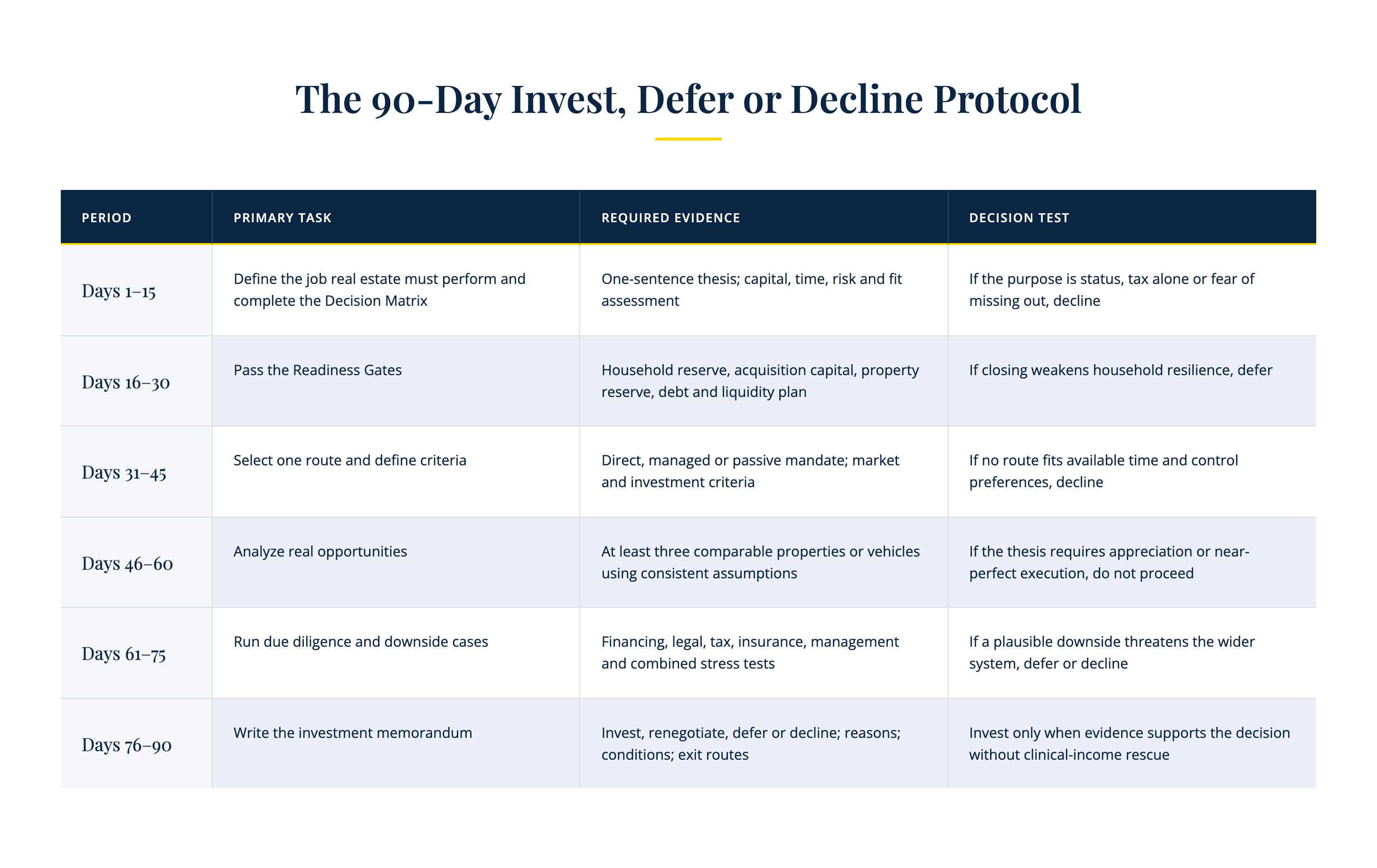
The goal of the next 90 days is a decision.
Not necessarily a purchase.
A disciplined decline is a successful outcome if it preserves capital and attention for a better opportunity.
The protocol converts the ideas in this deep dive into a sequence.
Invest
Proceed when the asset or vehicle fits a written purpose, the assumptions have been independently checked, the downside is survivable, reserves remain intact, the operating model is credible and the acquisition improves the total wealth system.
“Invest” does not mean every uncertainty has disappeared.
It means the remaining uncertainty is understood well enough to be accepted deliberately.
Defer
Defer when the thesis is sound but the timing is not.
Liquidity may be insufficient.
Debt may be too high.
Career or family circumstances may be changing.
Knowledge may still be incomplete.
The available opportunity may simply fail to provide an adequate margin of safety.
A defer decision should name the condition that would reopen the question.
For example: a larger liquidity reserve, lower consumer debt, completion of a career transition, stronger property economics, or a clearer operating arrangement.
Set a review date.
Otherwise “defer” can quietly become “eventually.”
Decline
Decline when the economics depend on optimistic appreciation, the sponsor or manager cannot be adequately evaluated, risks appear poorly compensated, the asset duplicates existing concentration, or real estate does not perform a necessary job in the portfolio.
You do not need to replace every declined property with another property.
Sometimes the correct result of real-estate analysis is to keep the capital liquid.
Sometimes it is to invest elsewhere.
Sometimes the correct result is simply:
No.
That is still an investment decision.
16. From Property Buyer to Capital Allocator
The central shift is from asking whether real estate is attractive to asking whether it is the best use of this capital, at this time, inside this life.
That is the difference between acquisition and allocation.
The Builder asks:
Have I created enough surplus and resilience to invest?
The Investor asks:
Where should my capital go?
The Owner asks:
What systems can produce durable value without requiring my constant intervention?
Real estate can participate in each transition.
It does not define any of them.
Financial Alchemy
The property count is not the measure. The architecture is.
A sound decision should leave the wider system more resilient, productive and less dependent on future clinical effort.
Sometimes direct ownership does that.
Sometimes professionally managed property fits better.
Sometimes the appropriate route is a diversified public vehicle or carefully underwritten private exposure.
Sometimes the most sophisticated real-estate decision is to keep the capital liquid and decline.
The goal is not to be able to say:
“I own real estate.”
The goal is to build a financial system that can support the life the capital is intended to serve.
Real estate should serve the strategy.
The strategy should never be built to justify the real estate.
Build Your Real Investor Operating System
Real estate should strengthen your wealth system, not become another source of professional and financial pressure.
Build the system Real Estate Investor OS
If you are already investing—or intend to build a portfolio—the Real Estate Investor OS is designed to help you organize the decision-making, underwriting, operations and portfolio-management system around it.
Explore the Real Estate Investor OS