The Owner’s Test: Would It Still Pay You If You Stopped Tomorrow?
A physician I know once showed me his net worth statement with quiet pride.
It was impressive.
A practice he co-owned. Two rental properties. A brokerage account. A small stake in a local development project.
Seven figures of assets spread across four categories.
I asked him a simple question:
“If you didn’t work for the next twelve months, what would still arrive in your bank account?”
He paused.
Then he said, “The brokerage dividends. Maybe a few hundred a month.”
The practice paid him well, but largely because he continued seeing patients.
The rentals produced income, but they still required him for repairs, tenants, and bookkeeping.
The development stake might become valuable, but it was not expected to distribute anything for years.
His wealth was real.
So was its dependence on him.
The distinction was not visible on his net worth statement.
He had accumulated meaningful assets. But only a small portion of them could support him without his continued participation.
That is a different measure of financial strength.
A balance sheet tells you what you own. It does not tell you what depends on you.
A balance sheet measures value.
It does not measure dependence.
Two people can have balance sheets of similar size and very different financial lives.
In one case, the assets keep producing income through systems, people, and structures that operate with little day-to-day involvement.
In the other, the owner remains the operating center.
Labor, decisions, relationships, and attention still flow through one person.
On paper, both may appear equally secure.
In practice, one may have far more independence than the other.
You can own a business and still be its most important employee.
You can own real estate and still have created another job.
You can have a large net worth and still depend heavily on your next day of work.
The dependence itself is not necessarily a problem.
The problem is allowing it to remain invisible.
If the objective is eventually to gain more control over your time, then the question is not only how much you own.
It is how much of what you own can function without you.
Capital has more than one job.
Part of the confusion comes from placing different kinds of assets into the same category.
Some assets primarily hold or compound capital.
A growth stock that pays little or no dividend.
Land held for appreciation.
A private investment that reinvests its earnings.
An equity stake that may become much more valuable over time.
Their primary function is to preserve or grow capital.
They may be excellent holdings.
But they may not produce meaningful current income.
Other assets primarily pay you.
A portfolio may distribute dividends or interest.
A rental property may produce net cash flow.
A business may distribute profit.
Their function is different.
They convert ownership into spendable income.
Neither function is inherently superior.
A durable financial system may require both.
The important point is not to confuse one role with the other.
An asset that increases your net worth is not automatically an asset that can support your life.
And an asset that produces cash is not automatically independent of your effort.
That is the second distinction.
You can own something that still owns your time
Consider a business generating several hundred thousand dollars a year.
From the outside, it appears to be a productive asset.
But suppose the owner still handles the largest clients, approves key decisions, solves staffing problems, maintains critical relationships, and intervenes whenever something breaks.
Now remove the owner for twelve months.
Revenue may decline.
Employees may hesitate.
Clients may leave.
Important decisions may stall.
The business produces income, but some portion of that income still depends on the owner’s labor and judgment.
The same pattern can appear in real estate.
A self-managed rental may produce positive cash flow.
But if the owner is still answering tenant calls, finding contractors, reviewing repairs, collecting rent, and solving operating problems, part of that income remains tied to an active role.
This distinction is easy to miss:
You can own something that still owns your time.
That does not determine whether the asset is worth keeping.
It identifies the relationship between the asset and the owner.
The Owner’s Test is designed to make that relationship visible.
The Owner’s Test
Take any asset that is intended to support your future and ask:
If I stopped tomorrow, would it still pay me?
Define stopped seriously.
No clinical shifts.
No client calls.
No approvals.
No tenant problems.
No daily operating decisions.
No stepping back in because something has gone wrong.
Assume you are unavailable for twelve months.
Then evaluate the asset across five dimensions.
1. Cash
Does the asset actually send you money, or does its value primarily exist on paper?
0 — Pays nothing; value is realized only through sale or a future event
1 — Pays irregularly or occasionally
2 — Pays regularly, but modestly relative to its value
3 — Pays regularly and meaningfully after costs
This score does not measure investment quality.
A zero-dividend index fund may be an excellent long-term holding and still score low here.
The purpose is to identify the function the asset serves.
2. Time
How much of your ongoing effort does the asset require?
0 — Requires your time every week to keep producing
1 — Requires you several times a month
2 — Requires you a few times a year
3 — Requires none of your time essentially
This category separates income generated by ownership from income still supported by labor.
3. Decisions
How much operating judgment still routes through you?
0 — Daily decisions depend on you
1 — Routine decisions regularly reach you
2 — Others handle routine decisions; you handle exceptions
3 — Systems or capable people handle operations; you mainly set direction
An asset can require relatively little time and still remain highly dependent on your judgment.
A business that calls only twice a month may still depend heavily on the owner if those calls contain the decisions no one else can make.
The issue is not only time dependence.
It is decision dependence.
4. Systems
Can the asset function through documented processes and capable people rather than your memory and personal effort?
0 — The process largely lives in your head
1 — Some systems exist, but you remain the backup for most failures
2 — Processes and people can run things with occasional oversight
3 — The system has repeatedly operated without you
This is often where hidden dependence becomes most visible.
There is an important difference between:
I could delegate this.
and:
This already works without me.
One describes possibility.
The other describes evidence.
5. Continuity
Finally:
What happens to the payments if you disappear for twelve months?
0 — Payments stop within weeks
1 — Payments decline noticeably within months
2 — Payments continue, but at a reduced level
3 — Payments continue at close to full strength
This is the stress test.
Not:
Could this theoretically function without me?
But:
Has it been built in a way that allows it to continue without me?
Add the five scores.
The result will fall somewhere between 0 and 15.
How to read the score
The score is a diagnostic, not a ranking.
It does not tell you whether an asset is good or bad.
It tells you how dependent that asset currently is on your labor, judgment, and continued participation.
A rough interpretation:
0–5: Capital holder or job in disguise
The asset may store value or produce income, but it remains heavily dependent on your effort or a future realization event.
6–10: Partially independent
The asset produces something for you, but meaningful dependence remains. That dependence may be reduced over time through systems, delegation, management, or restructuring.
11–15: Owner-grade
The asset produces cash and operates with relatively little dependence on your ongoing labor or judgment.
The purpose is not to make every asset score 15.
Some assets are meant to compound rather than distribute.
Some investments are intentionally illiquid.
Some businesses are worth owning even when the owner chooses to remain actively involved.
The relevant question is not whether every asset can become fully independent.
It is whether you understand the role each asset is playing.
The Owner’s Test is a diagnostic, not an optimization target.
It clarifies function.
And once function is clear, better decisions become possible.
Return to the physician.
Suppose the physician from the beginning of this essay scored his portfolio like this:
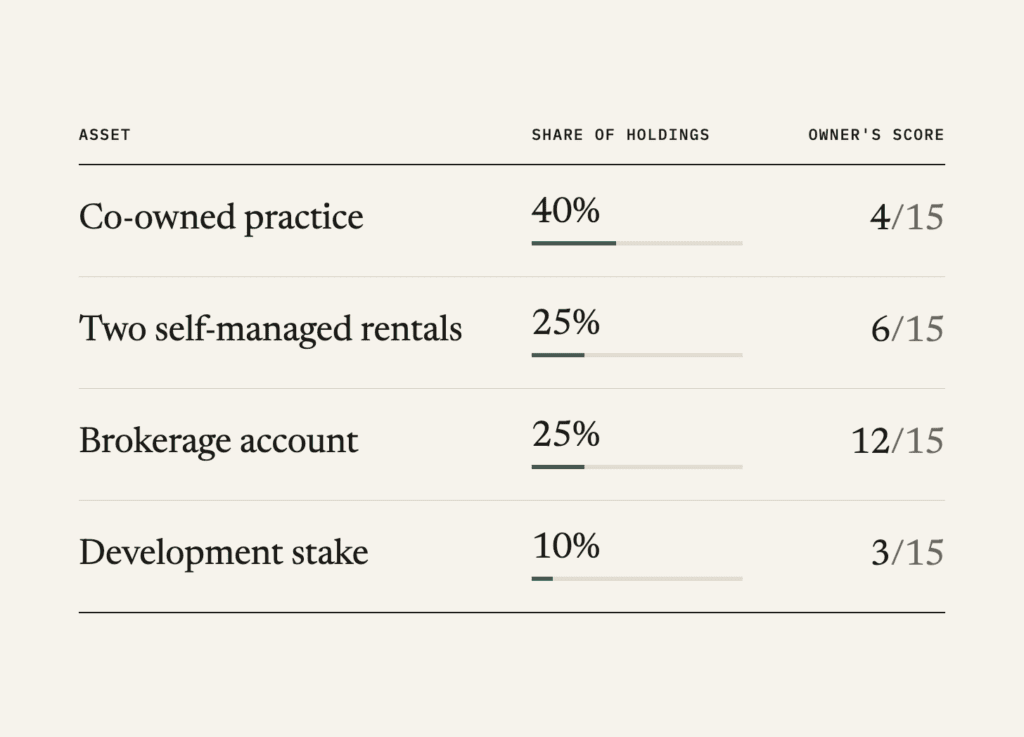
We can then weight each score according to how much of his portfolio it represents:
(0.40 × 4) + (0.25 × 6) + (0.25 × 12) + (0.10 × 3) = 6.4
His portfolio-weighted Owner’s Score is 6.4 out of 15.
That number is not a verdict.
It is a clearer description of the structure.
His wealth is substantial, but much of it still depends on his continued labor, involvement, or a future liquidity event.
Once that becomes visible, the next question changes.
Not:
What should I buy next?
But:
How can what I already own become less dependent on me?
Perhaps the answer is a property manager.
Perhaps it is better operating systems in the practice.
Perhaps another partner begins taking responsibility for decisions that still flow through him.
Perhaps nothing changes immediately, but future savings are directed more intentionally toward assets that already function with greater independence.
The point is not that one response is correct.
The point is that the trade-off is now visible.
And independence often has a cost.
Hiring a property manager may reduce cash flow.
Building a management layer in a business may compress margins.
Creating redundancy may reduce short-term efficiency.
Those costs do not automatically make the change worthwhile.
They clarify what is being exchanged.
In some cases, accepting a lower return in exchange for less dependence may be entirely rational.
In others, the owner may reasonably choose to remain involved.
The Owner’s Test does not determine the decision.
It makes the trade-off visible.
The question changes before the portfolio does
Most investors are trained to ask:
What should I buy?
That remains an important question.
But over time, another becomes equally important:
How much of what I already own can function without me?
That question changes the way a portfolio is understood.
The portfolio is no longer only a collection of valuations.
It is also a collection of systems.
Some require your labor.
Some require your judgment.
Some require your relationships.
Some require very little from you.
Once that distinction is visible, the next dollar can be assigned more deliberately.
You may still choose growth.
You may still build a business that requires years of active effort.
You may still own property that you prefer to manage yourself.
The relevant issue is not whether those choices are right or wrong.
It is whether they are deliberate.
Are you accumulating capital?
Creating cash flow?
Building independence?
Those objectives can overlap.
They are not the same.
Return to the central question.
Imagine that tomorrow you became unable—or simply unwilling—to work for twelve months.
No salary.
No operating role.
No client work.
No rescue missions.
No “just checking in.”
Then ask:
Which of your assets would keep paying you at close to full strength, and what percentage of your wealth do they represent?
The answer may be higher than expected.
It may be lower.
Either way, the result is useful because it reveals where dependence exists.
Once dependence becomes visible, it can be evaluated.
You can keep it.
Reduce it.
Build systems around it.
Diversify away from it.
Or deliberately accept it because the return, enjoyment, or long-term opportunity justifies the involvement.
The aim is not to remove yourself from every asset you own.
It is to know which assets depend on you, which do not, and whether that dependence is deliberate.
The goal is not passivity.
It is not to stop working.
It is to make effort increasingly discretionary rather than structurally mandatory.
To reach a point where continued work becomes more of a choice and less of a requirement built into everything you own.
Wealth measures what has been accumulated.
Ownership also asks how much of that accumulation can function independently.
That is the work of ownership.
Try the Owner’s Test
Take your three largest financial or business assets and score each one across:
Cash. Time. Decisions. Systems. Continuity.
Score what exists today.
Not what you hope to build.
Not what you could delegate one day.
“I could hire someone” describes a possibility.
“Someone has successfully run this without me” describes evidence.
The difference matters.
If one asset is especially difficult to score, spend more time there.
Uncertainty itself may reveal where the dependence is still hiding.
Next: Take the Stewardship Audit to examine how your wider financial system supports—or fails to support—a more ownership-based life.
Read next: Capital Deployment Architecture: Give Every Surplus Dollar a Job.
This essay is for general educational purposes and is not individualized financial, tax, legal, or investment advice. Businesses, corporations, rental properties, securities, and private investments involve risks and considerations that vary by person and jurisdiction. Consult appropriately qualified professionals before making decisions based on your individual circumstances.