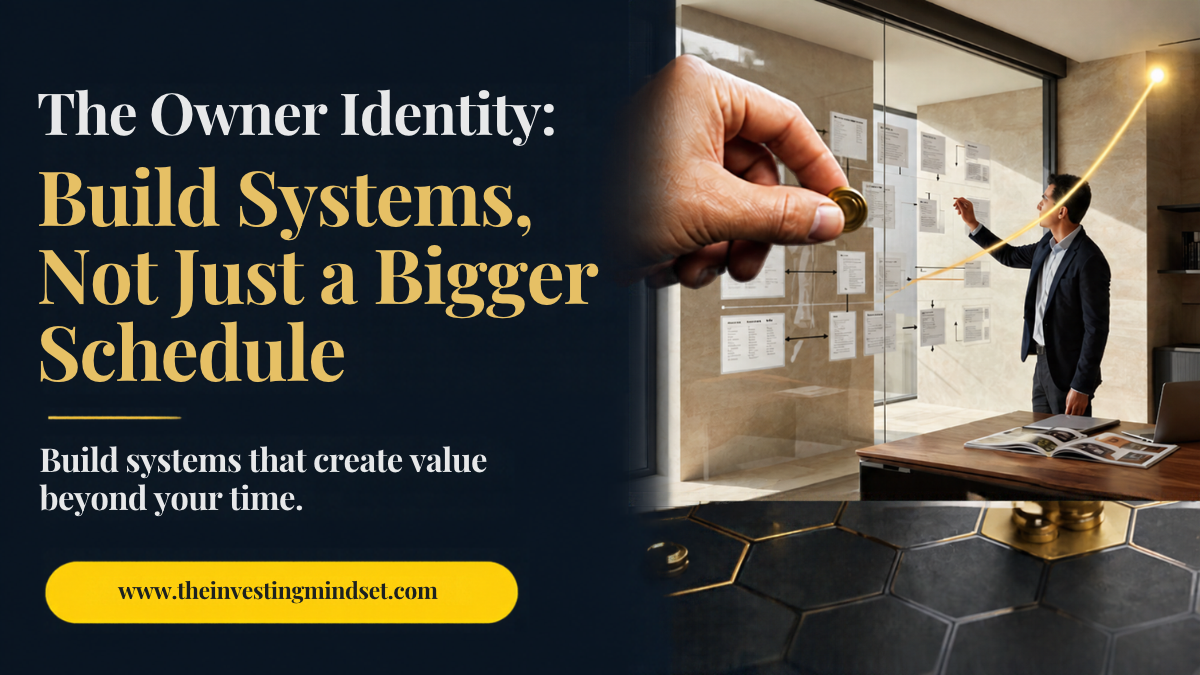
The Owner Identity: Build Systems, Not Just a Bigger Schedule
A full schedule proves your expertise is valuable. Lasting ownership needs structures that create value beyond your personal time.
Dr. R is a composite physician. Her story will sound familiar to many people who have built a successful career.
She was a partner in a busy family practice. Her patients trusted her. She invested every month. She owned a rental property and had a growing portfolio.
She also enjoyed medicine. She valued her patients and found real meaning in clinical work.
By most measures, she had done nearly everything right.
Then her mother became seriously ill in another province. Dr. R wanted to spend six weeks with her.
When she looked closely at her working and financial life, she saw how hard that would be.
Her clinical income depended on her being there. Many clinic decisions still needed her approval. Staff scheduling, purchasing and daily problems kept finding their way back to her desk. Even the rental property needed her now and then.
None of these duties was heavy on its own. Together, they formed a structure that could not run well without her.
She took eight days.
What unsettled her was not that she had to work. She loved her work.
It was that she had built real assets without building the freedom she thought those assets would bring.
She owned a great deal. But much of what she owned still depended on her.
The problem was not her income or her schedule. It was the absence of systems that could protect her choices when she was not available.
That is the heart of the Owner stage in Financial Alchemy. And it raises a question worth asking at any point in a successful career:
What have I built that still depends on me?
When Professional Success Creates Dependence
Medicine trains us to be very good at what we do.
We build judgment through years of study and responsibility. We learn to solve hard problems, act under uncertainty and own the results.
These qualities are essential to good care. They also make physicians valuable.
The better we get, the more patients want us. Our reputations grow. Our schedules fill. Our income usually rises.
So we link that rising demand with success. In many ways, it is.
The trouble starts when we assume that more productivity creates more financial independence. It does not.
- A physician can double their income and still depend fully on showing up to earn it.
- A practice can hire more people and still need the physician-owner to approve almost every decision.
- A growing property portfolio can build wealth and also create a second demanding job.
The professional becomes more successful. The structure underneath still depends on their personal effort.
We can call this the High-Income Dependency Loop:
- Expertise creates demand.
- Demand raises income and responsibility.
- More responsibility means more decisions, interruptions and duties that need you personally.
- The workload leaves less time to build the systems that could reduce those demands.
Success starts to reinforce owner dependence. It is a close cousin of the Financial Fragility Loop: the money looks strong while the structure stays fragile.
Three familiar professional instincts keep the loop running.
Competence. We are capable problem-solvers. Doing a task ourselves often feels faster than teaching someone else.
Control. We link responsibility with personal supervision. Handing work over can feel uncomfortable, even when someone else could do it safely.
Identity. For years, we have measured our worth by what we personally do. It can be hard to value work that happens without us.
These instincts are not flaws. In clinical settings, many are real strengths. But applied to every business and admin task, they turn the owner into the bottleneck.
This is owner dependence, and the result is a paradox. The physician becomes indispensable to the very structure that was meant to give them independence.
Want to see how much of your wealth would keep paying you without you? The Owner’s Test scores each asset. This article picks up where that test leaves off: how to reduce the dependence it reveals.
A full schedule is evidence that your expertise is valuable. It is not evidence that you have built durable ownership.
From Expert Operator to Systems Architect
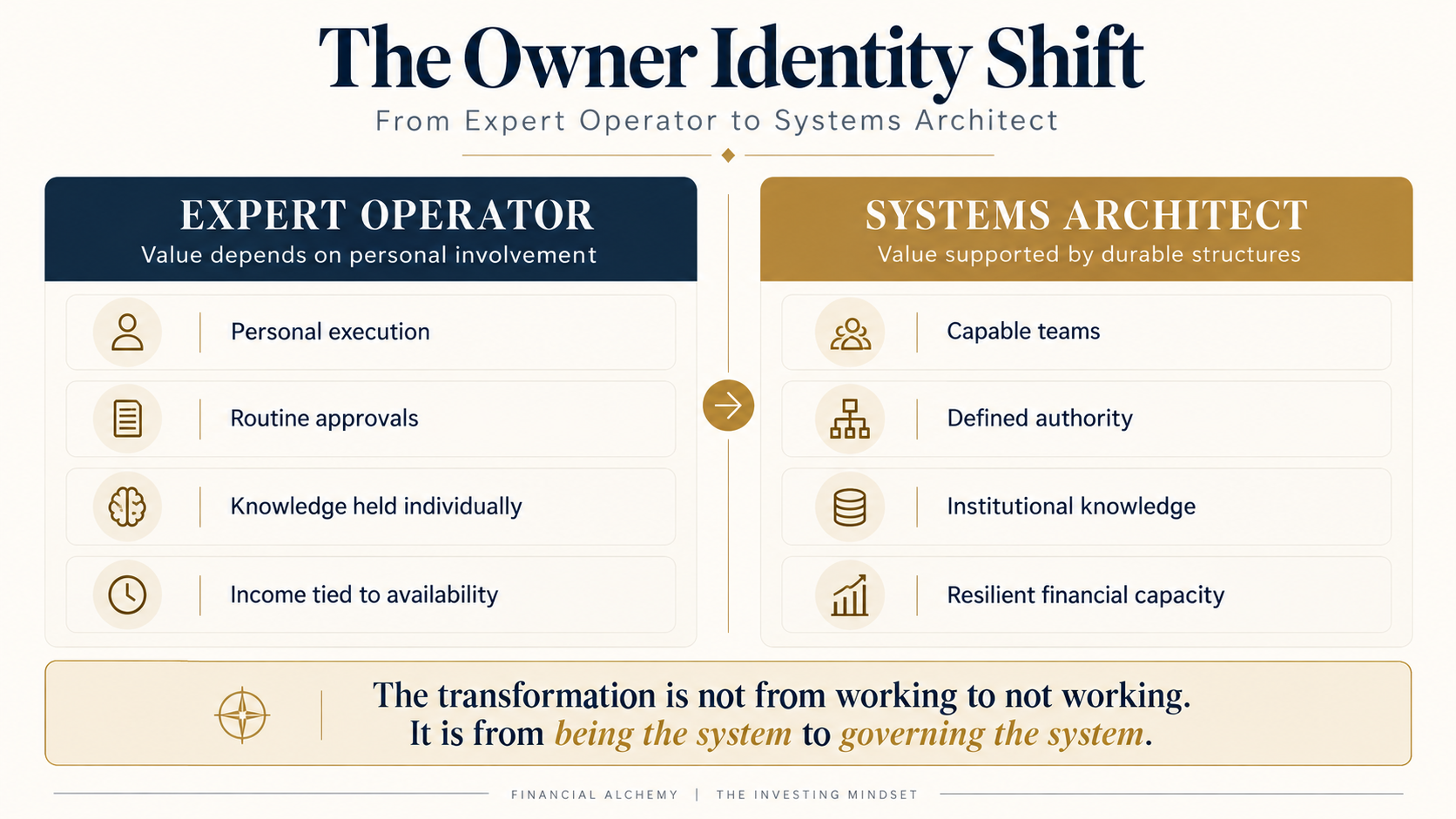
Financial Alchemy describes wealth-building in four connected stages. Each stage asks a different question.
- The Earner asks: How do I increase what I earn?
- The Builder asks: How do I keep and protect more of what I earn?
- The Investor asks: How do I make my capital work well?
- The Owner asks: How do I build systems that protect my choices beyond my personal effort?
These stages do not rank wealth or achievement. They describe different relationships between effort, money, capital and time.
The Earner learns to create value. The Builder keeps some of it. The Investor turns surplus into productive assets. The Owner builds the systems that let those assets keep creating value without constant personal effort. (The Owner Path walks through this stage in full.)
This is a shift in identity before it is a change in operations.
A skilled physician is trained to ask: How can I do this work very well?
An Owner adds a second question: What must I build so the value of this work lasts beyond my personal availability?
That question changes how we think about success. The goal is no longer only to be more productive. It is to build productive capacity: people, processes and capital that keep producing value inside a well-run structure.
Think of the difference between an operator and an architect.
An operator keeps the work moving through personal effort. An architect designs the structure through which the work continues.
A building does not stay up because its architect holds it up every day. It stands because the structure was designed to carry the load.
Durable ownership works the same way. An Owner does not give up responsibility. An Owner learns to exercise it through systems rather than constant personal intervention.
This matters most in medicine. Clinical judgment, patient safety and continuity of care remain core duties. The aim is not to make physicians interchangeable or remove human judgment. It is to save scarce judgment for work that truly needs it.
Ownership matures when your effort produces more than today’s results. It starts building the structure that supports tomorrow’s.
Systems Before Scale: Why Hiring Alone Doesn’t Buy Freedom
When professionals hit the limits of their time, the first instinct is often to expand. Hire another person. Add a clinic. Buy another property. Install new software.
Sometimes that is exactly right. But expansion does not create independence by itself. A bigger organization can become more dependent on its owner if its operating structure has not grown with it.
Take a physician-owner who hires a practice manager. The idea is sound: hand routine admin to someone with the skill and time to run it.
Now suppose the manager has no clear authority. Purchasing still needs approval. Staff questions still move upward. Financial reports are inconsistent. Nobody knows which decisions the manager can make alone.
The physician now has another employee, but not more freedom. The manager may simply become one more person waiting for instructions.
Technology has the same trap. Automating a poorly understood process rarely creates a strong system. It may just make a confused process run faster.
So the Owner works in a different order:
- Define what should happen. What outcome are we trying to reach?
- Set the standard. How will we know the work was done well?
- Assign responsibility and authority. Who does the work, who decides, and when do they escalate?
- Automate what is safe and repeatable. Technology helps most when it supports a process that is already well designed.
In a practice, this might mean written admin workflows, regular financial reporting, staff onboarding, purchasing limits or clear escalation steps. Clinical decisions stay with qualified professionals, and patient-safety and regulatory duties stay in place.
Systems do not remove responsibility. They make it more deliberate, visible and sustainable. When systems are designed well, they start to reduce the organization’s unnecessary dependence on the owner.
That is where the Five Transfers come in.
The Five Transfers of Durable Ownership
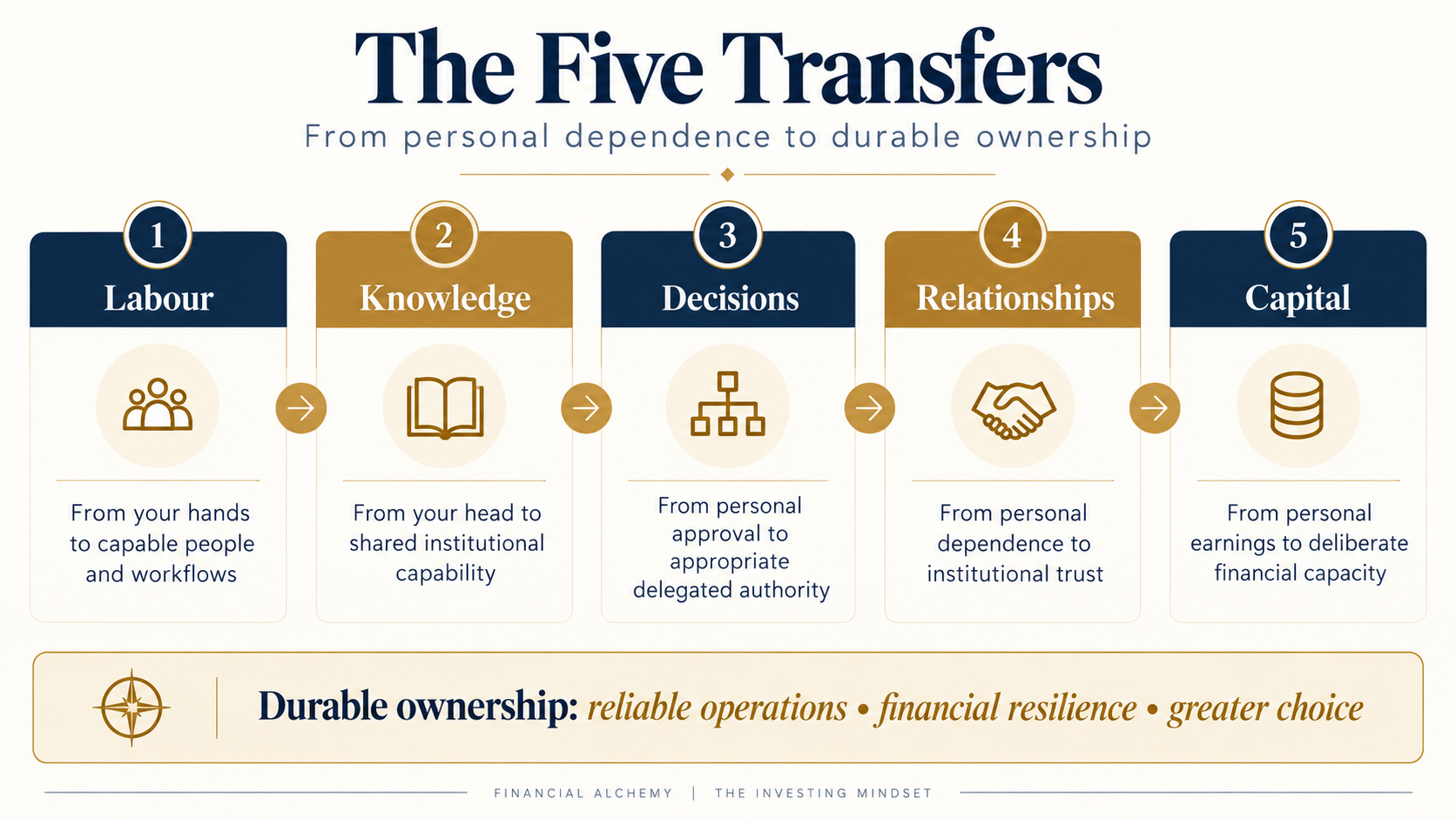
The move from expert operator to systems architect rarely happens in one dramatic step. It happens through a series of deliberate transfers.
Each transfer moves a task, skill or dependency away from you and into a more durable structure. Together, they show what you have built, and what still depends on you.
| Transfer | From | To | The choice test |
|---|---|---|---|
| 1. Labour | Your hands | Capable people and workflows | Could I reduce clinical days or step away without everything unravelling? |
| 2. Knowledge | Your head | Shared, written capability | Could a competent colleague run this process to standard without me explaining it each time? |
| 3. Decisions | Your personal approval | Clear delegated authority | How many weekly decisions reach me because they need my judgment, and how many because nothing else exists? |
| 4. Relationships | Trust in you alone | Trust in the organization | Would patients, colleagues and staff stay confident if I stepped away with proper coverage? |
| 5. Capital | Personal earnings | Deliberate financial capacity | Is the value I create becoming capacity that lasts beyond my working hours? |
Transfer 1: Labour, From Your Hands to Capable People and Workflows
The first transfer covers work that still needs your direct involvement.
For physicians, this needs care. Clinical income is often tied to personal patient care, individual billing and professional duties. Not every part of clinical work can or should be delegated.
Nor is cutting clinical time always the goal. A physician may truly prefer to practise four or five days a week. The question is whether that schedule is a choice or a financial and operational necessity.
Labour capacity might mean strong admin staff or the right clinical colleagues. It might also mean assets that earn outside your own billing.
The choice test: Could I reduce my clinical days, or take proper time away, without my financial and operational structure unravelling?
Transfer 2: Knowledge, From Your Head to Shared Capability
Many organizations run on knowledge that lives only in the owner’s memory. You know how an admin problem is handled and which supplier to call. You know what matters in a report and how old issues were solved.
While that knowledge stays personal, the organization stays dependent.
Written steps, checklists and training help capable colleagues act the same way each time. Knowledge becomes an asset of the organization instead of a bottleneck in one person.
The choice test: Could a competent colleague carry out this process to the expected standard without me explaining it every time?
Transfer 3: Decisions, From Personal Approval to Delegated Authority
For many physician-owners, this is the most important transfer.
An organization cannot become independent if every routine decision needs the same person’s sign-off.
Good delegation spells out which decisions others can make alone, and within what limits. It also says when an issue comes back to you. A clinic manager might approve routine non-clinical purchases within an agreed budget. Staff might resolve common admin problems through clear procedures.
The physician-owner still owns governance, standards and oversight. They just no longer resolve every ordinary operating question in person.
The choice test: How many decisions reach me each week because they truly need my judgment, and how many reach me only because no other decision structure exists?
Transfer 4: Relationships, From Personal Dependence to Institutional Trust
Professional relationships are among a physician’s most valuable assets. Patients trust the care they receive. Staff rely on leadership. Colleagues value sound judgment.
But an organization is fragile when all confidence rests on one person.
Durable ownership needs trusted teams, steady standards and clear continuity plans. This does not replace the physician-patient relationship with a faceless institution. It builds a place where patients stay well cared for and colleagues can use good judgment. Staff know how things work, even when the owner is away.
The choice test: Would patients, colleagues and staff stay confident in the organization’s care and operations if I stepped away for a period, with proper coverage in place?
Transfer 5: Capital, From Personal Earnings to Deliberate Financial Capacity
The fifth transfer links the operating side of ownership to its financial purpose.
Revenue is not wealth. And wealth does not create freedom if every new asset adds duties that need your time.
A durable ownership structure turns income into surplus, reserves and productive capital, on purpose. This is the job of the Surplus Conversion Engine. Some surplus may fund operating reserves. Some may pay for better systems or leadership. Some may go into diversified investments or other assets that suit your situation. Capital Deployment Architecture shows how to give each dollar of surplus a clear job.
The key shift is from reactive money decisions to a deliberate allocation system. Capital starts supporting your future choices instead of just funding more activity.
The choice test: Is the value I create being turned into financial capacity that can last beyond my working hours?
How the Five Transfers Work Together
The transfers are connected. Capable people need accessible knowledge. Written knowledge supports clearer decisions. Good decisions build trust. Trust and reliable operations improve continuity. And capital funds the people, systems and resilience that durable ownership needs.
None of this requires a large enterprise. Picture a physician with a modest practice, sound finances and a well-run portfolio. They may have more real freedom than someone who owns several businesses that need constant attention.
The goal is not scale for its own sake. It is to reduce unnecessary dependence while protecting the value, quality and purpose of what you have already built.
The 30-Day Absence Test
Here is a simple way to examine the architecture of your working and financial life.
Imagine stepping away from your ordinary operating duties for thirty days.
You are not abandoning patients or professional duties. Clinical coverage is arranged. Qualified people remain responsible for patient care. Required oversight, governance and regulatory duties continue.
You are simply unavailable for the routine stream of admin and operating questions.
What happens?
- Do ordinary decisions still get made?
- Can capable colleagues follow established processes?
- Are financial obligations met?
- Can the organization keep its standards without your constant involvement?
- Can you understand its financial and operating condition from reliable information?
- When you return, is your contribution needed because your expertise adds value, or because daily operations cannot run without you?
The answers show where dependence still sits. They might reveal a clinic with great clinicians but weak admin. They might expose a property portfolio that has quietly become another full-time job. Or they might show that your systems are sound but your finances still lean heavily on continued clinical earnings.
None of these findings is a failure. Each is information about what to build next.
Want a structured version of this exercise? The free Stewardship Audit scores your finances, assets, identity and systems. It shows where your life still leans on your personal effort.
A successful owner does not need to become unnecessary. But an owner should know the difference between being valuable and being structurally indispensable.
Build One System Before Adding Another Obligation
Durable ownership rarely comes from one big redesign. It usually grows from many small structural decisions.
Step 1: Keep a two-week dependency log. Each time a problem, question, approval or admin task needs your personal attention, write it down.
Step 2: Sort the log by the Five Transfers.
- Is the problem that only you know how something works? (Knowledge)
- Is there a capable person who lacks clear authority? (Decisions)
- Are you doing recurring tasks that could be standardized? (Labour)
- Is your capital creating more admin work than productive capacity? (Capital)
Step 3: Choose one recurring non-clinical dependency. Document the process, clarify who is responsible, set decision limits, and decide how results will be monitored.
Step 4: Test it. Let it run without you and check the results.
Step 5: Automate only once it is dependable.
The aim is not to remove every interruption. It is to save your involvement for the work where your judgment, expertise and leadership truly matter.
Each successful transfer makes the organization a little less fragile. Each reliable system adds a little more capacity. Over time, that capacity changes the choices open to you.
Putting It Together: The Freedom to Remain
Return to Dr. R.
After her mother’s illness, she began examining the ordinary dependencies built into her working life. She found that most of her daily admin involvement came from a few recurring issues: scheduling decisions, purchasing approvals, and questions that written procedures and clear authority could have resolved.
She worked with her clinic partners to strengthen roles and set up proper patient coverage. Competent colleagues got more authority, within clear limits. She also arranged professional management for her rental property.
None of this removed her responsibilities. It changed how they were supported.
When her mother needed her again the next spring, Dr. R spent six weeks with her. Her patients were well cared for. The clinic kept running. Her assets stayed in place.
When she came back, she returned to practising four days a week. Not because the system demanded every available hour. Because she wanted to.
That is the deeper purpose of the Owner identity.
Not everyone wants to own several clinics. Not every physician wants to cut clinical work. And not every professional needs an institution that runs entirely without them.
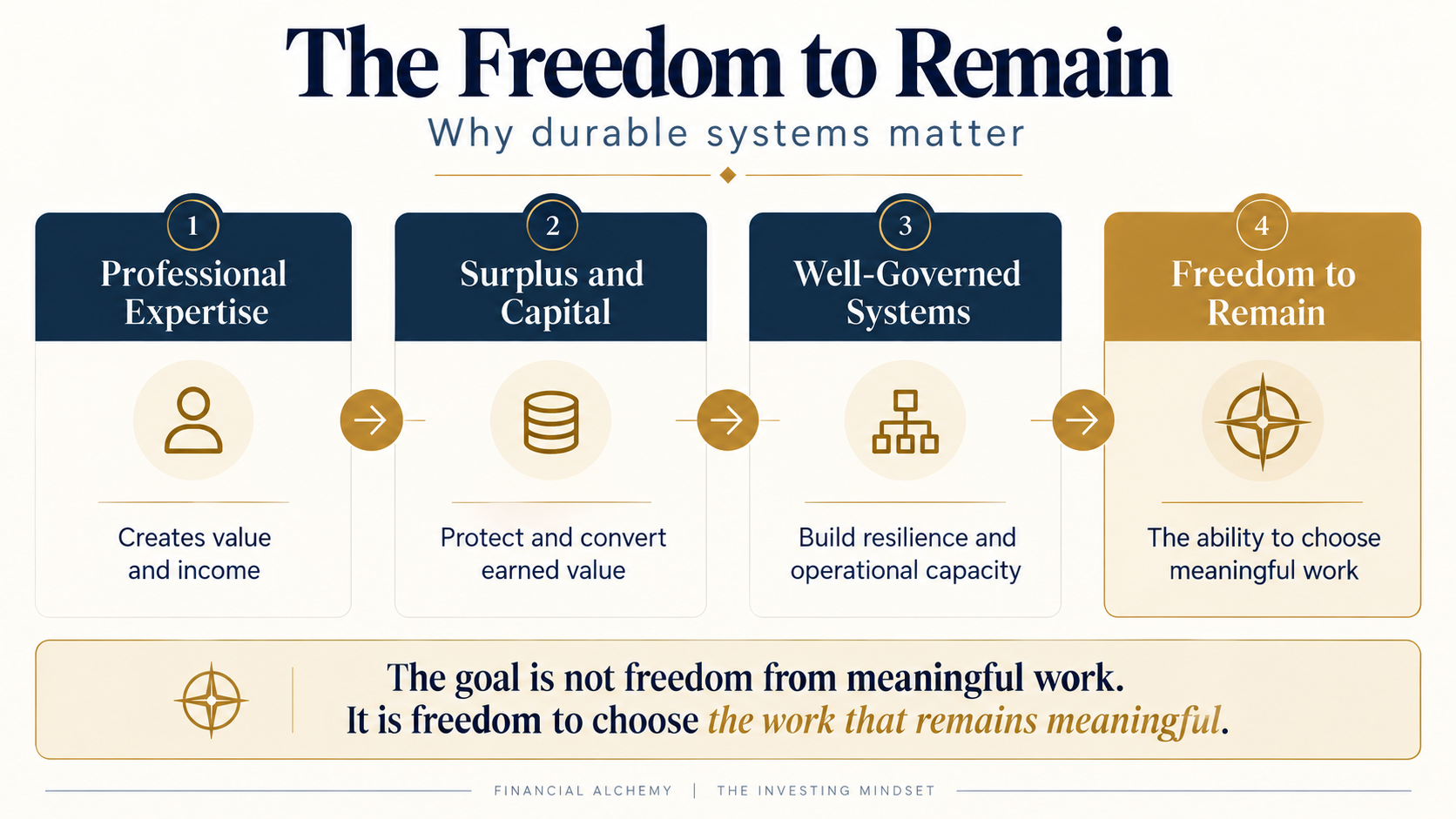
The purpose of ownership is not endless expansion. It is deliberate conversion:
- income into surplus,
- surplus into productive capital,
- expertise into organizational capability,
- personal responsibility into well-governed systems,
- and those systems into more freedom over your time, talent and money.
This is Income → Ownership → Freedom in practice.
In the previous essay, Financial Independence Is Not Retirement. It Is Negotiating Power, we explored how financial independence changes the terms on which you choose to work. The Owner stage extends that idea. Money can give you negotiating power. Durable systems make those choices workable in practice.
Without reliable systems, you can hold real wealth and still be bound by the duties you have built up. With the right structures, your participation becomes more deliberate.
You may choose to practise more. You may choose to practise less. You may choose to mentor, teach, lead, invest, or give more attention to family and community. You may even turn down an attractive expansion because the added complexity would cost more freedom than it creates.
These are not just lifestyle preferences. They are expressions of ownership. Ownership is not measured by the size of what you control. It is measured by how long your value lasts, and by the choices it makes possible. It is what makes the Freedom to Remain real: practising because the work matters, not because the structure demands it.
Your schedule can make you successful. Your expertise can make you indispensable. Your income can make you comfortable. None of these, alone, creates durable ownership.
A full schedule is one way to create value. A durable system is how that value begins to outlast the schedule.
Not sure yet whether you are at the Owner stage? The free Financial Clarity Diagnostic shows your stage and your most important next move.
A Question to Consider
Look at the practice, assets, responsibilities and professional relationships you have spent years building.
What have you built that still depends on your constant personal involvement, and what would become possible if that dependence were reduced?
The answer may reveal the next system worth building.
This article is educational and is not individualized financial, investment, tax, legal or clinical-practice advice. Delegation, clinical coverage and organizational systems must be designed in line with your professional obligations and patient-safety standards.