
The Fragility Problem: Why Your Income Alone Cannot Save You
Daniel spent eleven years becoming one of the best orthopedic surgeons in his city.
His referrals came from other surgeons—the kind of reputation that takes years to build. His income reflected it. In his strongest years, he earned seven figures.
From the outside, Daniel appeared financially secure.
Then a weekend fall tore his rotator cuff.
For eight months, he could not operate.
His knowledge had not disappeared. His judgment was intact. His reputation remained. The years of training were still there.
What changed was his ability to convert that expertise into income.
For a period of time, the financial value of his professional skill became inaccessible.
That experience revealed an important distinction.
Daniel had exceptional earning power.
But earning power and financial resilience are not the same thing.
That distinction sits at the heart of the Investor stage.
The Fragility Hidden Inside a High Income
There is a form of financial vulnerability that can exist alongside significant professional success.
It is easy to overlook because, while everything is working, the structure may appear very strong.
The income is substantial.
The career is established.
The lifestyle is comfortable.
Retirement accounts are growing. Investments are accumulating. Family obligations are being met. The future may feel increasingly secure.
And yet a large part of the financial structure may still depend on one important variable:
Your continued ability to work and produce income.
This is the fragility problem.
A high income creates significant financial capacity. But income alone does not necessarily create financial resilience.
If much of your lifestyle, savings, debt structure, and future planning still depends on continued labor, expertise, health, position, or business involvement, then part of that financial security remains connected to your ability to keep producing.
This is not inherently a problem.
For most people, active income is the primary engine of wealth creation.
The important question is what happens to that income once it arrives.
At some point, the question begins to shift from:
How much can I earn?
to:
What am I building that can continue supporting me if my ability or desire to work changes?
Income Is Raw Material
Financial Alchemy makes an important distinction between income and wealth.
Income is a flow.
It arrives because something is being exchanged for it: your time, expertise, judgment, labor, leadership, reputation, or involvement in a business.
Income matters enormously.
It creates options.
It gives you the raw material from which financial capacity can be built.
But income and wealth are not quite the same thing.
Wealth is the portion of that financial capacity that has been accumulated and converted into assets, reserves, and systems capable of supporting you beyond the next period of work.
That distinction matters because two households with very different incomes may have very different levels of resilience.
A professional earning $700,000 a year may have considerable earning power but still depend heavily on that income continuing uninterrupted.
Someone earning substantially less may have accumulated enough capital, maintained lower fixed obligations, or created greater financial flexibility.
The paycheck alone does not tell us which household is stronger.
The more useful question is what happens after the income arrives.
How much is consumed?
How much is committed to recurring obligations?
How much is retained?
And how much is gradually converted into capital that can exist independently of the next year of work?
Income gives you resources. Wealth gives you resilience.
The Investor begins to recognize the difference.
Why High Earners Can Overlook the Problem
A larger income often makes financial life easier.
It allows for a better home, more travel, educational opportunities, professional flexibility, generosity, and a wider range of choices.
Those are genuine benefits.
At the same time, higher income can gradually support larger recurring commitments.
The pattern may look something like this:
Higher income → greater spending capacity → larger commitments → continued reliance on future income.
There is nothing unusual about this.
It is simply how lifestyle and income often grow together.
The important point is that a larger financial life is not automatically a more resilient one.
A substantial income tells you that your work is economically valuable today.
It does not, by itself, tell you how well the financial structure could absorb a change in your ability to produce that income tomorrow.
That distinction becomes especially relevant for highly trained professionals.
A surgeon may have spent decades developing an unusually valuable technical skill.
An executive may possess rare leadership experience.
An entrepreneur may have built deep knowledge of a particular business or market.
These are extraordinary forms of human capital.
But they remain human capital.
And human capital is connected to health, energy, opportunity, and circumstance.
A surgeon’s hands can be injured.
An executive’s role can change.
A founder may need time away from a business.
A physician may decide that a demanding clinical schedule is no longer sustainable.
A family responsibility may require a temporary reduction in work.
None of these possibilities needs to be treated with alarm.
They are simply reminders that active income is connected to conditions that can change.
The purpose of financial planning is not to predict every change.
It is to create enough resilience that change does not automatically become a financial crisis.
The Income Dependency Test
One useful way to think about financial resilience is to examine each major source of income along two dimensions.
First:
Does this income require my ongoing labor, body, or time?
Second:
Does it depend heavily on a single employer, client, business, contract, or economic source?
Those two questions can help reveal four broad categories.
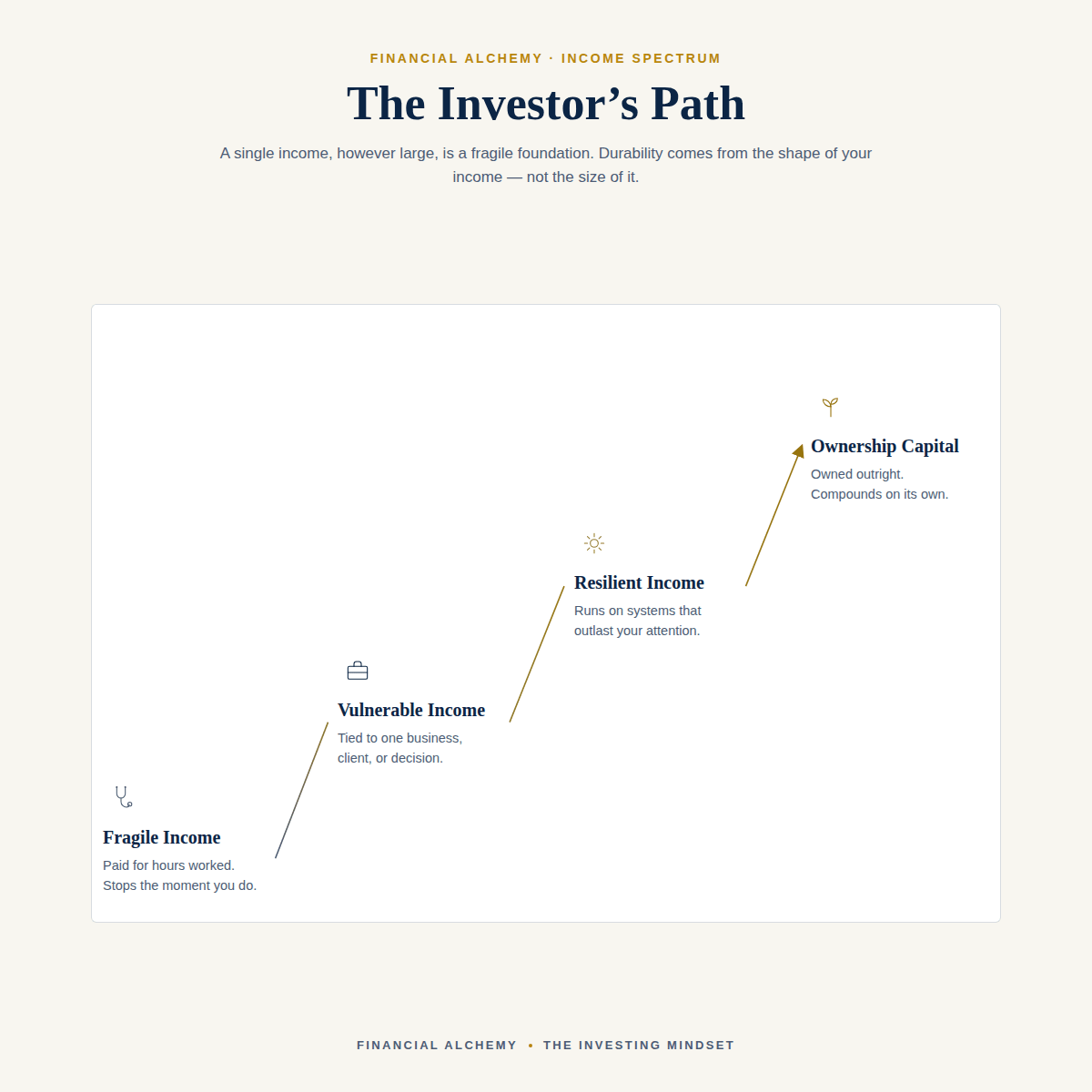
Fragile Income
This income requires your continued labor and is concentrated around a single source.
A salaried physician employed by one hospital system is a good example.
The compensation may be substantial. The employment may be stable. The work may be meaningful.
But the income still depends primarily on one person’s capacity to work within one system.
Vulnerable Income
This income still requires your labor, but is less dependent on a single payer.
A consultant with multiple clients or a physician doing locum work may have more flexibility and diversification.
The loss of one employer or contract may not eliminate all income.
But the income still depends substantially on continued work.
Resilient Income or Capital
Here, dependence on your daily labor has declined, although concentration may remain.
Perhaps you own a business that operates through systems and employees but relies heavily on one major contract.
Perhaps you hold a meaningful ownership interest in a single company.
Your labor is no longer the only source of support, but the structure may still depend on one economic source.
Ownership Capital
This is capital whose existence does not require your continued labor and is distributed across multiple sources.
It may include diversified investments, retirement capital, ownership interests, liquidity reserves, income-producing assets, or businesses that can operate without your constant involvement.
None of these is without risk.
That is not the goal.
The goal is to build financial capacity that does not disappear simply because your ability to work changes.
Over time, that is the direction of the Investor stage.
Not necessarily from work to no work.
But from dependence toward greater optionality.
Free Worksheet
How much of your life depends on your career staying exactly as it is?
The Career Margin of Safety Worksheet takes 45 to 60 minutes. It maps your exposure and shows what to build, so a career shock does not become a financial one.
Get the free worksheet →The Builder Is an Important Transition
The movement begins earlier.
The Earner is primarily supported by income.
Work produces money, and money sustains life.
The Builder begins retaining a portion of that income.
Spending becomes more intentional.
Surplus develops.
Savings accumulate.
Financial systems begin to take shape.
This is important progress.
The Builder asks:
How much can I consistently retain?
The Investor begins asking another question:
What should this retained capital now do?
That is where accumulation begins to become allocation.
The Investor recognizes that surplus serves a purpose beyond merely existing alongside income.
Over time, it can begin reducing dependence on the income that created it.
That is a subtle but important transition.
The Investor Begins With Resilience
When people hear the word investor, the first questions are often about returns.
What should I buy?
What will perform best?
Where can money grow most efficiently?
Those questions have a place.
But before optimizing return, the Investor first considers the strength of the overall financial structure.
A useful question is:
What would place this system under the most pressure?
If a six-month interruption in active income would create significant strain, then the first priority may not be finding a slightly higher return.
It may be improving liquidity, diversification, flexibility, or the amount of capital that no longer depends on continued labor.
The progression becomes:
Active-income concentration → disciplined allocation → diversified financial capacity → declining dependence on personal labor.
This is not about abandoning a successful career.
It is about using that career to gradually build something alongside it.
Building What Cannot Be Taken
This is what I mean when I describe the Investor phase as building what cannot be taken.
I do not mean assets that can never decline in value.
Markets fluctuate. Businesses fail. Real estate changes in value. Inflation changes purchasing power. Risk remains part of any financial system.
The phrase means something more specific.
Financial capacity that does not disappear merely because your ability to work changes.
Your employer may change.
Your energy may change.
Your health may change.
Your profession may evolve.
Your desire to work at the same intensity may change.
But capital that has already been accumulated does not require you to earn it again tomorrow in order for it to exist.
That is the gradual transformation:
Human capital into financial capital.
Labor-dependent cash flow into capital-supported resilience.
Earning everything into owning something.
Your professional skills may continue to produce substantial income for many years.
There is no need to diminish that.
The objective is simply to allow capital to begin sharing some of the financial burden that previously rested entirely on your work.
And as it does, your range of choices begins to expand.
Financial Freedom Is a Reduction in Dependency
Financial freedom is often described as a finish line.
One day you are working.
The next day you have enough money and no longer need to.
In practice, freedom usually develops more gradually.
A person who could comfortably absorb three months without employment has more flexibility than someone who could absorb three weeks.
A physician who can reduce clinical hours without disrupting the household has more flexibility than one whose entire lifestyle depends on maximum production.
A household whose accumulated capital can support part of its spending has more flexibility than one whose labor must support all of it.
Freedom, in this sense, is not necessarily the absence of work.
It is the gradual reduction in how much your financial life requires your work.
That distinction matters.
Many physicians, executives, and entrepreneurs have no desire to stop contributing.
They enjoy their work.
They value their expertise.
They want to continue practicing, building, leading, teaching, creating, or serving.
The Investor stage does not require leaving meaningful work behind.
It creates the possibility of doing that work with greater choice.
Capital cannot eliminate uncertainty.
But it can help reduce the number of uncertainties that have the power to disrupt your entire financial life.
A Quiet Test of Financial Strength
One way to assess your current level of resilience is to imagine that your active income stopped tomorrow.
Not permanently.
Not catastrophically.
Simply long enough to reveal what the current structure depends on.
Then consider:
How long could the household continue without major change?
How much of monthly spending still depends on continued labor?
How concentrated is income around one profession, employer, business, or client?
How much capital is already compounding without your direct involvement?
How much of your net worth is positioned to support future financial capacity?
If you could not work for six months, what would actually need to change?
And perhaps most importantly:
Is your current income increasing your future freedom, or primarily supporting a larger level of ongoing dependence?
There is no single correct answer.
The purpose of the question is simply to make the structure visible.
Once it is visible, it can be improved deliberately.
What Daniel’s Injury Revealed
Daniel eventually returned to surgery.
His career continued.
But the eight months away from the operating room revealed something that had been difficult to see while everything was working.
His professional skill was extraordinarily valuable.
It was also still human capital.
His body had been carrying more of the financial structure than he had realized.
The lesson is not that he needed to replace a seven-figure surgical income with seven figures of passive income.
That is neither necessary nor realistic.
The objective is more measured.
It is to make sure that, over time, active income becomes less of a single load-bearing pillar beneath your financial life.
The transition happens gradually.
You earn.
You retain.
You allocate.
You diversify.
You allow capital time to compound.
And year by year, a little more of your financial structure becomes capable of standing without requiring tomorrow’s labor.
That is the work of the Investor.
Building resilience.
Building ownership.
Building optionality.
Building something that can remain when circumstances change.
Your career may be the most powerful wealth-building engine you ever possess.
It is worth using well.
But every career has a finite productive lifespan, and every person will eventually experience some change in capacity, priorities, or circumstance.
The Investor prepares for that transition before it becomes urgent.
Your income may be powerful.
Its highest purpose may be to give you the raw material to build something more durable than the income itself.
That is what it means to build what cannot be taken.
If your income stopped tomorrow for reasons outside your control, how long could your financial life continue without a major change?

