
The Allocation Threshold: When Surplus Stops Waiting and Starts Working
The Surgeon Who Was Quietly Standing Still
A colleague of mine, a surgeon at the top of his field, once told me, almost proudly, that he kept “a healthy cushion” in his checking account.
When I asked how much, he paused.
“About two hundred thousand.”
He had earned that money through fifteen years of exceptional work. His income was high. His spending was controlled. He had no meaningful consumer debt. He had done what responsible high earners are told to do: create margin, build liquidity, and avoid allowing lifestyle to consume every increase in income.
And yet a large portion of that money had been sitting in the same account for years.
Not because he had decided it belonged there.
Because he had never decided where else it should go.
That distinction matters.
He was not being reckless. He was being idle.
And in wealth-building, idleness can wear the costume of prudence for a very long time.
His problem was not income. His income was extraordinary.
His problem was that his financial system had never answered a surprisingly important question:
When is enough cash enough?
The Misconception: Surplus Is Not Yet Wealth
Most high-income professionals are taught to think about money primarily through the lens of earning.
Increase revenue.
Take another shift.
Grow the practice.
Negotiate better compensation.
Build the business.
And income matters. Without sufficient income, there may be little surplus to allocate.
But income is only raw material.
Even surplus, the amount left after spending, is not wealth by itself.
Surplus is capacity.
The sequence is closer to this:
income → surplus → financial capacity → capital allocation → productive ownership → compounding → wealth
Each stage matters.
A person can become extremely good at producing surplus without becoming equally good at converting that surplus into productive capital.
You can accumulate cash for years.
You can watch account balances rise.
You can feel disciplined, responsible, and increasingly secure.
And all of those things may be true.
But eventually, accumulation reaches a point of diminishing usefulness.
The purpose of surplus is not merely to exist.
Its purpose is to give you choices.
And at some point, one of those choices must become allocation.
The Psychological Trap: When Good Financial Habits Overstay Their Welcome
The hesitation to deploy capital is understandable because, for a long time, caution is exactly what financial progress requires.
During the Builder stage, you are learning to stabilize the system.
You control spending.
You resist lifestyle inflation.
You build reserves.
You reduce expensive debt.
You make sure an unexpected expense does not immediately become a crisis.
You create distance between what you earn and what you consume.
Those are not minor achievements.
They are foundational.
Before capital can compound, the system holding that capital must be able to survive.
But there is a strange developmental problem hidden inside this progress:
The habits that make someone a successful Builder can eventually become the habits that keep them from becoming an Investor.
The Builder learns:
Protect the surplus.
The Investor must eventually learn:
Allocate the surplus.
That transition is difficult for at least three reasons.
The first is ambiguity.
Most people have no explicit rule telling them when excess cash should stop accumulating and begin moving toward productive assets. Without a rule, inertia wins.
And inertia almost always favors the bank account.
The second is the comfort of optionality.
A large cash balance feels powerful.
It says: You could do anything.
Buy a property. Change careers. Make an investment. Take a year off. Handle an emergency.
Some optionality is genuinely valuable.
But undefined optionality can become expensive. If every dollar must remain available for every imaginable future possibility, none of it is ever allowed to develop a long-term productive function.
The third is identity lag.
A person may be earning like an Investor while still thinking like someone whose primary financial fear is running out.
Income has evolved.
Capacity has evolved.
The balance sheet has evolved.
But the financial operating system has not.
That is how someone can appear wealthy while remaining structurally underinvested.
The Concept: The Allocation Threshold
I think of the transition from Builder to Investor as crossing the Allocation Threshold.
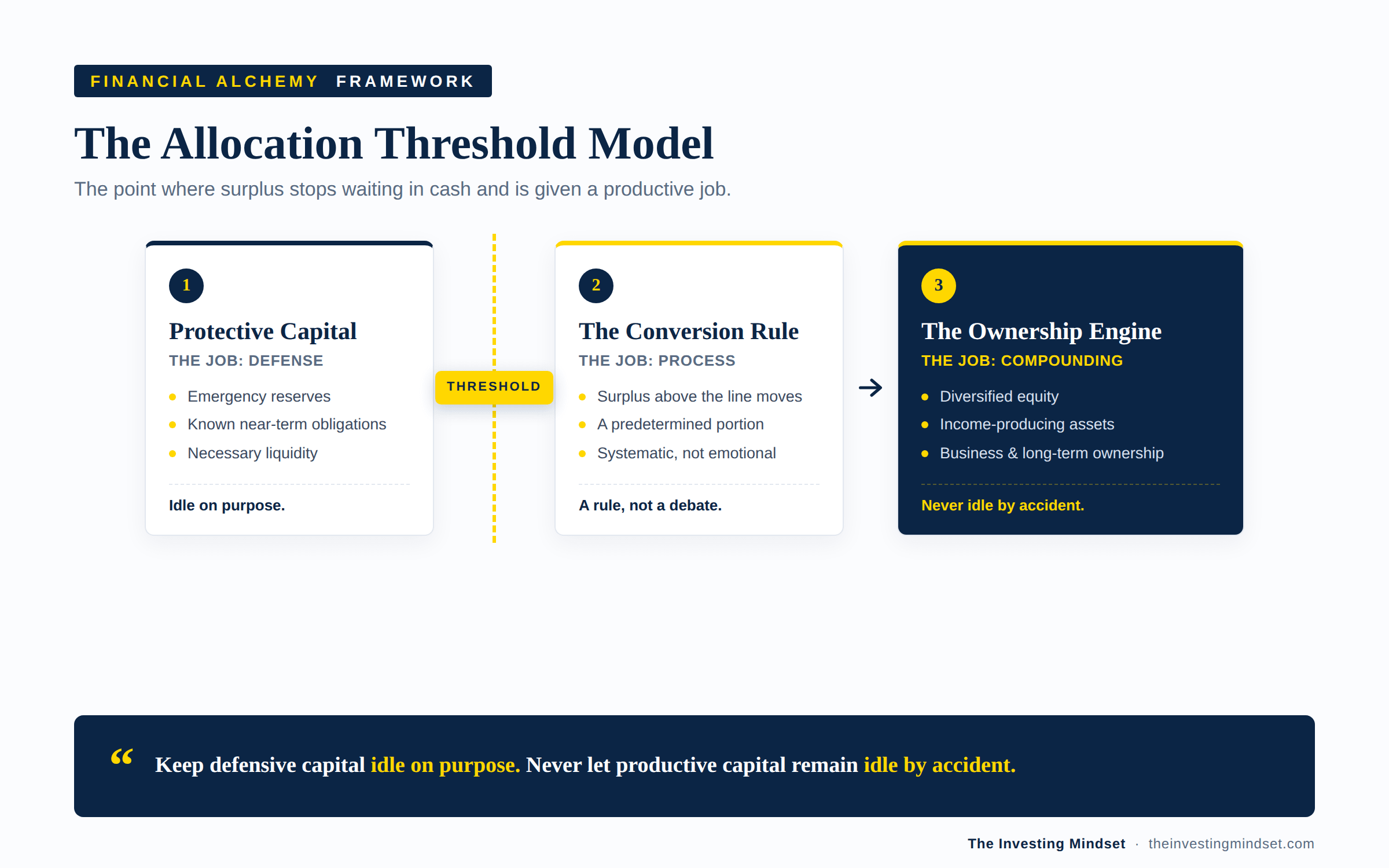
The Allocation Threshold is the point at which your financial system has enough liquidity, resilience, and recurring surplus for additional capital to begin to serve a different role.
Not a protective job.
A productive one.
This is not a universal dollar amount.
Someone earning $500,000 a year may not have crossed it.
Someone earning much less may already have.
Income alone cannot answer the question because income tells you how much raw material is entering the system.
It does not tell you whether the system itself is ready.
Three conditions usually matter.
1. Surplus is recurring
A large bonus is not necessarily a system.
One unusually profitable quarter is not necessarily a system.
A temporary decline in spending is not necessarily a system.
The closer you move toward the Allocation Threshold, the more important it becomes that surplus is reasonably repeatable.
Not perfectly predictable.
Not guaranteed.
But reliable enough that capital allocation can become a recurring function rather than an occasional event.
2. The financial base is resilient
Ordinary disruptions should not repeatedly force you to dismantle your long-term plan.
A repair, slow month, family expense, or temporary interruption in income should not automatically require expensive debt or the sale of long-term assets.
This does not mean all risk has disappeared.
It means the foundation has enough strength to absorb normal shocks.
3. Long-term capital can actually remain long term
This is the condition people most often overlook.
Money cannot compound effectively when it has three other jobs waiting for it next year.
A down payment.
A tuition bill.
A tax obligation.
A planned business purchase.
A major renovation.
Money earmarked for a near-term obligation does not become long-term capital merely because it is temporarily sitting in an investment account.
Compounding needs money.
But it also needs something equally important:
uninterrupted time.
The Distinction: Protective Capital and Productive Capital
None of this is an argument against cash.
Cash is not the enemy of investing.
Used correctly, cash is part of the architecture that makes long-term investing possible.
It provides liquidity.
It absorbs shocks.
It prevents forced selling.
It funds known obligations.
It gives the financial system room to breathe.
The problem begins when cash no longer has a defined job and simply continues to accumulate because accumulation feels safe.
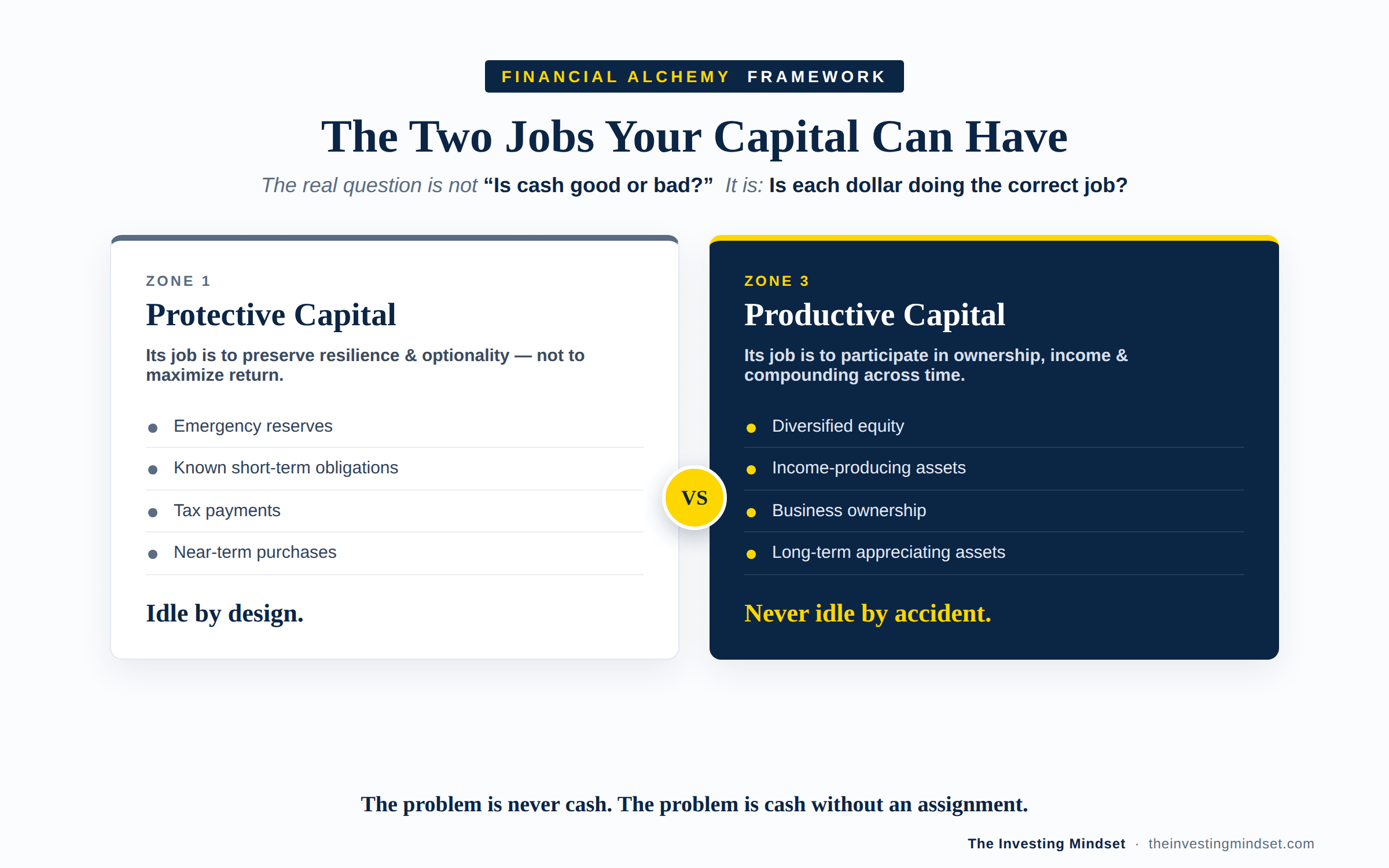
That is why I find it useful to divide capital into two broad categories.
Protective capital
Protective capital exists primarily to preserve resilience and optionality.
Emergency reserves.
Known short-term obligations.
Tax payments.
Near-term purchases.
Other cash needs that cannot reasonably tolerate market volatility.
Its job is not to maximize return.
Its job is to protect the system.
Productive capital
Productive capital has a different purpose.
Its job is to participate in ownership, income generation, growth, and long-term compounding.
It is capital that can remain invested long enough for time to matter.
The important question is therefore not:
Is cash good or bad?
It is:
Is each dollar being asked to perform the correct job?
That reframes the entire discussion.
The problem is not cash.
The problem is cash without an assignment.
The Framework: The Allocation Threshold Model
A practical Allocation Threshold system has four parts.
Zone 1 — Protective Capital
This is the money that is allowed to remain stable.
Your emergency reserve.
Known near-term obligations.
Necessary liquidity.
Its purpose is defense.
It is idle by design.
That is not a failure.
That is precisely what it is there to do.
The Threshold — The Decision Line
The threshold is the point beyond which incoming surplus no longer has an obvious short-term defensive responsibility.
It is not determined by emotion every month.
It is defined in advance.
The exact number will differ from person to person, but the principle is the same:
Once protective needs have been reasonably satisfied, additional surplus requires a different job.
Zone 2 — The Conversion Rule
Crossing the threshold should trigger a process.
Not a debate.
Not an attempt to predict markets.
Not a vague intention to “invest when things settle down.”
A process.
A predetermined portion of excess capital begins moving toward productive assets according to the rules of your financial plan.
The defining word is systematic.
Zone 3 — The Ownership Engine
This is where productive capital lives.
Diversified equity.
Income-producing assets.
Business ownership.
Other long-term assets appropriate to your strategy, time horizon, and risk capacity.
The specific assets matter.
But the larger transformation matters more:
Capital has gone from being something you merely possess to something you have assigned to productive work.
The entire framework can be summarized in one principle:
Keep defensive capital idle on purpose. Never let productive capital remain idle by accident.
The New Risk: Permanent Under-Allocation
Financial risk changes as your financial life develops.
Early on, the major dangers are usually obvious.
Overspending.
Lifestyle inflation.
Excessive debt.
Insufficient reserves.
Unstable cash flow.
Dependence on every paycheck.
Those risks deserve attention because they can destroy a financial system before compounding ever gets the opportunity to matter.
But once those problems have been substantially addressed, a different risk begins to emerge.
Permanent under-allocation.
There is a point at which excessive inactivity begins to carry its own cost.
Capital can preserve its nominal value while failing to participate meaningfully in long-term economic growth.
Inflation matters.
Opportunity cost matters.
But the deeper issue is time.
A dollar that remains permanently unassigned is not merely missing one year of potential growth.
It may be missing decades of compounding.
This does not mean you should chase returns.
It does not mean abandoning liquidity.
It does not mean concentrating wealth in speculative investments.
It means recognizing that financial risk has multiple dimensions.
There is the risk of losing money.
There is also the risk of never giving long-term money the opportunity to behave like long-term capital.
Prudence does not disappear at the Allocation Threshold.
It evolves.
Implementation: Build the Rule Before You Choose the Investment
This is where many people get distracted.
The moment they decide to invest more, they immediately ask:
Which fund?
Which stock?
Which property?
Which account?
Which strategy?
Those questions matter.
But they are not the first questions.
The first question is:
What should happen when new surplus arrives?
A sound allocation system can be remarkably simple.
First, define your protective capital.
Know how much liquidity you genuinely need and what near-term obligations that money must cover.
Second, distinguish short-term capital from long-term capital.
Money needed soon should not be disguised as investable surplus.
Third, establish your threshold.
Create a clear point at which additional recurring cash no longer needs to accumulate defensively.
Fourth, create the conversion rule.
Determine in advance what portion of new surplus will move toward productive assets.
Fifth, automate as much of the process as practical.
A rule that depends entirely on motivation will eventually compete with fear, distraction, headlines, and changing moods.
A rule embedded in the architecture has a better chance of surviving all four.
Finally, review the system periodically.
Not to tinker constantly.
Not to react to every market movement.
But to make sure the assumptions underneath it still reflect your actual life.
Income changes.
Expenses change.
Families change.
Businesses change.
Risk capacity changes.
The threshold can change too.
But the system should not need to rediscover its purpose every month.
The rules should exist before the money arrives.
Back to the Surgeon
Eventually, my surgeon colleague stopped asking how large his checking account should become and started asking what the money was actually for.
Some of it had a legitimate protective purpose.
It belonged in cash.
Some was associated with known obligations.
That belonged in cash too.
But another portion had no near-term assignment at all.
It was simply there because there had never been a rule telling it to leave.
Once he saw the distinction, the problem became much easier to solve.
He identified the liquidity he genuinely needed.
He separated near-term obligations from long-term capital.
He established a threshold.
And he began systematically moving the excess into a diversified ownership strategy rather than allowing it to accumulate indefinitely.
Nothing dramatic happened.
He did not discover a secret investment.
He did not take extraordinary risk.
He did not suddenly earn more.
He simply gave the dollars he already had clearer instructions.
His income had not been the problem.
His allocation system had.
The Identity Shift: From Builder to Investor
This is why the Allocation Threshold is more than a portfolio decision.
It represents a change in financial identity.
The Builder says:
I create and protect surplus.
That identity is necessary.
Without it, there is nothing reliable to allocate.
But the Investor begins to say:
I allocate capital deliberately and manage the risks surrounding compounding.
Those two identities create different behavior.
The Builder asks:
How can I create more financial capacity?
The Investor adds another question:
What should that capacity now be doing?
That change eventually becomes structural.
Investing stops being an occasional decision.
It becomes a permanent function of the financial system.
Surplus arrives.
The architecture recognizes it.
Protective needs are satisfied.
Long-term capital is identified.
Allocation occurs.
Ownership grows.
Time continues.
Compounding is given room to work.
The strongest Investors do not abandon Builder habits.
They retain them.
They simply build another layer on top.
First, you learn how not to consume every dollar.
Then you learn that not every unconsumed dollar should remain idle.
The Diagnostic: Are You Approaching the Threshold?
If you are wondering whether your own financial system has reached this point, do not begin by asking whether you “have enough to invest.”
Ask better questions.
Is your surplus reasonably predictable?
Could ordinary disruptions occur without forcing you to abandon your long-term plan?
Does the cash you hold have clearly defined jobs?
Can you separate genuine reserves and known future obligations from money that has no near-term purpose?
Can the capital you intend to invest actually remain invested long enough for time to matter?
And perhaps most importantly:
If another $10,000 arrived in your account next month, would your financial system already know what to do with it?
That question reveals far more than the size of your bank balance.
An Investor increasingly makes allocation decisions before the capital arrives.
The rules exist first.
The money follows them.
When Surplus Stops Waiting
At first, accumulating cash is evidence that your financial system is improving.
You are no longer consuming everything you earn.
You have created breathing room.
You have reduced fragility.
You have built capacity.
That is real progress.
But eventually, the definition of progress changes.
The question is no longer merely whether you can create surplus.
You have already answered that.
The next question is whether you can assign that surplus a productive role—and leave it there long enough for time to work.
Wealth does not emerge simply because more money arrives.
It emerges when surplus is protected where protection is needed, allocated where productivity is appropriate, connected to ownership, and allowed to compound across time.
There comes a point when protecting every new dollar in cash is no longer the highest expression of prudence.
The next form of prudence is allocation.
That is the Allocation Threshold.
And perhaps the most useful question is no longer:
How much have I accumulated?
It is:
Does my financial system know what the next dollar is supposed to do?