

Financial Independence Is Not Retirement — It Is Negotiating Power
Two Physicians, One Contract
Imagine two physicians receiving the same revised clinic contract.
Both have spent years building successful careers. Both are respected by their colleagues. Both enjoy practising medicine. Neither has any intention of retiring.
But the new agreement means longer hours, greater administrative demands, and less control over their schedules.
The first physician earns an exceptional income. Over the years, however, his household commitments have grown alongside it: a large mortgage, school fees, investment debt, and a lifestyle that has gradually adjusted to what he earns.
He reads the contract carefully.
He disagrees with several provisions. He considers pushing back. Perhaps he could move to another practice or reduce his clinical commitments.
But the financial consequences would be substantial.
His household still depends heavily on his continued earnings.
So, reluctantly, he signs.
The second physician earns less.
But over fifteen years, she has deliberately converted a meaningful portion of her earnings into invested capital, accessible reserves, and income-producing assets.
Her investments and a small business that no longer requires her daily involvement now contribute substantially to her household’s essential expenses. She also maintains sufficient liquidity to withstand an interruption in clinical income.
She reads the same contract.
Then she approaches the managing partner.
“I’d like to stay. But not on these terms.”
Perhaps the clinic agrees to revise the arrangement.
Perhaps it does not.
Either way, she has something the first physician lacks.
A credible alternative.
The difference between these two physicians is not intelligence, professional accomplishment, or even income.
It is what happens if the negotiation fails.
Financial independence did not give the second physician permission to stop working. It gave her the financial capacity to stop agreeing.
These physicians are illustrative examples, used to demonstrate contrasting financial structures rather than to describe specific individuals.
The Retirement Frame
We have inherited a particular picture of financial independence.
It is a finish line.
Work hard. Earn money. Save consistently. Invest wisely. Accumulate enough wealth.
Then, one day, stop working.
Perhaps the image involves a beach, a distant destination, or an empty calendar. Whatever the setting, financial independence is presented as the moment employment ends.
There is nothing inherently wrong with wanting to retire.
For some people, retirement offers a welcome opportunity to recover time, pursue interests, and enjoy life beyond professional responsibilities.
But retirement and financial independence are not the same thing.
Retirement describes what you choose to do about work. Financial independence describes the capacity that makes such a choice possible.
One is a decision.
The other is a condition.
Confusing them creates three distortions.
First, it makes independence appear binary. You are either financially independent or you are not. Freedom supposedly arrives all at once, when a portfolio crosses a predetermined threshold.
Second, it postpones the value of independence. A professional in their forties may assume that financial freedom belongs to some distant future rather than the decisions being made today.
Third, it makes financial independence seem irrelevant to people who genuinely enjoy their work.
A physician may have no desire to stop practising. An entrepreneur may love building businesses. An executive may find meaning in leadership.
When independence is defined exclusively as retirement, these individuals understandably conclude that the goal is not for them.
Yet they negotiate the terms of their working lives every day.
With employers, clients, professional partners, lenders, and the financial commitments they have accumulated.
And the strength of those negotiations depends partly on how much they need the next payment.
The retirement frame hides an important truth.
Financial independence can begin changing your life long before work becomes entirely optional.
It may first appear as the ability to decline an additional shift.
Or reject an unreasonable client.
Or reduce clinical commitments without destabilising your household.
Eventually, your assets may provide enough durable financial capacity to support your chosen lifestyle without employment income.
But meaningful freedom can begin earlier.
Independence is not simply a destination.
It is a growing capacity to choose.
The Dependency Tax
Negotiation theory offers a useful concept for understanding this distinction.
It is called BATNA: Best Alternative to a Negotiated Agreement, a concept popularised by Roger Fisher and William Ury in Getting to Yes.
The principle is straightforward.
Your negotiating position becomes stronger when you have a credible alternative to accepting the terms offered.
If a negotiation fails, what happens next?
Can you pursue another opportunity?
Can you withstand a period without income?
Can you refuse an arrangement without threatening your household’s financial stability?
A credible alternative does not guarantee a successful negotiation. But it reduces the pressure to accept terms that no longer serve you.
This is where many high-income professionals encounter a paradox.
They earn substantial amounts of money but retain surprisingly little freedom to refuse.
Each increase in income has supported another permanent commitment.
A larger home. More expensive schooling. Additional property. Greater debt. Higher fixed expenditure.
Individually, these decisions may have seemed reasonable.
Together, they can create what Financial Alchemy calls High-Income Fragility: a financial structure in which impressive earnings coexist with deep dependence on those earnings continuing.
The hidden cost is what I call the Dependency Tax.
It is the price you pay when your financial obligations weaken your ability to negotiate.
It does not appear as a line item on your financial statements.
Instead, it appears in the conditions you feel compelled to accept.
The additional clinical sessions you would prefer to decline.
The business partnership you continue despite deteriorating relationships.
The unreasonable client you cannot afford to lose.
The personal time you repeatedly surrender because your obligations require more income.
The investment you sell at an unfavourable moment because liquidity is suddenly essential.
This creates an uncomfortable possibility.
Higher income can coexist with less negotiating power.
Not because earning more is harmful, but because income can be converted into commitments that reduce flexibility rather than assets that increase it.
This is how golden handcuffs are often created.
Not through one dramatic decision.
But through a succession of reasonable financial commitments that gradually become difficult to reverse.
You do not necessarily lose negotiating power during the negotiation.
You may have lost it years earlier, through the way you structured your financial life.
The Owner’s Blind Spot
The Dependency Tax does not automatically disappear when someone begins accumulating assets.
Sometimes it becomes harder to recognise.
Consider a professional with a substantial net worth.
They own a valuable home, investment properties, a professional practice, and a diversified portfolio.
On paper, they appear financially secure.
Yet much of their wealth may be difficult to access without selling assets, borrowing against them, or disrupting the businesses that generate their income.
Property equity is valuable, but it cannot automatically pay next month’s household expenses.
A business valued at several million dollars may depend heavily on its owner’s continued involvement.
Investment assets may be concentrated, volatile, pledged as collateral, or subject to significant tax consequences if liquidated.
And leverage that accelerated wealth accumulation can also create continuing obligations.
An Owner can be wealthy and still be financially cornered.
That is why the Owner stage of Financial Alchemy requires a deeper distinction between the amount of wealth accumulated and the independence that wealth actually provides.
The Earner asks:
How much income can I produce?
The Builder asks:
How much of that income can I retain?
The Investor asks:
How can my capital be allocated, protected, and compounded?
The Owner confronts a different question:
What should the financial independence I have built allow me to do?
This is the transition from accumulation to stewardship.
Ownership is not merely the possession of valuable assets.
It is the architecture supporting a life in which more decisions can be made deliberately.
Liquidity creates time.
Diversified capital can support long-term resilience.
Productive assets may reduce dependence on continued personal labour.
Manageable obligations lower the amount of income required to sustain the household.
Together, these structures reduce the cost of refusing an unfavourable arrangement.
The Owner’s goal is therefore not necessarily to maximise every available source of income.
It is to preserve and intelligently exercise the choices that ownership has created.
This is not a rejection of ambition.
It is a refinement of ambition.
The Five Positions of Power
If independence is not simply a switch that turns on at retirement, how should we think about its progression?
One useful approach is to examine two dimensions of financial capacity.
The first is income coverage.
The second is liquidity.
I use a simple indicator called the Walk-Away Ratio.
Walk-Away Ratio = Sustainable Non-Labour Income ÷ Essential Annual Household Spending
For this purpose, consider non-labor income after relevant taxes and expenses, and assess its reliability and sustainability.
A business distribution requiring ongoing personal labour should not automatically be treated as independent income. Nor should an unusually strong investment year be assumed to represent a permanent income stream.
The second measure is Runway.
Runway = Accessible Financial Reserves ÷ Essential Monthly Spending
Expressed in months, Runway estimates how long accessible reserves could support essential household spending if employment income stopped, before accounting for other ongoing cash inflows.
These are different measures.
The Walk-Away Ratio helps illustrate how much essential expenditure can be supported without personal labor.
Runway indicates how much time available reserves may provide when circumstances change.
A strong income ratio with limited liquidity may still leave someone vulnerable to a short-term disruption.
A long runway with little independent income may create substantial breathing room without providing permanent financial independence.
Neither measure, by itself, establishes whether someone can safely leave employment. Taxes, debt obligations, investment risk, inflation, family needs, and the durability of expected income all matter.
Nevertheless, together they offer a useful way to think about the progressive development of negotiating power.
Five Illustrative Positions of Power
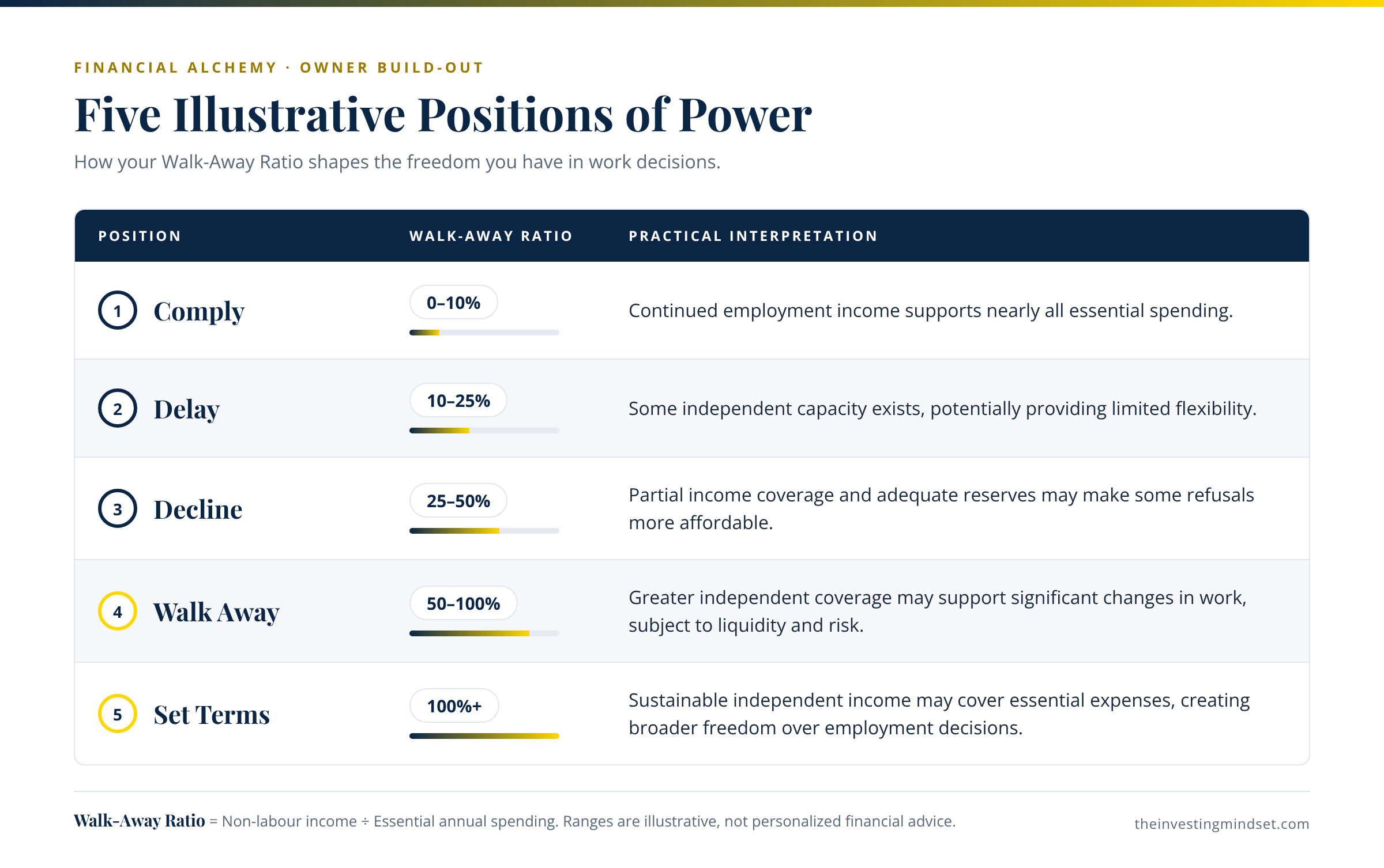
These thresholds are illustrative Financial Alchemy teaching categories, not scientifically validated financial independence levels or automatic recommendations to leave employment.
They also do not correspond mechanically to the Earner, Builder, Investor, and Owner stages. Someone may own substantial assets yet possess limited accessible cash flow; another individual may have modest net worth but considerable short-term negotiating flexibility.
The important insight is that independence develops along a continuum.
At first, financial resilience may simply allow you to question an additional obligation.
Later, it may provide the confidence to reduce your working hours.
With greater independence, it may allow you to reject a professional arrangement entirely.
Eventually, work may become a choice grounded primarily in meaning, contribution, and personal priorities.
Most discussions of financial independence focus on the final position.
Yet some of the most consequential changes in a professional’s life occur much earlier.
The ability to reject an unreasonable contract, recover one day each week, or leave an unhealthy partnership can transform a career.
That is negotiating power.
Not the guarantee that others will accept your terms.
But the capacity to make a different decision if they do not.
The Identity Paradox
There is another complication.
One that financial projections rarely capture.
You may become financially capable of making a different decision and still find yourself unable to make it.
Imagine a physician approaching sixty.
Over several decades, he has accumulated diversified investments, maintained sufficient liquidity, and brought his household commitments under control.
After careful financial analysis, he recognises that reducing his clinical workload is unlikely to threaten his long-term security.
Yet every year, he postpones the change.
Perhaps he should work one more year.
Perhaps the portfolio should grow a little larger.
Perhaps this is not the right time.
There may be legitimate reasons for caution. No financial plan eliminates uncertainty about markets, inflation, longevity, healthcare costs, or family responsibilities.
But suppose those concerns have been thoughtfully addressed.
What remains?
For much of his adult life, being a physician has meant more than receiving an income.
It has provided identity, responsibility, recognition, intellectual challenge, relationships, and a sense of usefulness.
He understands how to organise his life around professional demands.
He may be less certain how to organise it around choices he no longer has to justify financially.
And so he continues.
Not necessarily because the income is required.
But because the familiar rhythm of earning, producing, and remaining indispensable has become difficult to question.
This is a different kind of dependency.
Earlier in the Financial Alchemy journey, the challenge was primarily structural.
Financial obligations required continued income.
Now the challenge may be psychological.
The financial necessity has diminished, but the habits and identity formed around that necessity remain.
This does not mean that continuing to work is a failure.
A physician may genuinely love practising medicine.
An entrepreneur may find deep satisfaction in building businesses.
An executive may value leadership and the responsibility it brings.
The question is not whether you continue working.
The question is whether continuing reflects genuine choice.
Would you accept the same workload if the additional income made little difference to your security?
Would you remain in the same professional arrangement if losing your salary no longer frightened you?
Would you pursue the same opportunities if compensation and status were no longer the primary measures of achievement?
These questions can be uncomfortable.
They challenge identities that may have taken decades to establish.
Yet they also reveal the deeper purpose of the Owner stage.
Financial independence creates the capacity to choose.
The Owner’s identity must mature sufficiently to exercise that choice.
The Owner’s Test: What Could You Negotiate Differently?
If financial independence is negotiating power, the practical question becomes:
What would you do differently if your financial structure gave you greater freedom?
Begin by examining the foundations of that freedom.
1. Measure your financial dependency.
Calculate your Walk-Away Ratio and Runway using conservative assumptions.
Look beyond net worth.
Understand what income may continue without your labour, what reserves are genuinely accessible, and which financial obligations must still be met.
2. Examine the commitments that limit your choices.
Identify the fixed costs, debt obligations, and business arrangements that depend on continued earnings.
Some may be worthwhile.
But each should be evaluated against the flexibility it consumes.
Reducing an unnecessary obligation can increase negotiating power without requiring you to earn another dollar.
3. Conduct a dependency audit.
Consider the people and institutions that currently influence the terms on which you work.
An employer.
A professional partnership.
A major client.
A lender.
For each relationship, ask:
If the terms changed tomorrow, could I reasonably refuse?
The answer may expose a weakness in your financial structure that deserves attention.
4. Define your terms of engagement.
Financial independence has limited practical value if you have never considered how you intend to use it.
What professional conditions are no longer acceptable?
What responsibilities are you willing to retain?
What would you prefer to reduce?
What kind of work remains meaningful, even when additional income is not essential?
You do not need to resign, sell a business, or make a dramatic career change.
You may simply identify one arrangement that deserves reconsideration.
A clinical schedule.
A partnership.
A recurring commitment.
An opportunity that offers more income but demands too much of something else.
Then ask whether accepting it strengthens or weakens the freedom your financial system was designed to create.
The Owner’s responsibility is not simply to accumulate more.
It is to ensure that what has already been accumulated serves a deliberate purpose.
Ownership gives you options.
Stewardship determines what you do with them.
The Freedom to Remain
Return to the two physicians considering their contracts.
Both are experienced.
Both are professionally successful.
Both have spent decades developing valuable skills.
Yet only one can approach the negotiation without the immediate fear that a failed agreement will destabilise her financial life.
Perhaps she negotiates more acceptable terms.
Perhaps she decides that the existing arrangement remains worthwhile after all.
Perhaps she chooses to leave.
The outcome is less important than the condition under which the decision is made.
She has regained the authority to choose.
That is what ownership, at its best, makes possible.
It does not eliminate responsibility.
It does not remove uncertainty.
It does not guarantee successful negotiations, superior investment returns, or an effortless life.
And it does not mean that productive work loses its value.
Quite the opposite.
When work is no longer primarily a financial necessity, its meaning can become clearer.
You may discover that you still want to practise medicine.
You may continue leading your business.
You may devote more time to teaching, entrepreneurship, investing, mentoring, or service.
You may work harder on something that matters more deeply to you than anything you pursued before.
From the outside, your life may look remarkably similar.
But your relationship with the work has changed.
You are no longer participating simply because your financial obligations leave you no acceptable alternative.
You are participating because the work still deserves your time.
Perhaps that is the deepest reward of financial independence.
Not the freedom to do nothing.
Not the obligation to retire.
But the capacity to decide what is worth doing, what is worth refusing, and what deserves the remaining years of your life.
Financial independence is not retirement. It is negotiating power.
And the highest expression of that power may not be the ability to walk away.
It may be the freedom to stay, knowing you no longer have to.
The Stewardship Audit: Are You Using the Freedom You Have Built?
Financial independence creates choices. But possessing the capacity to choose is not the same as exercising that capacity deliberately.
You may own significant assets and still find yourself accepting obligations or pursuing additional income that no longer serves your priorities.
The Owner’s next responsibility is to examine whether the wealth already built is translating into meaningful independence.
The Stewardship Audit helps you reflect on four dimensions of your financial position:
- Financial Position: The resources, financial obligations, and surplus available to support future choices.
- Asset Ownership: The assets you own and how they contribute to long-term financial capacity.
- Mindset & Identity: Your relationship with earning, ownership, and the purpose of wealth.
- Systems & Automation: The structures and income sources that may reduce dependence on your personal labour.
It is an opportunity to identify where greater stewardship could strengthen your financial autonomy.
Financial Alchemy explores the progression from earned income to durable wealth, meaningful ownership, and financial autonomy. Its four stages — Earner, Builder, Investor, and Owner — describe a journey in which the ultimate purpose of wealth is not simply accumulation, but the capacity to live and act with greater independence.
If this essay resonated with you, consider sharing it with a colleague who says, “I enjoy my work. Financial independence isn’t for me.” It may change the way they approach their next professional decision.
This essay is for educational purposes and does not constitute personalised financial, tax, legal, or investment advice. The financial measures and position thresholds discussed are illustrative tools, not validated assessments of financial independence. Individual decisions should reflect personal circumstances and, where appropriate, guidance from qualified professionals.