

Capital Deployment Architecture: Give Every Surplus Dollar a Job
A surgeon once told me he kept about $200,000 in his checking account.
He was not careless with money. He had earned well, controlled his spending, avoided meaningful consumer debt, and built a substantial financial cushion.
The balance had grown because he knew how to create surplus.
It stayed there because he had never decided what the surplus should do next.
His problem was not an inability to accumulate capital. It was the absence of a system for directing it.
This distinction matters because creating financial capacity and directing financial capacity are two different responsibilities.
The first requires the discipline to earn, spend less than you earn, and preserve the difference.
The second requires a deliberate process for determining which capital must remain available, which capital can be committed to productive ownership, and what circumstances should change those decisions.
A person can become exceptionally good at the first responsibility without ever developing the second.
That was the situation my colleague had reached.
He had built financial capacity. But the next stage required something more than continued accumulation.
It required architecture.
From the Allocation Threshold to Capital Deployment Architecture
In The Allocation Threshold, I explored a question many successful professionals eventually confront:
When is enough cash enough?
The answer was not a universal dollar amount or a fixed percentage of income.
It depended on whether surplus was recurring, whether the financial foundation could withstand ordinary disruption, and whether some of the accumulated capital could genuinely remain committed for the long term.
Those conditions help establish when additional cash may no longer be required for protection.
But identifying available capital is only the beginning.
Even after my colleague determined how much of his $200,000 needed to remain accessible, several questions remained.
How much of the excess should move toward long-term ownership?
Should it move immediately or over time?
What should happen to next month’s surplus?
What if his income declined, a major expense appeared, or an attractive investment opportunity emerged?
Without answers, he could easily replace one form of indecision with another.
He might move some cash into investments, but each new deposit would still require a fresh decision.
The account balance would change.
The underlying problem would remain.
This brings us to the central distinction:
The Allocation Threshold identifies capital that is available for a new assignment. Capital Deployment Architecture makes that assignment repeatable.
The threshold establishes when capital can move beyond accumulation and protection.
The architecture establishes how that movement occurs, where the capital goes, and what would cause the process to change.
One identifies capacity.
The other gives that capacity direction.
And together, they describe an important transition in the development of an Investor.
The Builder creates capacity. The Investor directs it.
The Builder learns to create and preserve surplus.
This work is foundational.
Without reliable surplus, adequate reserves, and control over financial obligations, there is little capital that can safely remain committed to long-term ownership.
The Investor does not abandon those habits.
The Investor builds upon them.
The responsibility expands from creating capital to allocating it deliberately.
That means developing a financial system capable of distinguishing between money that must remain accessible and money that can be assigned to productive ownership.
It also means establishing rules that operate before the next deposit arrives.
Consider two professionals who each generate substantial recurring surplus.
The first allows excess cash to accumulate until an investment opportunity attracts his attention. He occasionally makes large investments, but the timing and amounts depend largely on what feels appropriate at the moment.
The second establishes a reserve requirement, identifies known future obligations, and directs eligible surplus toward a defined ownership plan according to written instructions.
Both may own investments.
Both may accumulate wealth.
But their capital allocation processes are fundamentally different.
The first continues making largely discretionary decisions.
The second has established a repeatable process.
This does not eliminate judgment. It changes when and how judgment is exercised.
Instead of reconsidering the entire question every time money arrives, the second professional makes the foundational decisions in advance and revisits them when circumstances warrant.
That is the purpose of a capital deployment architecture.
It is not a particular portfolio, investment product, or asset allocation.
It is the set of instructions that tells your financial system where available capital goes, when it moves, and what would cause you to change course.
Before capital can move, its responsibilities must be clear
Not every dollar of accumulated cash is available for long-term investment.
Some capital must remain accessible because its responsibility is to absorb disruption.
Some is committed to known future obligations.
Some can remain invested for extended periods.
And, for certain investors, a separate amount may be reserved for opportunities that satisfy predetermined criteria.
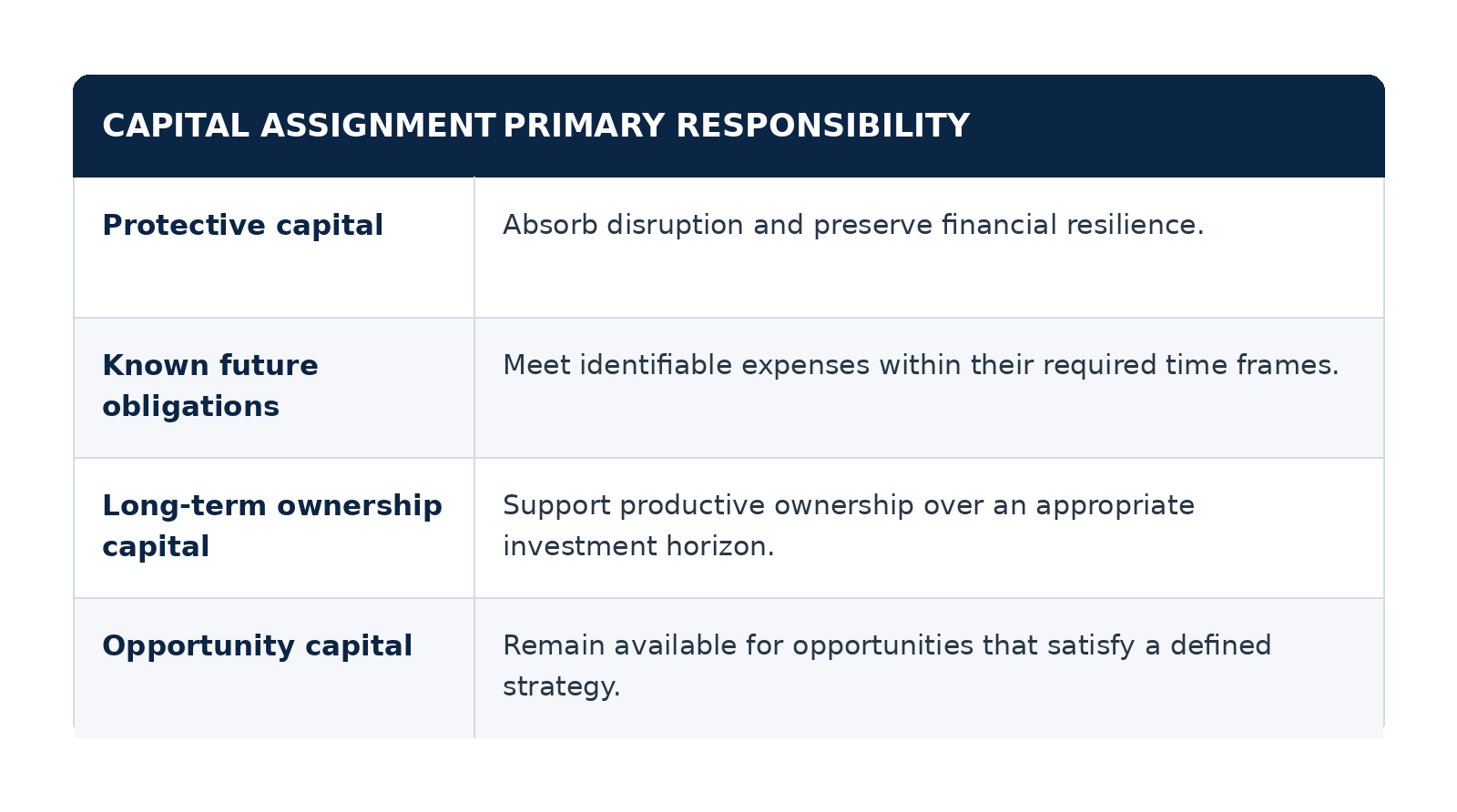
These are assignments, not necessarily separate accounts. Opportunity capital is also optional; it is not a required allocation for every investor.
The important point is that each pool has a defined purpose.
Protective capital is not necessarily unproductive simply because it is held in cash.
Its job is to prevent ordinary disruptions from forcing expensive borrowing, distressed asset sales, or interruptions to an otherwise sound long-term plan.
Likewise, money reserved for a known tax payment or a major family expense cannot simultaneously be treated as capital available for indefinite investment.
The problem begins when the same money is assigned incompatible responsibilities.
An emergency reserve quietly becomes the down payment for an investment property.
Money intended for long-term ownership is needed for next year’s tuition.
Cash described as an opportunity fund accumulates indefinitely because no criteria exist for deploying it.
In each case, the difficulty is not necessarily the amount of capital.
It is the absence of a clear assignment.
The architecture therefore begins with a straightforward question:
What must this money remain available to accomplish?
Once those responsibilities are identified, the remaining capital can be evaluated for longer-term commitments.
Recurring surplus matters, but repeatability alone does not make a dollar suitable for long-term investment.
The capital must also have a time horizon compatible with its intended assignment.
Compounding needs capital.
It also needs time that is not repeatedly interrupted by forced withdrawals.
This is why the architecture begins with the financial system rather than an investment selection.
Before deciding what to buy, determine which capital can remain committed.
And before committing that capital, establish the instructions governing its movement.
That is where the conceptual framework becomes a practical operating system.
Part I: Write the Conversion Rule
The conversion rule is the central operating instruction in a capital deployment architecture.
It determines what happens when new surplus arrives or accumulated cash exceeds its defined protective requirement.
Without a conversion rule, the investor must repeatedly answer the same questions.
Is this enough cash?
Should I invest some of it?
How much?
Should I wait?
What happens if something changes?
A conversion rule does not eliminate these questions. It requires the investor to answer them deliberately, before the next allocation decision.
A useful rule has five components.
1. The Trigger: When Does Capital Become Available?
The first component identifies the condition that permits capital to move.
For one professional, the trigger might be recurring monthly surplus after ordinary spending, reserve requirements, and known obligations have been funded.
For another, it might be an account balance exceeding a defined protective threshold.
A third might use both conditions.
The particular trigger should reflect the financial system supporting it.
What matters is that the trigger can be identified without relying entirely on how the investor feels about the market that day.
Consider the difference between these two instructions:
“I will invest when I feel comfortable with my cash balance.”
And:
“Once my defined reserve requirements and known near-term obligations are funded, additional recurring surplus becomes eligible for deployment.”
The second instruction does not determine the entire investment decision.
But it establishes an observable condition under which the next decision can occur.
That is the first step toward repeatability.
2. The Amount: How much Capital Moves?
Once the trigger is satisfied, the architecture must determine how much capital receives a new assignment.
The instruction might specify a dollar amount, a proportion of eligible surplus, or the balance above a defined threshold.
There is no universal allocation appropriate for every professional.
A household with stable income, modest obligations, and substantial reserves may have a different capacity to commit capital than a business owner with uneven income and significant future expenditures.
The amount should reflect the financial strength beneath the allocation.
It should also distinguish between existing accumulated cash and new recurring surplus.
A professional may need to make an initial decision about a substantial balance that has already accumulated.
That decision does not necessarily require the same instruction that will govern future monthly deposits.
For example, an investor might establish a separate plan for deploying previously accumulated excess cash while using a recurring conversion rule for new surplus.
The architecture should make both decisions explicit rather than assuming they are interchangeable.
3. The Timing: When Does the Transfer Occur?
A decision to deploy capital remains incomplete until the investor establishes when it will happen.
Without a timing instruction, even well-defined surplus can remain idle.
The investor may wait for a more attractive market entry, a reassuring economic forecast, or simply a convenient moment.
Some delays are justified by changed financial circumstances.
Others occur because no operating instruction exists.
A scheduled transfer or review point can reduce this ambiguity.
The schedule might be monthly, quarterly, or tied to a particular financial event.
The purpose is not to force capital into an unsuitable investment.
It is to prevent eligible surplus from remaining unassigned merely because the investor has postponed the decision.
4. The Destination: Where Does the Capital Go?
This is where the architecture connects to the ownership engine.
The destination should have a defined role within the investor’s broader financial plan.
Productive capital might support diversified equity ownership, an income-producing asset, or an existing business system.
Each route carries different demands for liquidity, oversight, concentration, and ongoing work.
The fact that an asset can generate a return does not automatically make it suitable for the capital available.
Before selecting a destination, the investor should understand what the ownership capital is intended to accomplish.
Is its primary responsibility long-term growth?
Is it intended to produce income?
Will it strengthen an existing business?
Will it create future financial flexibility?
How much attention will the asset require?
And how much additional exposure will it create to a particular company, property, sector, or source of income?
These questions matter because capital deployment is not simply the act of acquiring more assets.
It is the process of assigning capital to assets whose characteristics are compatible with the financial system supporting them.
A portfolio can contain numerous investments while remaining vulnerable to concentrated risks.
An investor can own productive assets while lacking sufficient liquidity to hold them through an ordinary disruption.
The ownership engine must therefore be evaluated as part of the larger system.
The conversion rule determines how capital reaches that engine.
The ownership plan determines what the capital is expected to accomplish once it arrives.
5. The Pause Condition: What Would Change the Instruction?
A conversion rule should be consistent without becoming rigid.
The financial circumstances supporting an allocation can change.
A reserve may fall below its required level.
Income may decline.
A significant new obligation may appear.
A major investment may alter the household’s concentration or liquidity exposure.
These changes can justify revisiting the original instruction.
It helps to distinguish between two types of conditions.
An automatic pause condition is an event that the investor has already determined should suspend a transfer.
For example, the rule might specify that transfers stop whenever the protective reserve falls below its defined floor.
A review condition is an event that requires reassessment but does not necessarily dictate the outcome.
A change in income might prompt the investor to examine its likely duration and effect before deciding whether the existing transfer remains appropriate.
This distinction matters.
Without pause conditions, a rigid system may continue allocating capital after the assumptions supporting it have changed.
Without defined review conditions, an overly reactive investor may interrupt a sound process whenever markets become unsettling.
The objective is neither blind automation nor constant reconsideration.
It is disciplined adaptation.
Putting the Five Components Together
A first conversion rule might read:
“Once my defined reserves and known near-term obligations are funded, I will direct a specified portion of recurring monthly surplus to my established long-term ownership plan. Transfers will occur on a scheduled date. If my reserves fall below their required level, I will pause the transfers. If my income or financial obligations change materially, I will review the instruction.”
This is a structure, not a recommended allocation.
The amounts, destinations, and conditions must come from the investor’s circumstances.
Its value lies in making the next decision visible before the next deposit arrives.
The rule establishes a process that can operate repeatedly while remaining responsive to meaningful changes.
And that is the essential difference between an intention to invest and a capital deployment architecture.
An intention describes what you hope to do.
An architecture establishes the conditions under which you will do it.
Part II: What Happens to the Next $10,000?
The original Allocation Threshold essay ended with a diagnostic question:
If another $10,000 arrived next month, would your financial system already know what to do with it?
Let’s make that question practical.
Imagine a professional receives an additional $10,000 after ordinary spending.
She has already established her protective reserve requirements, identified her known future obligations, and written a conversion rule.
The money arrives.
What happens next?
Step 1: Identify Existing Obligations
The first decision is not which investment to purchase.
It is whether any portion of the new surplus already has an assignment.
A planned tax payment requires another $2,000.
Her household reserve is also $1,000 below its defined floor.
Those amounts have immediate responsibilities.
Assignment
Amount
Planned tax obligation
$2,000
Restore protective reserve
$1,000
Remaining surplus
$7,000
The first $3,000 does not become long-term investment capital simply because it arrived as surplus.
It is already responsible for something else.
By recognizing those assignments first, the investor protects the foundation supporting her long-term plan.
Step 2: Confirm That the Remaining Capital Can Stay Committed
The remaining $7,000 is not automatically available for investment.
She must determine whether another known obligation could require the money during the period for which she intends to commit it.
In this example, no such obligation exists.
Her recurring income remains sufficient to support the conversion rule.
Her protective reserves have been restored.
The remaining capital is therefore eligible for the assignments established in her plan.
Notice the sequence.
She did not begin by asking whether the market looked attractive.
She began by determining what the financial system could reasonably support.
Step 3: Follow the Conversion Instruction
Under her illustrative rule, the remaining capital receives two assignments.
She directs $5,000 to her established long-term ownership plan.
She retains $2,000 for a separately defined opportunity fund.
The complete allocation is:
Capital assignment
Amount
Known tax obligation
$2,000
Protective reserve
$1,000
Long-term ownership
$5,000
Defined opportunity fund
$2,000
Total
$10,000
The particular amounts are illustrative.
The lesson is not that every investor should allocate half of a surplus deposit to long-term ownership or maintain a separate opportunity fund.
The lesson is the sequence of decisions.
First, satisfy existing responsibilities.
Second, confirm that the remaining capital can remain committed.
Third, follow the written deployment instruction.
The investor has converted a potentially improvised decision into a repeatable process.
A Note About Opportunity Capital
An opportunity fund deserves special attention because it can easily become another form of unassigned cash.
If an investor maintains such a fund, its purpose should be explicit.
What types of opportunities qualify?
What conditions must be satisfied before capital is deployed?
How much capital may accumulate in the fund?
What happens if no qualifying opportunity appears?
Without answers, “waiting for opportunities” can become an indefinite justification for accumulating cash.
That would reproduce the very problem the architecture is intended to solve.
Opportunity capital should have a defined responsibility, just like every other pool.
Step 4: Change One Assumption
Now imagine the same professional receives another $10,000.
But this time, a major source of her income has become uncertain.
Her reserves remain intact, and her known obligations have not changed.
Nevertheless, the assumptions supporting her original conversion rule may no longer hold.
Should she automatically follow the same allocation?
Not necessarily.
The appropriate response depends on the nature and potential duration of the income disruption, the strength of her existing reserves, and the obligations her financial system may need to support.
She may determine that additional liquidity is temporarily necessary.
She may pause part or all of the scheduled transfer while reassessing those circumstances.
The important point is that the change follows an identifiable reason.
She is not abandoning her investment plan because of an unsettling headline.
She is responding to a change in the financial capacity supporting that plan.
A repeatable process does not require an unchanging allocation.
It requires consistent principles for determining when an allocation remains appropriate.
This is why the pause and review conditions belong inside the original architecture rather than being invented during a disruption.
A good rule tells you when to continue.
It also tells you when to stop and reconsider.
The Deeper Lesson
The $10,000 example illustrates something more important than a particular allocation.
The investor did not need to rebuild her financial strategy when the deposit arrived.
She had already established the responsibilities of her capital.
She knew which obligations took priority.
She knew the conditions under which additional capital could move toward ownership.
She knew where eligible capital was intended to go.
And she knew which changes would require reconsideration.
Her architecture did not eliminate financial uncertainty.
It gave her a process for making decisions within it.
That is the practical advantage of moving from discretionary accumulation toward deliberate capital deployment.
Part III: Build Your Capital Deployment Map
The architecture becomes most useful when it is written down.
You do not need an elaborate financial model to establish the first version.
You need a clear picture of the financial responsibilities your capital must support and the instructions governing what happens after those responsibilities are satisfied.
The Capital Deployment Map brings those decisions together on one page.
It contains six entries, organized into three parts.
A. Establish Your Financial Capacity
The first part identifies what your system can reasonably make available.
1. Recurring surplus
Write down the amount of surplus you can reasonably expect after ordinary spending, existing commitments, and irregular costs.
This should reflect the actual financial system rather than an unusually favorable month.
If income varies, the estimate should account for that variability.
The purpose is to identify the recurring capacity that may support a continuing deployment instruction.
2. Protective capital
Identify the accessible capital your household and, where relevant, business require.
Specify the responsibilities the reserve is intended to cover.
The amount should reflect the risks and obligations of your circumstances rather than an arbitrary target copied from someone else.
This capital has a legitimate job.
Its purpose is to protect the financial system supporting your longer-term commitments.
3. Known future obligations
Identify expenses that should not be treated as long-term investment capital.
Record both the expected amount and the period in which the money may be needed.
These might include taxes, planned family expenditures, business purchases, or other identifiable commitments.
The important distinction is between money that can remain committed and money that must be available for another purpose.
B. Define the Movement of Capital
The second part establishes the instructions governing eligible surplus.
4. Allocation Threshold
Write down the condition under which additional surplus becomes available for a new assignment.
This may involve satisfying reserve requirements, funding known obligations, and confirming that the remaining capital has a suitable time horizon.
The threshold should be understandable and observable.
Its purpose is to establish when capital can move beyond its existing protective responsibilities.
5. Conversion instruction
Specify the five elements of your deployment rule:
- The condition that triggers movement.
- The amount or proportion that moves.
- The timing of the transfer.
- The destination receiving the capital.
- The conditions that pause the instruction.
This is the central operating component of the map.
It converts the financial capacity identified in the first four entries into a defined process.
C. Establish Oversight
6. Review and pause conditions
Identify the circumstances that would require you to suspend or reconsider the instruction.
These may include changes in income, reserve requirements, known obligations, liquidity needs, or the risks associated with your existing ownership plan.
Also establish a regular review interval.
A deployment architecture should not require constant intervention.
But neither should it remain unchanged after the financial circumstances supporting it have materially evolved.
The purpose of oversight is to preserve the relationship between the allocation process and the financial system beneath it.
Your One-Page Capital Deployment Map
Use the following worksheet to bring the six entries together.
Entry
Your instruction
Recurring surplus
My reasonably expected recurring surplus is: ______
Protective capital
My required accessible reserves are: ______
Known future obligations
The amounts and timing of my identified obligations are: ______
Allocation Threshold
Additional capital becomes eligible for deployment when: ______
Conversion instruction
I will transfer ______ to ______ on ______
Review and pause conditions
I will pause or reconsider the instruction if: ______
Once the entries are complete, connect them in a single operating statement.
My Capital Deployment Instruction
“When surplus exceeds ______, and my defined reserves and known obligations are funded, I will move ______ to ______ on ______. I will pause this instruction if ______ and review it if ______.”
My next scheduled review will occur on ______.
The sentence is deliberately plain.
It should be understandable when markets are calm and when they are unsettling.
It should be usable when you are busy, tired, or tempted to postpone another financial decision.
If you cannot confidently complete one of the entries, that is useful information.
It identifies an assumption your system still depends upon.
Perhaps your recurring surplus is less predictable than you believed.
Perhaps you have never defined the amount of accessible capital your household requires.
Perhaps you know you want to invest more but have not established the role the additional ownership should serve.
Or perhaps you have a clear investment plan but no instruction governing when new capital reaches it.
Each incomplete entry identifies a specific decision requiring attention.
You do not need to solve every financial question at once.
You need to make the next unresolved decision visible.
Your First 30 Minutes
Before setting this article aside, complete three actions.
First, identify the capital that already has a responsibility.
Write down your required protective reserves and known future obligations.
Separate that capital from the amount potentially available for longer-term ownership.
Second, draft your conversion instruction.
Specify what triggers a transfer, how much moves, when it occurs, and where the capital goes.
Identify at least one condition that would pause the process.
Third, establish your next review.
Choose a regular review interval and identify the changes that would require an earlier reassessment.
These steps will not complete every investment decision.
They will establish the first version of the system governing those decisions.
The objective is not to create a perfect architecture immediately.
It is to replace an undefined intention with a process that can be examined, refined, and repeated.
The Risk of an Incomplete System
A person can make regular investments and still lack a dependable capital deployment architecture.
They may contribute when they remember, stop when markets frighten them, accumulate excessive cash between decisions, or purchase an appealing asset without examining its effect on liquidity and concentration.
Their portfolio may be active.
Their allocation process remains improvised.
The opposite problem is also possible.
An investor may establish an ambitious deployment schedule that cannot survive an ordinary disruption.
On paper, nearly every dollar has a productive assignment.
In practice, too little capital remains accessible when something predictable goes wrong.
Both problems arise when the investment plan is disconnected from the financial system supporting it.
The architecture must hold two truths together:
Protection makes long-term ownership sustainable. Long-term ownership gives surplus a productive future.
Neither responsibility eliminates the other.
The Builder’s discipline creates the capacity to invest.
The Investor’s discipline directs that capacity while preserving the foundation that makes continued ownership possible.
This is why capital deployment cannot be reduced to the question of which asset to buy next.
The more important question is whether the entire system can support the assignment being made.
An ownership engine is more than a collection of holdings.
It is a continuing process that receives capital according to a plan, holds appropriate assets for their intended horizons, and reviews risk without rebuilding the strategy every month.
Its strength depends partly on the investments it owns.
It also depends on the reliability of the financial system feeding those investments.
A sound deployment architecture connects the two.
Back to the Surgeon
My colleague’s $200,000 checking balance was not one problem requiring one sweeping move.
Some of that money had a legitimate protective purpose.
Some was responsible for known obligations.
Another portion had no near-term assignment and could potentially support long-term ownership.
The important distinction was not simply between cash and investments.
It was between capital with a defined responsibility and capital accumulating without one.
Identifying the Allocation Threshold helped clarify which portion of his capital could receive a new assignment.
But that recognition alone could not answer what should happen to the next deposit.
For that, he needed a repeatable process.
He needed instructions that distinguished protective capital from capital available for ownership.
He needed to establish how much eligible surplus would move, when it would move, and what responsibilities the receiving assets would serve.
And he needed to identify the circumstances under which those instructions should change.
That is the work of Capital Deployment Architecture.
It transforms a recurring financial question into a defined operating process.
The Builder asks:
How do I create and preserve financial capacity?
The Investor adds:
How do I direct that capacity so it can endure, compound, and expand my future choices?
The second responsibility does not replace the first.
It builds upon it.
High income had given my colleague capacity.
Architecture could give that capacity direction.
Now consider your own financial system.
If another $10,000 arrived next month, would you know which dollars needed to remain available, which could move toward productive ownership, and what circumstances would change those decisions?
Would your system already have an answer?
Or would you need to begin the entire debate again?
The purpose of the Capital Deployment Map is to make that next decision easier to identify before the money arrives.
Complete the map.
Write your conversion instruction.
Establish your review conditions.
Then examine whether the broader financial system can consistently support the process you have designed.
The Investor Stage Scorecard provides a separate way to assess that broader system across capital protection, allocation discipline, the compounding engine, optionality, and decision quality.
Use it to identify which area deserves attention during your next 90 days.
The goal is not to eliminate uncertainty or automate every financial decision.
It is to establish a process in which capital receives a deliberate assignment, the assignment reflects the responsibilities of the financial system, and changes follow identifiable reasons rather than recurring indecision.
The Allocation Threshold identifies capital available for a new assignment.
Capital Deployment Architecture makes that assignment repeatable.
The aim is not to invest every available dollar. It is to make every dollar’s job clear.
Continue the Investor Stage journey: Complete the Investor Stage Scorecard to evaluate the financial system supporting your capital deployment decisions.

