
The Builder Trap: Busy Without Leverage
Why earning more, doing more and managing more doesn’t always bring you closer to financial freedom.
Builder Activation Series, Part One
The Physician Who Built Five Jobs
Dr. K did what ambitious professionals are told to do.
After more than ten years building his medical career, he decided to get serious about his financial future.
He picked up locum shifts on weekends. He bought two rental properties and managed them himself to save on fees. He began consulting for a local med spa. He launched a podcast and started recording an online course.
Within two years, his income had grown a lot.
So had his responsibilities.
His calendar was full. His evenings were taken. There was always another opportunity to explore, another account to review, another decision that needed him.
When colleagues asked how things were going, he answered with real pride: “I’m building.”
Then he caught a bad flu and was off his feet for two weeks.
The locum shifts went to someone else. A tenant’s furnace failed and needed urgent attention. The consulting work was put off. The podcast went silent. The course sat unfinished.
What surprised him was not just that some income stopped. It was how much of what he had built still depended on him.
He had created several sources of income. Very little of it could run without his personal effort.
He had built income. He had not built much leverage.
Many successful professionals hit this same wall. They get very good at earning income, and very busy managing it. They earn more, do more and take on more financial duties. Yet they are still unsure whether their financial lives are getting stronger.
The hard question is not whether they are working hard enough. It is whether all that effort is creating something that can one day work without them.
Dr. K is a composite character. He reflects patterns seen among high-earning professionals.
The Builder Trap: When Activity Replaces Progress
The Builder stage is one of the most important steps on the Financial Alchemy path of Earner → Builder → Investor → Owner.
It is where the Earner starts turning income into surplus, protection, productive capital and, in time, ownership. It is also where many capable professionals get stuck.
The trap is hard to see because the activities look responsible. You work extra hours to raise your income. You buy an investment property. You open another account. You explore another business idea. You research investments, track expenses and watch the markets.
Each step may make sense on its own. Each one gives visible proof of progress: more deposits, bigger balances, new opportunities and a sense of momentum.
But financial activity and financial capacity are not the same thing.
Financial activity measures what you are doing. Financial capacity measures what your system can do.
Say a physician earns an extra $20,000 by working extra weekends. That is more income, and it may be a real achievement. But where does that money go? If it vanishes into more spending, new commitments or investments that need constant attention, the extra effort may leave little lasting capacity behind.
The same is true for someone running several businesses or properties. Many income streams can spread risk. But if every stream depends on the same person’s time, health and attention, they all share one weak point that is easy to miss.
An Earner trades time for money once. A trapped Builder trades it five times and calls it diversification.
The problem is not a lack of discipline or ambition. It is a failure to turn that discipline into structure.
Financial progress lasts when effort produces something you don’t have to rebuild every month. That might be a reliable way to capture surplus, solid cash reserves, a well-diversified portfolio, a documented business process or an income-producing asset that no longer needs you every day.
The Builder Trap begins when more activity becomes a substitute for building that capacity.
It is related to the Builder’s Plateau, but it is not the same thing. The Plateau is a stall: surplus exists but never becomes ownership. The Trap is a swap: activity takes the place of the capacity that would create and protect that surplus in the first place.
How the Trap Develops: Three Counterfeits of Leverage
The Builder Trap rarely starts with one bad decision. More often it grows from a series of sensible choices. Each one adds activity without reducing your dependence on personal effort. Three patterns are especially common.
Counterfeit One: More Hours Disguised as Leverage
Extra clinical shifts. More consulting clients. Weekend contracts. Rental properties you manage entirely yourself.
The income is real. But the ceiling hardly moves. It is still set by your energy, your health and your hours.
Extra work can be a fair way to speed up progress. The danger comes when every gain needs another huge effort. If earning more is the only way your finances move forward, you may have raised your income without changing the structure underneath it.
Counterfeit Two: More Complexity Disguised as Diversification
Five projects can feel safer than one. Many accounts can feel smarter than a simple plan. More investments, properties and ventures can look like growing strength.
But complexity has a cost. Every new arrangement brings decisions, paperwork, cash-flow needs and demands on your attention. In time, just managing your financial life becomes a big job of its own.
So the question is not how many income streams or assets you have. It is whether each one adds to your financial capacity once you count its cost, risk, liquidity and the effort it takes to maintain.
Sometimes the best financial decision is not to add another opportunity. It is to strengthen the structure you already have.
Counterfeit Three: More Knowledge Without Deployment
Courses, podcasts, newsletters, investment research, books and conferences can all deepen your understanding. But information does not become leverage just because you have it.
Knowledge becomes useful when it changes a decision, sets up a repeatable process, strengthens your protection or guides money toward a clear purpose.
Think of the professional who tracks every dollar of spending but saves only what is left at month-end. Some months, a lot is left. Other months, household costs, work expenses and extras take nearly everything.
The problem may not be a lack of knowledge. It may be the lack of a reliable way to capture an affordable share of income before it disappears.
Surplus creates the possibility of accumulation. A surplus-capture system makes that accumulation repeatable. This is the work of the Surplus Conversion Engine.
Without this step, effort can defeat itself. More opportunities create more duties. More duties use up more attention. More demands leave less capacity. And when illness, fatigue or a surprise obligation strikes, several activities can stall at once.
The Builder ends up busy maintaining the very financial life that was supposed to bring more freedom.
The Financial Alchemy Reframe: From Effort to Systems
Financial Alchemy starts with a simple idea:
Income is raw material. What matters is what that income becomes.
An Earner makes income mainly through personal effort. A Builder starts turning that income into surplus, reserves and repeatable systems. An Investor places capital on purpose, based on goals, risk and time horizon. An Owner builds lasting assets and structures that create more independence, choice and long-term leverage.
Each stage has its own job. The Builder’s job is not to act like an Owner too early. It is to build the financial capacity that makes investing and ownership last. Three principles guide that shift.
Capture Before Consumption. Direct a planned, affordable share of income to your financial priorities before extra spending takes the whole margin. The goal is not to save more when life allows. It is to build a steady process that captures surplus every time.
Protection Before Optimization. Emergency reserves, manageable commitments, the right insurance and realistic cash needs keep ordinary setbacks from undoing your progress. Without enough protection, even sound long-term investments can be cut short by short-term pressure.
Systems Before Complexity. Over time, routine money decisions should become repeatable processes, not monthly improvisation. A scheduled savings transfer, a written allocation plan, set-asides for known yearly costs and a regular review all cut needless decisions. You keep the oversight you need.
These systems may not look exciting. They lack the thrill of a new property, a new investment or a new income project. But at the Builder stage they do something more important: they make progress less dependent on constant effort from you.
This is the shift from financial discipline to financial capacity. It matters because compounding needs more than occasional deposits or a few great income years. It needs capital that can be captured, protected, placed well and left alone long enough for time to do its work.
The Builder’s real achievement is not getting endlessly better at managing money. It is building a system that makes sound financial behaviour repeatable.
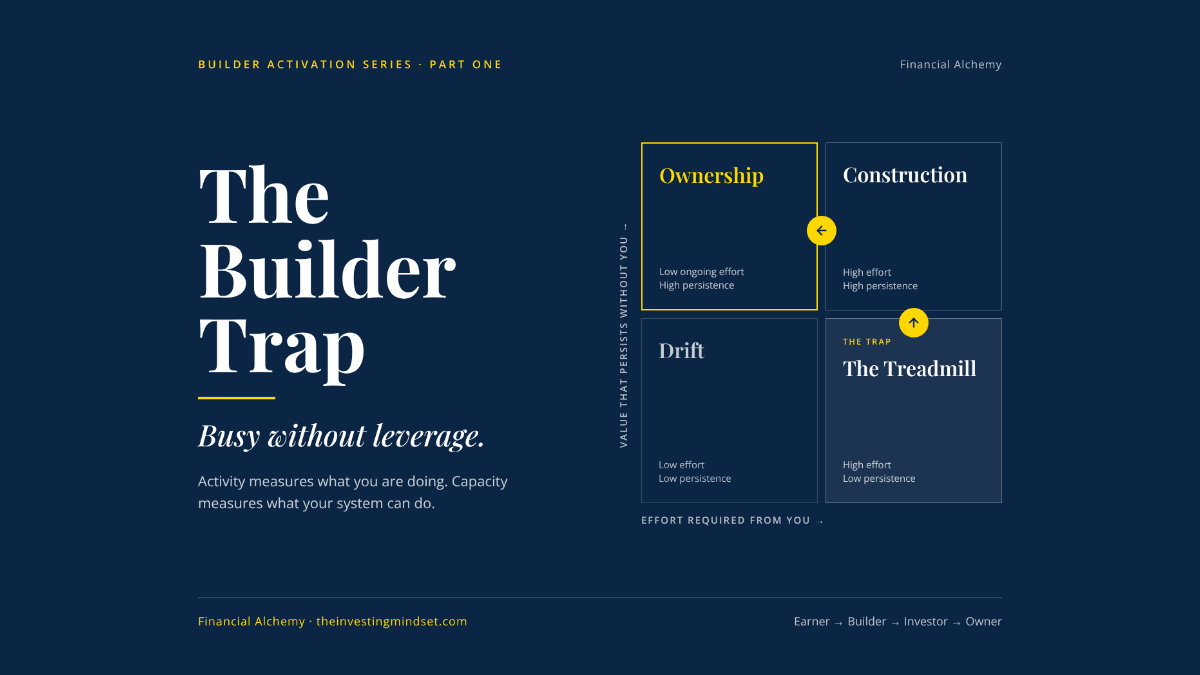
The Leverage Matrix: What Does Your Effort Leave Behind?
To see the Builder Trap clearly, look at your activities on two scales. The first is effort: how much of your own time and energy an activity takes. The second is persistence: how much value keeps being produced or protected without you.
| Effort ↓ / Persistence → | Low persistence | High persistence |
|---|---|---|
| High effort | The Treadmill Output stops when you stop (the Builder Trap) | Construction Hard work that leaves something durable |
| Low effort | Drift Comfortable, but little is built | Ownership Systems and assets that keep working |
Drift: low effort, low persistence. Little effort is needed, but little lasting capacity is being built. It may feel comfortable, but progress stays limited.
The Treadmill: high effort, low persistence. This is the Builder Trap. You work hard, earn income and stay financially busy. But much of the output stops when your effort stops.
Construction: high effort, high persistence. This is productive Builder work. It may take a lot of effort at first, but that effort leaves something durable behind: a reliable process, a documented system, protected reserves or an asset that can create future value.
Ownership: low ongoing effort, high persistence. This is where mature leverage is heading. Well-built systems and well-structured assets keep producing or protecting value with less day-to-day reliance on you. Oversight, risk and upkeep never fully disappear.
The key difference is between the Treadmill and Construction. Both can be demanding. Both can fill your calendar. Both can deliver results this month. But only one keeps leaving something behind after the work is done.
There is also a difference between a financial system and an income-producing asset. An automatic savings plan does not create income by itself. It creates operational leverage by capturing and keeping the value your work produces. A portfolio or a well-structured business may in time create capital leverage: returns that are less tied to your labour. The Builder needs the first to make room for the second.
The path is not simply from working harder to working less. It runs from effort, to structure, to ever more durable ownership.
Getting Off the Treadmill: Five Practical Moves
Escaping the Builder Trap does not have to start with earning less, dropping opportunities or making drastic changes. It starts by changing what your current effort leaves behind.
1. Audit Your Financial Activity
List your income sources, investments, recurring money decisions and major financial duties. For each one, ask three questions. How much time does it take? What value does it create? How much of that value continues without me? The goal is to separate busy activity from activity that builds lasting capacity.
2. Build a Reliable Surplus-Capture System
Work out what share of your income you can keep, steadily, after needed costs, obligations and cash needs. Then set up a planned way to send that surplus to the right priorities. A reliable process beats repeated good intentions. Your progress should not depend on remembering the right move at the end of a busy month.
3. Protect the Progress You Capture
Review your reserves, commitments, insurance and the large costs you can see coming. The aim is to lower the chance that an ordinary setback forces you to undo past progress. A system that builds capital but can’t handle predictable disruptions is not yet strong.
4. Systematize Before You Expand
Before you add another opportunity, look at the duties you already carry. Which repeat decisions can follow clear rules? Which tasks can be written down, simplified, automated or handed off? Which activities should stop because they use up capacity without leaving enough lasting value? Start with one process. Make it repeatable. Check that it works. Then move to the next.
5. Convert Surplus Into Durable Assets
As your foundation grows more reliable, direct spare capital toward investments and productive assets that fit your situation, goals, risk tolerance and time horizon. The point is not complexity for its own sake. It is to slowly raise the share of your progress that comes from capital and durable systems, not ongoing extra labour.
Beneath these steps is a deeper identity shift. The Doer asks, “What more can I do?” The Operator asks, “How can I do this more efficiently?” The Designer asks, “What can I build that keeps working without me repeating the same effort?” That mindset carries the Builder toward the Investor stage and, in time, the Owner stage.
What Survives Your Absence?
Return to Dr. K. His problem was not a lack of ambition, knowledge or earning power. He had plenty of all three. His problem was that too much of his financial life depended on him to keep supplying the effort that built it.
The next stage of his journey might not need another business, property or income stream. It would need him to examine what he already had. Could he simplify his finances? Could he set up a more reliable way to capture surplus? Could he protect that surplus from disruption? Could some business duties be written down or handed off? Could he start sending more capital toward assets that don’t need him there all the time?
These questions are less exciting than how to earn another $50,000. But they are the questions that start to change the structure of a financial life.
Here are two useful ways to test your own progress.
The 30-Day Systems Test
Imagine that for the next month you keep earning your normal income and meeting your duties. But you stop handling routine money decisions by hand. Would your planned savings still happen? Would key bills still be paid? Would your reserves and priorities stay protected by set processes? Or would progress depend on you remembering, checking and stepping in at every turn? This test shows how much of your financial discipline has become a repeatable system.
The 90-Day Dependence Test
Now imagine illness or another setback keeps you from your usual work for three months. What income would continue? Which assets or businesses would still run? What reserves would cover your obligations? Which parts of your financial life would hold up, and which would quickly show their dependence on you? This test shows how well your situation can survive a pause in your earning power.
Neither test needs a perfect score. Systems need oversight. Investments carry risk. Businesses need management. The goal is not total freedom from effort or uncertainty. It is steadily reducing how much of your personal effort it takes to keep and grow what you have built.
That is what real leverage begins to feel like. Not more motion. More freedom.
Not sure whether your effort is on the Treadmill or in Construction? The free Financial Clarity Diagnostic shows where you stand on the Earner → Builder → Investor → Owner path, and the questions that matter most for your next stage.
This essay opens the Builder Activation Series. In the coming weeks, we will look at how to capture surplus, strengthen your systems, cut needless complexity and turn effort into more durable financial capacity. To get each essay as it comes out, subscribe on Substack.
A Question to Consider
You may be earning well, saving often and making sound money decisions. But are those efforts building a structure that grows stronger over time? Or are you getting busier maintaining one that still depends almost fully on you?
Before you add your next opportunity, ask yourself: what is my effort actually building?
If this essay struck a chord, share it with a colleague who is working harder than ever but wondering why financial freedom still feels so far away.
